Editor's Note: For more on tees, click here to check out February's feature "Cross your T’s and Dot your I’s: A tee complex’s appearance can significantly impact golfer satisfaction and influence their opinion of overall course conditioning and playability."
 |
Architects don’t usually get the opportunity to quiz golfers en masse, but we recently had that rare opportunity to interact with a gaggle of golfers in an authentic focus group setting. The job we’re prepping for at this municipal course is all about stormwater management, but the focus group tackled issues both larger and further afield.
At one point, the facilitator was keen to get answers from regular patrons of the facility on this question: How can you get more out of the golf experience here?
In order to lead them a bit, we piped in with a simple question: What tee do you folks play from? Everyone answered right away: blues, yellows, whites… However, when we followed up with, What overall yardage are those particular tees?, we got a bunch of blank stares in response. Hardly anyone knew!
There was one guy in the crowd who knew exactly what tees played which yardage: the superintendent, naturally. This got me thinking about a bunch of issues surrounding tee placement and tee design.
First, the Tee It Forward initiative makes a world of sense but its appeal — creating shorter, more manageable golf holes based on how far individual golfers hit the ball — will rely on players having a reasonable comfort level with 1) how far they truly hit it; and 2) how well the course sets up from those forward tees. Golfers need a frame of reference that, I’d argue, they don’t currently have.
The sponsors of this program, The PGA of America and U.S. Golf Association, provide a table that helps on a general level:
Driver Distance Recommended 18-Hole Yardages
275 6,700-6,900
250 6,200-6,400
225 5,800-6,000
200 5,200-5,400
175 4,400-4,600
150 3,500-3,700
125 2,800-3,000
100 2,100-2,300
But more to the point, it’s the superintendent who will make this program, this idea, stick. Only the superintendent truly understands how the variable yardage groupings relate to the tee boxes at his/her particular facility. It’s the superintendent who sets up the course day to day and appreciates (from divot patterns and just being on the course, observing all day) where traditional landing areas are, where tee spacing and size are deficient, and where golfers should truly be playing from. In short, it’s the super who will provide the framework — by way of setup — for a Tee It Forward event and for golfers perhaps making better tee choices going forward.
Let’s come at this from another angle: How often do you think you really play a course from its true scorecard yardage? Here is one of golf’s dirty little secrets: If a white tee yardage is listed at 6,400 yards, you can bet on most occasions it’s actually closer to 6100, especially at daily-fee and resort courses. There’s a strong PR element to scorecards. Course operators are convinced the overstatement of length is what sells — but they also recognize that length kills pace of play! So they set up the course at shorter yardages (shorter than advertised) in the hopes of improving pace.
To some degree, courses have anticipated the Tee It Forward initiative and taken it into their own hands.
Seems like a nifty trick, but this approach often falls short of solving the problem, because it is typically too focused on the sum of the parts (i.e. overall course yardage) when it’s really the parts themselves (individual hole setup) that matter. If you’re asking someone who hits the ball, say 150 yards, to play from a certain tee marker, it’s vital to ensure that each marker on each hole is set up to effectively accommodate that theoretic distance. Simply moving a golfer forward is not always the answer, and can often destroy the strategic design intent of a hole — making it confusing, or difficult to navigate —which can actually compound the pace of play problem you were trying to resolve.
Here’s where the superintendent needs help. To tee it forward effectively, the resources need to be in place to do so properly. I’m not talking about the tees you set 125 yards from the green on a par-4, to accommodate an 8-year-old kid who’s new to the game. Placing these tees is a no-brainer; design doesn’t enter into it.
But maybe the ASGCA and GCSAA should collaborate on a Design It Forward initiative to study the constructive deployment of forward tee systems.
Tee It Forward started as a weeklong event that took place July 5-12, 2011, but it’s intent is to change the way people play courses into the future. When looking forward, it’s always instructive to look back.
Our firm has a long history of long histories with client courses; it’s not uncommon for us to work with individual facilities over the course of two decades. It’s fascinating and instructive to study how a course is plays today vs. how we envisioned it 20 years ago.
We are currently revisiting a master plan and comprehensive renovation we did back in the early 1990s at 27-hole Schaumburg GC in suburban Chicago. Schaumburg remains a popular municipal facility but it has a lot of new competitors nearby, plus longtime competitors that have newly renovated. So they’re looking to upgrade.
Among several other renovation priorities, they’re focusing on improving pace of play in the context of Tee It Forward, which they had tried to do with their existing tee system with limited success.
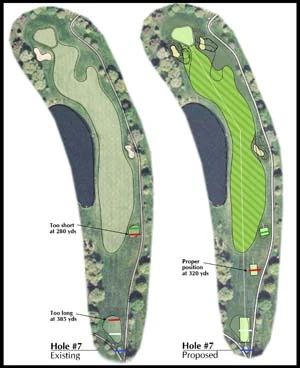
In the early ‘90s, we took Schaumburg from a two-marker to a three-marker system, each marker having its own tee pad. Indeed, a fourth set of markers — playing about 5,600 +/- yards — was added recently in the spirit of teeing it forward, though not as successfully as was hoped. That’s because the new markers (red) don’t fully do what they were intended to do: provide a consistent middle ground between the existing middle (white) and forward (green) markers.
Why? Because the set-up options are limited. On some holes, the new marker is placed on the forward tee, while on others it shares the longer middle tee, resulting in a desirable overall yardage but no consistency from hole to hole. Ego has come into play, too. Guys don’t like playing the new markers when they are placed among the “women’s” tees, and some complain the hazards are no longer in the right spots from the shorter distances. On the other hand, on the holes where markers have been kept back, they remain simply too long. The results are limited impact on pace of play and too many unfulfilled customers.
Clearly the influx of senior male golfers (read: Baby Boomers) over the next several decades is only going to heighten the need for tee box flexibility at places like Schaumburg — a public course (because we can agree the entire dynamic is different at private facilities). Ideally, the Tee It Forward campaign will ease some of the ego issues but fixation on overall course yardage won’t make it work. Adjustments will have to be assessed on a hole-by-hole basis.
About the author
Bob Lohmann is founder, president, and principal architect of Lohmann Golf Designs, Inc., Bob provides hands-on leadership and management of all LGD projects. Since its founding in 1984, Lohmann Golf Designs, Inc. has enjoyed tremendous growth under Bob’s leadership, and great success in both renovation and new golf course projects. You can follow his BLOG by CLICKING HERE.