Editor's Note:
GCI's January cover story "After a perfect storm" shared the stories from industry bloggers on how they coped with Summer 2010 and the important lessons they learned. We were extremely fortunate to have a surplus of superintendent contributions for this story that we regret we couldn't include in the print edition. However, we intend to share these compelling accounts with you. Here is one such contribution.
The summer of 2010 will certainly be one that we will never forget in the Turf industry. Many factors came into play this year that influenced the management of not only turfgrass, but also the way we had to manage our budgets and personnel. When budgets were tight already in 2010, we were asked to find a little magic in the barn for the summer months and keep grass alive. You no longer considered what healthy conditions would look like, and you had to concern yourself more with tiny grass plants on the verge of death every morning, afternoon, and night on the golf course for about three months straight. It was a test, and if you passed, it made you a better, more efficient turf manager.
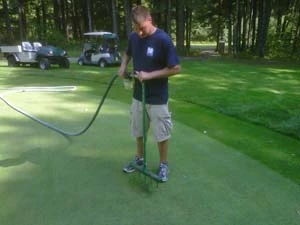
 At Stow Acres Country Club we also had to take this test. A test of intelligence, commitment, endurance, instinct, and just a general will to keep grass alive. From mid-June to mid-September, we received approximately 4 inches of precipitation below the average. In July, we had 19 days above 90 degrees during the day, and many nights that were above 72 degrees. Disease pressure definitely became a threat, as well as root health. Hoses became a necessity in the back of the cart. Tools such as soil thermometers, soil probes, surface temperature guns, and wetting agents pellets became second nature to carry like your wallet, keys, and cell phone. Teams of staff members were divided and assigned to certain parts of our 36-hole facility and some days we would start checking greens at 6 o'clock in the morning. “Was there going to be recovery needed from the previous day?” “Did anyone miss an assigned area?” “Did our irrigation program run last night?” “Were we going to run out of water?” were all questions that made for many sleepless nights. We had to research pond depths and natural water feed into the pond. Google Earth, a boat, and a measuring stick became very useful in helping manage our water inventory. Even though we had a great plan to keep our conditions playable, what was all of this work doing to our budget? What would it do to our budget if we let some areas go dormant?
At the beginning of 2010, staying within budget was a priority. It remained a priority all year long, but it was very difficult during the summer months.
 Using a system that I learned at the 2009 GIS, from superintendent Darrin Batisky, called labor tracking, helped our maintenance team easily manage hours and overtime on a weekly basis. We modified it to our needs, but kept the concept the same for tracking individual hours and individual tasks. Each staff member had a mailbox and at the beginning of each week he received a blank task sheet. At the end of the day, he filled out the task sheet. Every Monday morning, the sheets were collected and the data entered into the master sheet. It definitely helped keep track of our labor dollars in a year that could have sent us very far over the labor budget. If certain areas needed extra attention, it was understood what it would do to the budget, and a very informed decision could be made. It was the uninformed that became the battle.
This was definitely a summer for uninformed players to ask questions such as, “Why don't you just run the water at night?” or “How come the rough is turning brown? or “Don't you guys put any water out here?” Even though we would do our best to gather the energy to give a polite response, sometimes it sent you to a breaking point. Just when I thought I was going to snap, I found solace in my blog. It became a place that I could express what was happening on the golf course. I could gather information and publish it for the public eye, so that they could try to understand what we were battling.
The summer of 2010 presented many challenges. It taught us a lot about turf, personnel, and customer management. Some techniques that we had never tried and others that we had to try by necessity became part of our daily day. Our summer at Stow Acres Country Club was very challenging, but it was fun. We enjoyed the battles and problem solving needed to endure another growing season in the Northeast!
About the author:
Jason VanBuskirk is superintendent at Stow Acres Country Club in Stow, Mass. Check out his blog, Stow Acres Turf Golf Course Maintenance News