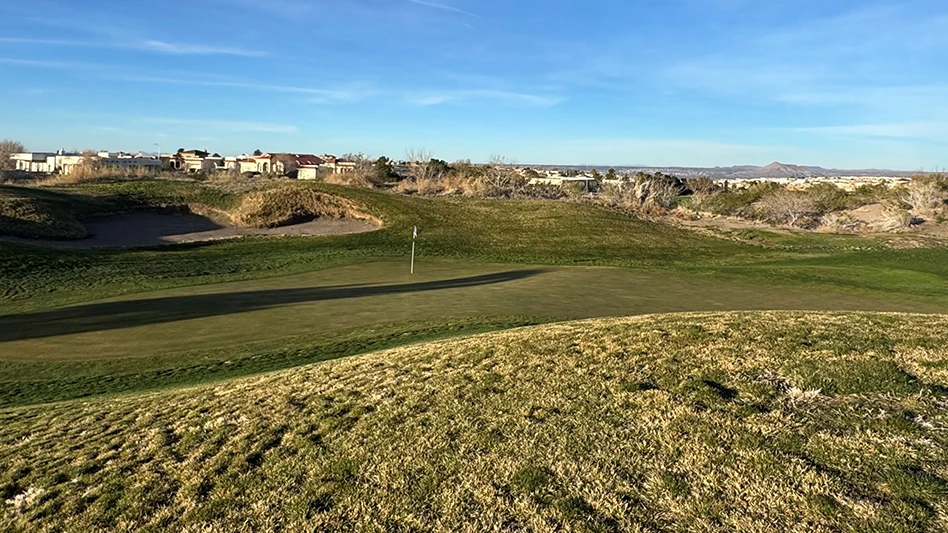
Salem, Va. - Using the latest in GPS technology, Frontier Construction Co. has completed a green renovation/restoration project at Hidden Valley Country Club. Working with architect Bill Love, 20 putting surfaces - 18 holes plus a putting and chipping green - were rebuilt to USGA specifications while all the greenside bunkering was also reconstructed.
Frontier turned to the latest generation of GPS because, while the club was intent on rebuilding its 50-year-old push-up greens, it was adamant about maintaining the existing contours on 16 of those putting surfaces. Using the new HiPer Lite GPS System from Topcon (www.topcongps.com), Frontier mapped the 16 greens before breaking ground in June and followed the HiPer Lite readings when restoring the new putting surfaces this fall.
"This Topcon system is the most precise GPS capability available today, accurate to within one-eighth of an inch," says Nick Scigliano, president of Jones Mills, Pa.-based Frontier Construction. "We used the system to record all existing green data on one-foot centers, meaning every foot there was a point recorded. Old push-up greens like those at Hidden Valley can now be rebuilt with a USGA-specified soil profile while preserving the original green contours during construction."
Love, immediate past president of the American Society of Golf Course Architects, says he has used GPS systems to map existing contours but Hidden Valley was the first time he'd used it to replicate them post-construction.
"If you shoot an existing putting surface and put it into the software, you've essentially mapped that surface," Love says. "If you set those elevations to what you did originally, you can bring it right back to those points on any grid you want: two feet, five feet, 10 feet - whatever you want depending on the level of replication you want. It's quite something.
"The Hidden Valley job really turned out well, which is a credit to Frontier. You can't even tell that we went in there and did anything. It looks new but it doesn't look new. I guess when you put things back exactly, it looks like it's always been there. And in a sense, it has."
Frontier (www.frontiergolf.com) can attest to the number of older clubs whose push-up putting surfaces, though well loved, are failing agronomically. Scigliano can also attest to how difficult a task it was to replicate original contours during reconstruction. For example, Frontier recently handled architect Craig Schreiner's green renovation project at the historic Pittsburgh Field Club. In that instance, Scigliano's crew actually cut and saved the sod from one putting surface, re-cored the green profile to USGA specs, rebuilt the greens to original contours using traditional survey equipment, then relaid the original sod.
That was before HiPer Lite.
"Before, we had to employ a regular transit survey system and set grids," Scigliano recalls. "You can only keep the spacing on 10-foot centers to allow the equipment to work - a bulldozer blade is nine-feet wide. Clearly this isn't nearly as accurate. Resetting points with a three-man crew is also painstaking, time-consuming work. With the Topcon system there are no stakes. It records everything, no matter where you are, taking a reading every foot.
"Lasers couldn't do this sort of job either, as it only shoots a flat plane. That's fine for a tee box, but on a putting surface you need detailed data on any given elevation and any given point. We're now able to do this with the HiPer Lite, and we can't wait to use it again. There are so many older clubs out there with greens whose contours are great but whose push-up soil profiles aren't doing the job anymore."
The HiPer generation of GPS products operates on what the company calls a dual-constellation system. Simply put, most GPS systems have access to the 24 U.S. satellites circling the globe at 11,000 feet. The HiPer Lite series also has access to 14 Glonass satellites, a Russian network. This increase in available satellites means more plotting points and more accurate readings than traditional GPS.
"This is a leap in technological capability," Scigliano says. "It's going to change the way green and course renovations are done."
"I think it could have that effect," adds Love, whose practice is based in College Park, Md. "This sort of technology has been around, but what's different is its accuracy and convenience. This technology is just so easy to use. You just walk around with it and 'bip, bip, bip,' the site is mapped. You don't have to worry about losing the original character of the greens because we know with confidence that we can put them back."
Frontier broke ground at Hidden Valley in early June 2005, closing the back nine to play. The front nine was closed July 4. All 20 putting surfaces were rebuilt over the summer and prepared for seeding Sept. 1. The new greens, planted this fall with A4 bentgrass, will debut in spring 2006.
"This is a club, built in the 1950s - a Dick Wilson design - which had gotten to the point where the greens had to be rebuilt," Love explains. "They liked the greens; they had a good reputation. But these were 50-year-old modified push-up greens and things got to the point agronomically where something had to be done. So we went in and replaced them all with USGA profiles and tried to hang on to the design intent of each one."