What started out as a nine-hole addition project at Hinckley Hills Golf Course in Hinckley, Ohio, ended up as a way to draw nontraditional golfers to the game. Instead of nine holes there are five, and a course was born for beginners, youngsters or those who simply don’t have time to play nine or 18 holes.
The project began eight years ago, according to golf course superintendent Jean Esposito. Her family owns the 18-hole, Harold Paddock, Sr.-designed course, which is in a rural area south of Cleveland. It wanted to add nine holes but encountered problems securing the amount of land necessary for that size addition. This is when it began to think of alternatives.
|
|

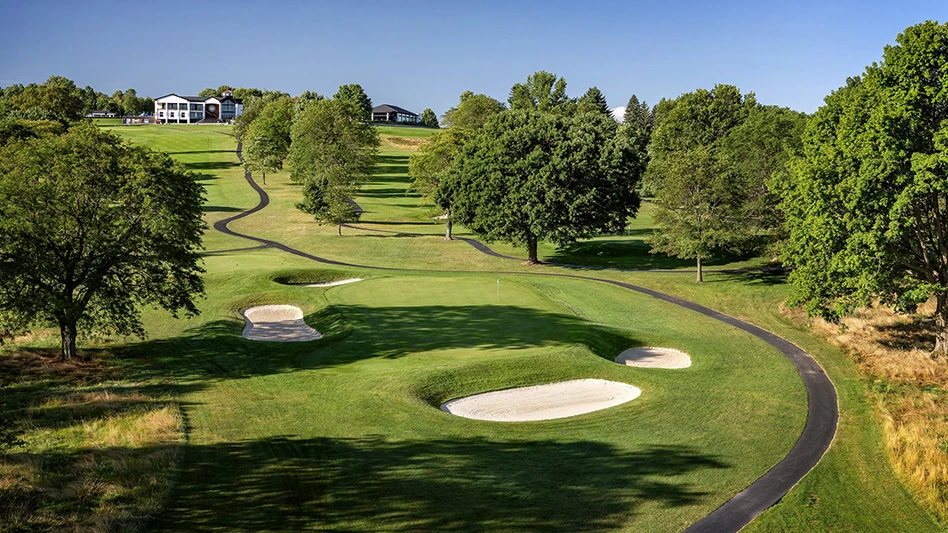
Five years later, after five new holes were completed (three on the back side first, then two more on the front side), they were integrated into the existing course and a cluster of five par-4 holes were made into The Buzzard’s Nest, named after the bird of prey the course adopted as a mascot because of its yearly visits to the area.
“We hope it’s a great way for less experienced golfers to start, no matter what the age is,” Esposito says. “We thought five would be just enough.”
Esposito hopes that attracting a more diverse group of golfers will help better business. Rounds at Hinckley Hills have decreased in recent years, she says, citing the current economic situation, gas prices and competing outlets for people’s disposable income as some of the causes for the decline.
It’s not just her course that’s feeling the burn, as Esposito knows. Rounds have been declining industrywide recently – they’re down 3.2 percent since 2001, according to the National Golf Foundation – but she’s hoping the five-hole course will help buck the trend. Families can only do so much with their time and money, and an inexpensive, short course could be the answer.
“You can go out and play before work or in the evening before it gets dark,” she says.
People are sometimes hesitant to play the five-hole course because it’s unorthodox, and beginners tend to not realize that the five-hole course won’t wear them out as much nine or 18 holes will, Esposito says, pointing out that the Buzzard’s Nest has regulation, par-4 holes, which separates it from an executive course. Plus, she says, playing a second round of five from the second set of tees can give the golfer a new perspective.
“A lot of people haven’t heard of it before they come,” she says. “We would like to have people realize it’s available.”
|
|

When the Buzzard’s Nest opened, it took holes four, five, 12, 13 and 14 from the existing course. The newly built holes took their places, moving from the inside of the course to the outer edges. The holes from the existing course that were taken out of play for the five-hole course had some time to sit out of commission before the Buzzard’s nest opened, which gave the stressed turf a break.
“It was amazing to see the difference in the turf,” she says.
The original 18 holes opened in 1964. Until a few years ago, the layout hasn’t been changed. The only exception was 10 years after it opened, when the front nine became the back nine, and vice versa.
In the beginning, Esposito’s family was one of three owners. Each of the three families, including the children, labored to build the course, with the help of Aldridge & Sons, a construction company. Much of the work was done in-house.
The original golf course superintendent (and Esposito’s father) Donald Krush, 89, continues to keep her up to date on industry practices. He was involved heavily in the design and construction of the course, including the addition eight years ago.
“My dad was on a bulldozer or whatever was needed during the construction,” Esposito says.
The new holes were built consistently with the old ones. Penncross bentgrass (with some Poa annua) are on the greens, and a bluegrass/ryegrass/fescue mix is on the fairways. Esposito, along with her husband, Mark, nephews and a handful of other part- and full-time help, manage the grounds. Her sister, Sue Smith and nephew, Mike Smith, manage the clubhouse and pro shop, respectively.
While the golf course is open, this is a seven-day-a week job for some of the family, which means holiday dinners during the golf season are spent in the clubhouse’s back room.
“We do it because that’s what needs to be done,” Esposito says.
Esposito also does it because she enjoys the industry. Her aim is to foster a greater enjoyment of the industry among golfers, five holes at a time.
Latest from Golf Course Industry
- Tartan Talks 116: Doug Smith
- Audubon International adds 127 golf courses to Monarchs in the Rough
- USGA’s GAP preps for fourth year
- Protect your vehicles from rodent damage
- VIDEO: Fun with fairways
- From the publisher’s pen: Humble giving
- Syngenta adds two to western U.S. team
- The Aquatrols Company introduces soil surfactant for Canada