Krista Browning
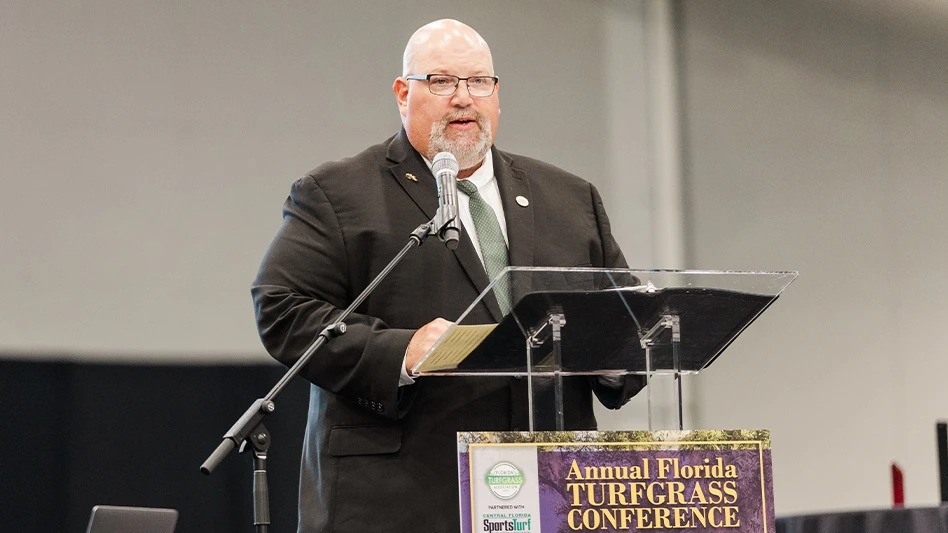
Mark Kann, the director of Florida operations for Sod Solutions, was elected Florida Turfgrass Association president during the annual conference in October.
Kann joined Sod Solutions in 2021 and brings three decades of experience spanning golf course management, university research and industry leadership. His current role marks what he calls “a full circle moment” in his career. “I’ve always loved serving and helping others and it’s just another chance to do that,” he said. “Being voted in shows the confidence my colleagues in this industry have in me to run this organization and that’s humbling. I’m ready to go.”
Kann’s path through the turfgrass industry began on Florida golf courses working as a superintendent and an assistant superintendent before spending 14 years managing the turf research facility at the University of Florida’s Plant Science Research and Education Unit in Citra. He earned his bachelor’s in turfgrass science and his Master’s in horticultural sciences from UF.
He has held leadership roles across multiple allied associations, including serving as president of both the Florida GCSA and the Seven Rivers Golf Course Superintendents Association. He also chaired the FGCSA Education and BMP Committee for nearly a decade, where he helped develop the association’s nationally recognized Golf BMP Certification Program.
In his current role with Sod Solutions, Kann works closely with superintendents, turf managers, sod producers and landscapers across the state. This ongoing connection to every segment of the industry makes his role as FTGA president a natural fit.
“We service all these different segments by providing grass and working with them, so it fits really easily for me,” he said. “I love the industry and this just feels like another way to serve it.”
As president, Kann plans to build on the association’s existing momentum while focusing on collaboration and unity. He emphasized the FTGA’s role in education, research and advocacy. “We support all segments of the industry,” he said. “We provide quality education and have a great relationship with the University of Florida, which gives us access to top researchers and resources.”
The association will continue prioritizing research that addresses real challenges for Florida turfgrass professionals, including projects that improve environmental stewardship, support best management practices and guide policy decisions with science. Kann also pointed to the importance of raising funds for the Florida Turfgrass Research Foundation, which provides student scholarships and supports research benefiting multiple industry sectors.
A key focus for Kann’s presidency will be uniting turfgrass professionals across golf, sports, landscape and sod sectors under one statewide voice while also investing in the next generation of leaders. “The more allied associations we can partner with, the more successful we will be,” he said. “We’ve heard time and time again from the Commissioner of Agriculture that they want Florida coming to Tallahassee as a unified turfgrass industry. That’s how we ensure our voice is heard.”
He believes collaboration doesn’t require full agreement. “Even if we don’t agree on everything, we can work together on shared goals to make the industry stronger.”
He acknowledged that water use, fertilizer and regulatory pressures will always challenge the industry but believes the path forward depends on science and stewardship. “We’ve spent years building Best Management Practices programs to work with the state and show our commitment to doing things right. Significant time, money and effort have gone into this research, much of it through the University of Florida, and it deserves to be heard. The science exists for a reason.”
Kann said he finds it inspiring how proactive the industry is when issues arise, always looking for ways to educate the public and find solutions together, and credits the many mentors and colleagues who have shaped his approach to leadership over the years. “I’ve covered a lot of ground in this industry and learned from so many good people,” he said. “I don’t have all the answers, but I’ll always find someone who does. That’s how I try to live and lead.”
He said he values the exchange of ideas and experience within the turfgrass community. “I always tell people I have as much time for you as you have for me. There’s so much wisdom in this industry, and I never want to miss the chance to learn from it.”
Looking ahead, Kann also wants to engage more students and young professionals. This year, the FTGA partnered with the Florida GCSA, the GCSAA, the Florida Nursery Growers and the Florida Future Farmers of America Association to launch a new mentorship program pairing high school participants with superintendents across the state. Students will form cohorts to gain hands-on management experience ahead of a statewide competition at the 2026 GCSAA Conference in Orlando. “That’s a big initiative because we need more leaders and future leaders in every segment of this industry,” Kann said. “It’s inspiring to see the number of schools already wanting to get involved.”
The recent fall Florida Turfgrass Conference, which grew from about 300 attendees last year to nearly 500 this year, was driven by partnering with UF and the CFSTMA to combine the Citra Field Day with the event. Kann thanked everyone who helped make the two and a half days in Ocala a success and encouraged members to stay engaged and take part in shaping the organization’s future.
Kann said the FTGA’s strength lies in the sheer scope of the industry it represents. “The FTGA looks at the industry from a broad spectrum. When you look at the number of golf courses, sports fields, sod farms and landscaped acres compared to other states, no one even comes close to what we have here. I think we should be the strongest organization in the country. It’s just a matter of pulling everybody together.”