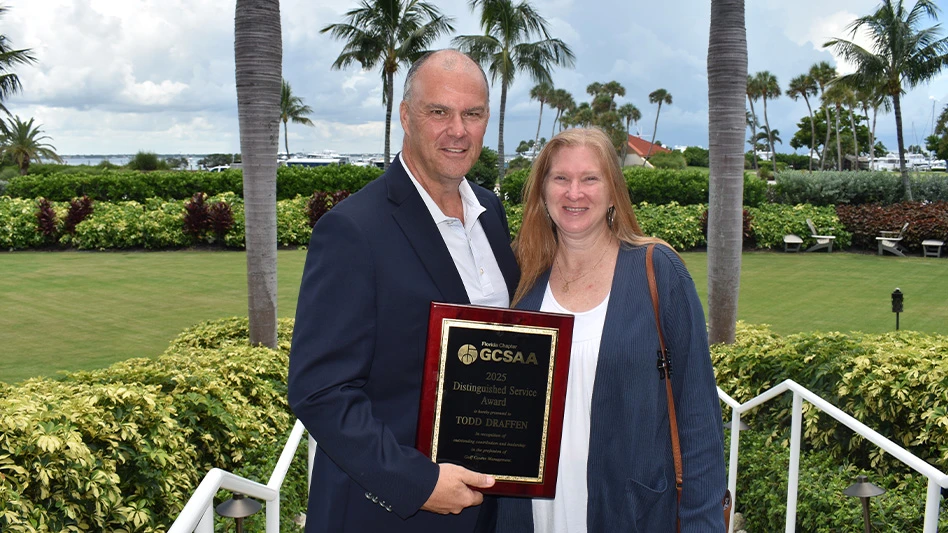
The Florida Golf Course Superintendents Association honored Todd Draffen, director of agronomy at The Old Collier Golf Club in Naples, with the Distinguished Service Award.
Draffen was recognized for his environmental stewardship and outreach efforts educating regulators and lawmakers on golf course maintenance practices. He received his award at the association’s annual business meeting in August at The Resort at Longboat Key Club in Longboat Key.
“Golf course superintendents are committed to environmental stewardship and Todd is a prime case in point,” Florida GCSA executive director Jennifer Bryan said. “Better still, he goes above and beyond each year, taking key decision-makers behind the curtains, if you like, to let them see, hear and touch a golf course maintenance operation first-hand.”
Since the early 2000s, The Old Collier has been a regular stop on the annual Environmental Protection Agency Regulatory Tour. Coordinated by the Florida Fruit and Vegetable Association, the tour gives those who write regulations controlling water, crop protection chemicals, food safety and the agricultural workforce the opportunity to see production practices in person. Over several hours at The Old Collier, dozens of representatives of federal and state agencies that monitor and create policies affecting agriculture tour the golf course and the golf course maintenance facility. Superintendents from neighboring facilities come to supplement Q&A sessions that Draffen leads along the way. Draffen has led the tour for more than a dozen years.
“I would love to say it has helped,” he once said. “But I don’t ever see regulations being changed just because of the visits we host. Still, I do think there is more communication now. I get emails and questions. So, at least I know we’ve touched some people, and they are thinking about real world implications rather than just sitting behind a desk and writing decisions without any idea of what a golf course is about.”
The Old Collier Golf Club is a Tom Fazio design and opened in 2001. It comprises about 80 acres of maintained turf among another 190 acres of mangrove and wildlife habitat. The course has been the site of its pioneering work with paspalum to combat salinity issues. Audubon International gave the course its imprimatur as the world’s first Certified Gold Signature Sanctuary, the most stringent measure of a course’s compatibility with nature.
Draffen started at The Old Collier in 2000 before leaving for a new course construction in 2007. He returned to The Old Collier in 2015. He is a protégé of Tim Hiers, CGCS, one of the golf industry’s most decorated superintendents and a passionate advocate of environmental stewardship in golf. Hiers once said of Draffen: “Other than maybe fly and play scratch golf, there’s nothing he doesn’t do well.”
“Doing what’s right for the environment really doesn’t cost a lot of money,” Draffen said after hosting this year’s tour in March. “We’ll never know for sure what impact these tours have but the goal is to have an open line of communication. We want to know that decisions are being made with the best information instead of someone just sitting in Tallahassee or Washington, making rules without truly understanding their impact.”
After this year’s tour, FFVA science and regulatory affairs VP Michael Aerts wrote: “Participants were impressed with the knowledge, professionalism, and efficiency in which golf course systems are run in Florida. … Following our visit we received comments from participants such as: ‘There are so many scientific disciplines that go into managing a golf course, and our hosts did a tremendous job explaining all of these aspects’ … ‘Surprising, the depth of knowledge and applied sciences possessed by the presenters, and the fruits of their labors are impressive’…‘This is an important stop because of so many misconceptions about golf courses.’
“Sounds like the messages were soaked up and comprehended,” Aerts wrote. “We truly believe that the openness and candor of discussions was fantastic and will go a long way toward building a better level of understanding that will be necessary to effect meaningful improvements.”