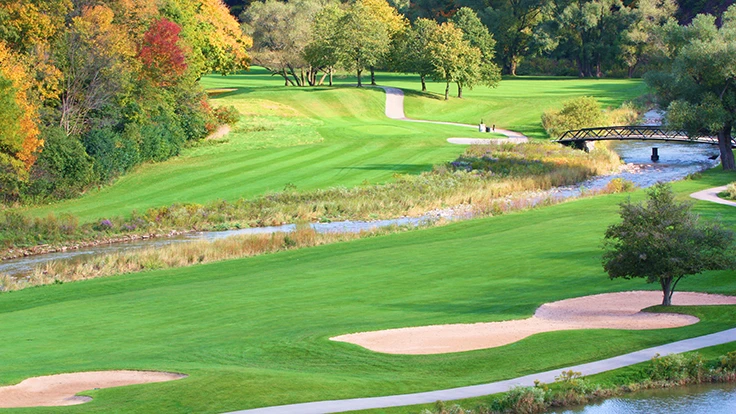
One concern for superintendents is avoiding a disease outbreak at the start of the season when the turf may be vulnerable. Dr. John Kaminski, the director of the Golf Course Turf Management Program at Penn State University, maintains that the most effective way of warding off disease in the spring is to nurture healthy turf through the fall and into the winter.
“I think of it as fundamental Turf 101,” he says. “I think the stronger you are going into winter, the more likely you are to avoid some avoid some (disease issues) that you may come across.”
Dr. Jim Kerns, associate professor and extension specialist of turfgrass pathology at NC State, agrees. “Turf that struggles through the winter months is predisposed to disease in the spring,” he says. “Pathogens are opportunistic, therefore having weak plants at any time can allow for disease development.”
When it comes to heading off early season disease problems, Kaminski says superintendents working in northern sections of the United States and Canada are at a disadvantage. “The northern guys have the challenge of having annual bluegrass,” he says. “You can have perfect turf and still have a bad winter and get turf loss, but the adage of having healthy turf going into the winter is definitely going to be important.”
The primary disease issue confronting northern-based superintendents each spring is snow mold, whether it be pink, gray or speckled. “The type depends on snow cover and conditions in the spring or before snow falls in the winter,” Kerns says. “In order to get gray or speckled snow mold, at least 60 days of snow cover are required. Pink snow mold, or Microdochium patch, does not require snow cover and can be severe when temperatures reach 65 degrees Fahrenheit or below with periods of high humidity.”
Beware of snow mold even before colder weather sets in, Kaminski says. “Pink snow mold can start up in October and become active,” he says. “So, you’re going to have to be on the lookout for that. Gray snow mold … everybody’s putting out preventative applications for that sometime around Thanksgiving or Christmas depending on how far north you are.”
Another concern for superintendents tending to bentgrass greens is take-all patch. “The disease won’t show up until the following summer,” Kaminski says, “but the best time to apply fungicide is when the pathogen is active. And that’s going be in the fall, October and November.”
“I think of it as fundamental Turf 101,” he says. “I think the stronger you are going into winter, the more likely you are to avoid some avoid some (disease issues) that you may come across.”
Dr. Jim Kerns, associate professor and extension specialist of turfgrass pathology at NC State, agrees. “Turf that struggles through the winter months is predisposed to disease in the spring,” he says. “Pathogens are opportunistic, therefore having weak plants at any time can allow for disease development.”
When it comes to heading off early season disease problems, Kaminski says superintendents working in northern sections of the United States and Canada are at a disadvantage. “The northern guys have the challenge of having annual bluegrass,” he says. “You can have perfect turf and still have a bad winter and get turf loss, but the adage of having healthy turf going into the winter is definitely going to be important.”
The primary disease issue confronting northern-based superintendents each spring is snow mold, whether it be pink, gray or speckled. “The type depends on snow cover and conditions in the spring or before snow falls in the winter,” Kerns says. “In order to get gray or speckled snow mold, at least 60 days of snow cover are required. Pink snow mold, or Microdochium patch, does not require snow cover and can be severe when temperatures reach 65 degrees Fahrenheit or below with periods of high humidity.”
Beware of snow mold even before colder weather sets in, Kaminski says. “Pink snow mold can start up in October and become active,” he says. “So, you’re going to have to be on the lookout for that. Gray snow mold … everybody’s putting out preventative applications for that sometime around Thanksgiving or Christmas depending on how far north you are.”
Another concern for superintendents tending to bentgrass greens is take-all patch. “The disease won’t show up until the following summer,” Kaminski says, “but the best time to apply fungicide is when the pathogen is active. And that’s going be in the fall, October and November.”