Source: Associated Press
A plan to expand the Washington State University golf course to attract elite college players, tourists and new businesses to this sleepy college town is scoring a double bogey with environmentalists, who call it a waste of land and the limited water supply of the Palouse.
Scotty Cornelius of Pullman has filed a formal challenge to the proposal, saying the 20 to 30 million gallons a year a golf course would consume is not sustainable.
"A lot of people think a golf course would be great, but they are not being realistic about groundwater levels," said Cornelius, who manages the university's electron microprobe laboratory.
University officials have made a preliminary ruling that the project will not harm the environment, and are now studying public comments prior to issuing a final decision, said Gerald Schlatter of the Office of Capital Planning and Development.
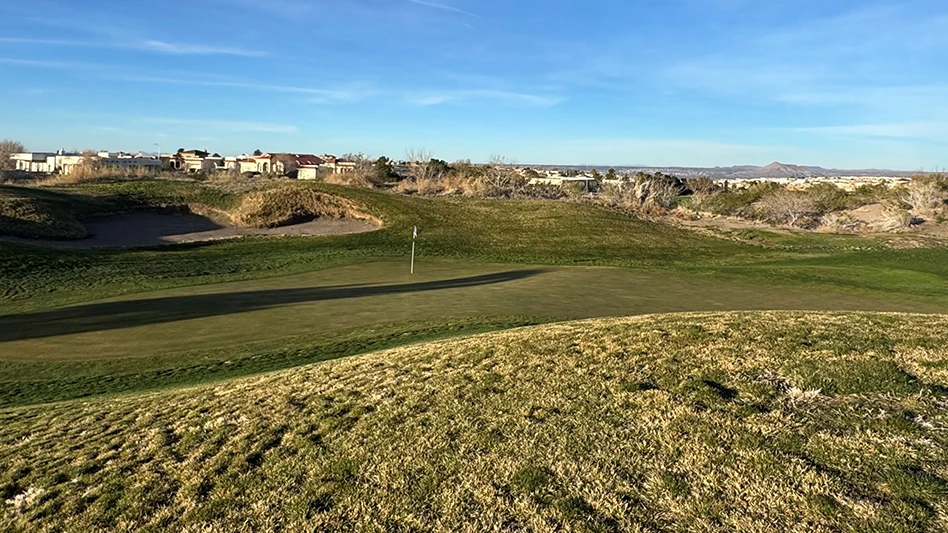
Washington State's existing 9-hole golf course is a relatively Spartan layout on the edge of campus, with a nondescript clubhouse and a small parking lot. It is the only golf course in Pullman, which has a population of about 25,000.
A better course would lure more businesses, tourists, retirees and conventions to the city, said Mel Taylor of the university's Office of Business Affairs.
"Pullman is an isolated community," Taylor said. "When we look at developing the community, one of the key developments we lack is a golf course."
The school's proposal envisions a 315-acre, 18-hole destination golf course, with two driving ranges, a new clubhouse and 300-car parking lot. Private donors will be sought for the $8.4 million cost of the course.
It costs students just $12 to play nine holes on the present course. Fees on the new course would be higher, but have not been set yet, WSU said.
The city of Pullman has proposed the expansion several times in the past, but this is the first time WSU has pushed the idea. School President Lane Rawlins is personally leading the fund-raising effort, Taylor said. The new course has been endorsed by the Chamber of Commerce and local politicians.
Supporters contend the new course will be designed to minimize water use. Toward that end, they are seeking $3.4 million from the Legislature to build a joint water reclamation project with the city of Pullman. Money for the work was approved by the Legislature last year but was vetoed by Gov. Gary Locke.
The water reclamation project would provide 1 million gallons per day of reclaimed water for irrigation to the WSU campus.
The course is intended to be self-supporting after it is built, and will help Pullman and WSU lure the types of professional gatherings that require a quality golf course, Taylor said.
Many universities own courses where their golf teams - plus the future CEOs, politicians and recreational duffers who attend the school - hone their games. The nearby University of Idaho has an 18-hole golf course. The University of Washington plays at Washington National Golf Club in Auburn, which is privately owned but was built to be the home of the Huskies.
Walt Williams, golf coach at WSU, said his teams plays most of their rounds at courses in Lewiston, Clarkston and at the University of Idaho.
The Cougars just concluded their first home tournament of the season, at the Walla Walla Country Club, a 2 1/2 hour drive away. The Cougars will use the same course to host the Pacific-10 golf championships this season, Williams said.
Stanford, Arizona, Arizona State and Oregon State all have their own golf course.
"It's a tremendous recruiting advantage to have a home course that is a high-quality facility," Williams said.
In late October, the WSU board of regents approved building the golf course with private money. Construction is scheduled to begin next spring and be complete in summer 2006. John Harbottle Design of Tacoma will design the course.
Cornelius said the Moscow-Pullman area depends on groundwater from the Grande Ronde Aquifer, which environmentalists contend is dropping by 1 to 2 feet per year.
"Using scarce water from this aquifer to irrigate a golf course raises troubling questions about the water future for Pullman and Moscow," said Rachael Paschal Osborn, a public interest water lawyer representing Cornelius.
The university's initial finding of no environmental significance does not consider the damage to the aquifer, Osborn said.
Last September, Washington State issued a report saying that since the mid-1980s the university has decreased the amount of water it pumps from the aquifer from about 700 million gallons annually to about 600 million gallons annually, despite a growth in enrollment and facilities. University officials attribute the decrease to conservation strategies, more efficient irrigation and other improvements.
In addition to water concerns, critics contend the new golf course will bring more noise and traffic to Roundtop Park, a five-acre neighborhood park on the north side of the university.
"We will lose what we love about Roundtop, the quiet, natural, pastoral setting close to our community, where one can escape our motorized society and listen to the wind in the pines," Cornelius said.