Source: Press Enterprise (Riverside, Calif.)
Golf courses are changing. And it's not just a matter of courses seeming shorter because of the technologically advanced equipment that players are
toting in their bags.
There are physical, often obvious, differences on many of the area golfing links as courses get in touch with their natural side.
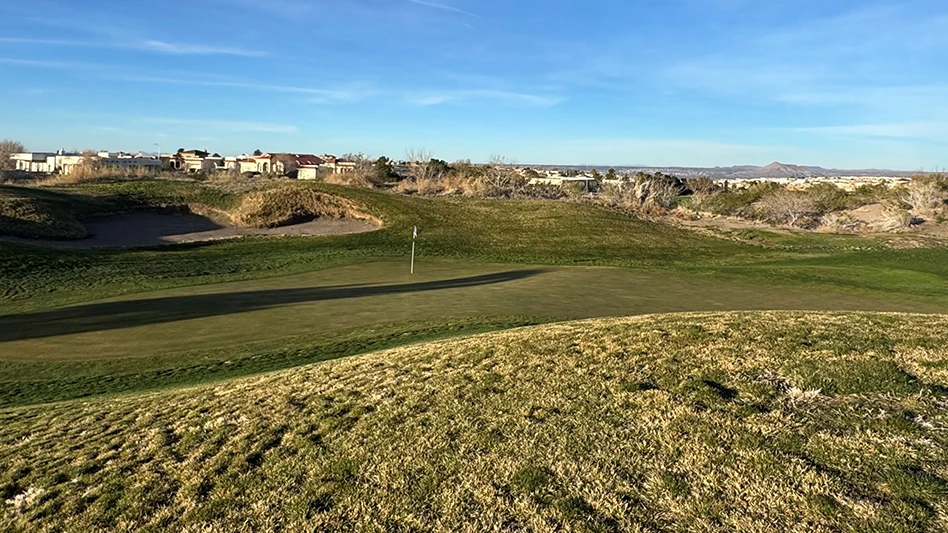
Just take a peek at that collection of ball-shaped barrel cacti to the left of the hole a golfer is trying to gauge, or the young mesquite trees growing where the water-gobbling citrus groves used to be.
It's with a boost from politically minded folks, environmental organizations and well-meaning superintendents and designers that golf courses and clubs are experimenting with layout ideas and new ways of watering and fertilizing turf.
"Every new course that's built is definitely ecologically friendly," said Jeff Comer, superintendent at La Quinta Resort and Club's Citrus Course. "They have to be, because of the pressure from society."
But what is "ecologically friendly?"
According to Audubon International, which teamed with the U.S. Golf Association in 1991 to help improve environmental practices at golf courses across the nation and start the Signature Sanctuary Program, there are six parts to being such a course: Environmental planning; wildlife and habitat management; chemical use reduction and safety; water conservation; water quality management; and outreach/education.
If a course exhibits a mastery of all six elements, presents as much to Audubon International (which is not associated with the National Audubon Society) and pays the $ 150 annual membership fee, it will be recognized as a Certified Audubon Cooperative Sanctuary.
Two area courses - La Quinta's Citrus Course and the PGA of Southern California Golf Club in Beaumont - have earned such designations. Palm Desert's Desert Willow Golf Resort is working toward it, and Corona's Green River Golf Club also has signed on with the organization.
But many more are just as environmentally savvy, or close to it.
"In this area, 70 percent of courses could be Audubon certified without batting an eyelash. It just requires a lot of sitting down and a lot of paperwork," says Comer."
Two others that have a notable commitment to ecologically sensitive practices are The Reserve in Indian Wells and the soon-to-be-opened Stone Eagle Golf Club in Palm Desert, both developed by Lowe Enterprises.
Ted Lennon, president and chief operating officer of Lowe Enterprises, has overseen both projects.
"I think (protecting the environs) is a smart thing economically," Lennon said. "You save on the cost of water by conserving water with as much desert planning as possible."
Ah, water. Golf courses use a lot of it. Like at Comer's Citrus Course, where three years ago about 2.5 million gallons of water were used a day. With some re-thinking, the course now operates on about 500,000 gallons daily.
Credit that to an upgraded, computerized irrigation system that replaced an 18-year-old setup.
At Desert Willow, half the water used on the course is reclaimed from a sewage plant and treated on-site. The staff also has devised a more efficient way to wash equipment, which requires as little as 10 percent of the water used before, according to course superintendent Rodney Young.
Similarly, The Reserve has invested in bubblers that drip on plants around the course instead of the traditional sprinkler systems, which not only require more water but also lose a lot to evaporation.
Those plants the bubblers are watering are different, too.
In the eastern part of Riverside County, it's called "desert landscaping," or the implementation of plants that are native to that region.
When the City of Palm Desert started planning its municipal golf course, the city council had a clear vision in mind.
"They wanted desert planning," Desert Willow's Young says. "And they set up a good plan wherein we use the minimum amount of grass ... and every plant we used is indigenous to the desert, which is what we are.
"Now everyone is copying it, because it is better and the aesthetics are beautiful; it's prettier than just a lot of green grass."
To varying degrees of success, they're also trying on a new look at the Hideaway Golf Club in La Quinta, where they've gone from the typical course-side landscape that included those colorfully dense California bluebells and bright, low-level gazanias to a more unconventional mix that includes dense, bluish-green Idaho fescue and fellow bunchgrass relative purple threeawn.
The new lineup isn't necessarily native to the Coachella Valley, but Hideaway superintendent Gerry Tarsitano said it does call for less watering and has a sparse, definitely desert appearance.
"Everyone wants a little different look," Tarsitano said. "And that's what we were trying to do."
Many of the courses that have implemented the natural landscaping - especially those younger ones such as the as-yet-unopened Stone Eagle - are taking the less-is-more approach to the overall design of courses.
Tom Doak, a golf course architect known for his minimalist approach, has designed Stone Eagle so that no more than 90 of the property's 240 acres will be used as golf turf.
Desert Willow uses only 75 of its 120 acres for golfing purposes.
On average, courses working with Audubon International convert 22 acres of turf grass into wildlife (which also benefits the creatures such as birds and rodents surrounding courses) after joining the program, according to Joellen Zeh, the program's manager.
Two of the other area courses built in accordance with their natural surroundings are Bighorn Golf Club, where desert transition areas and large rock outcroppings come prominently into play; and Oak Quarry Golf Club, where the course winds its way through the jagged, white-faced, one-time mining terrain of the Jurupa Mountains.
Do golfers notice these things? Do they approve, or care?
"I suspect a lot of them don't even know about (what Desert Willow is doing environmentally)," said Buford Crites, Palm Desert's mayor who, as a member of the city council, was involved in the building and environmentally friendly design of the city's course. "They're interested in a quality golf experience, something they remember and can get at a good price.
"But if they don't notice or if they do, it's going to be a positive thing. It's absolutely the wave of the future. The days of wall-to-wall petunias and grass are hopefully over and we can be how we are in the California Desert and be proud of it.
"It's the right thing to do."
Audubon International, with which 13 percent of all golf courses in the nation have worked, would prefer that golfers both realize and appreciate which courses have taken strides to become good friends with their surroundings.
"One of the good reasons we like working with golf courses is that if we can change the way golf courses look, hopefully we can change the way people manage their own property," Zeh says. "This goes way beyond the boundaries of golf courses."