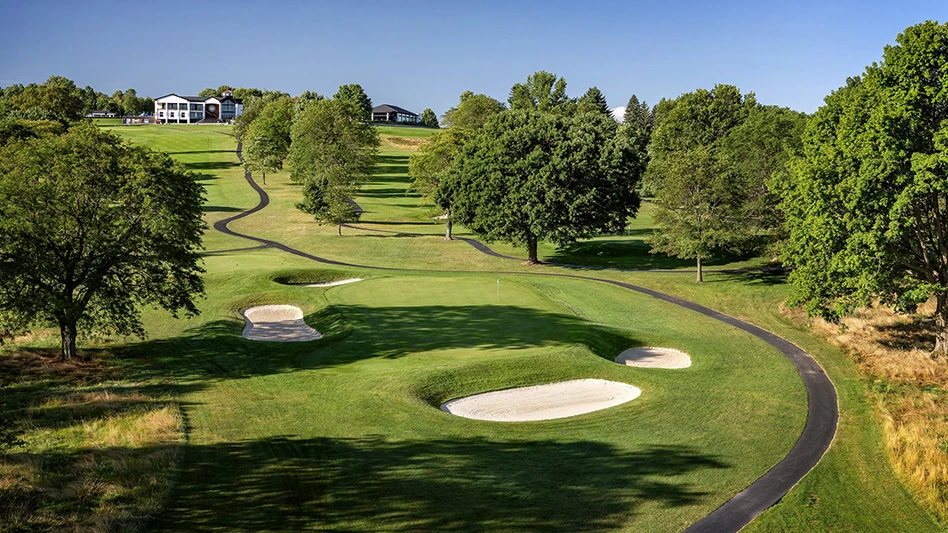
Some go to boot camp, while others attend detention centers, but there are other juveniles who, when convicted of a crime, serve part of their sentence on a golf course.
The Golf Course at Glen Mills is located near Philadelphia on the campus of Glen Mills Schools, a facility for court-referred juvenile delinquents. It’s the oldest school of its kind.
|
|

While Glen Mills is a correctional facility, it’s referred to as a school, and the boys sent there are called students. The philosophy of the facility is that locking up juveniles isn’t the best way to promote positive change. Boys who are sent there, ranging in age from 15 to 18, are required to participate in nine units of activity per day, which vary from academics to vocational activities, including auto mechanic, print shop and barber shop work.
Some students opt to work at the 18-hole, Bobby Weed-designed golf course that has been on campus for six years. Golf course superintendent John Vogts has been at the course since it opened.
Because the students are constantly rotating in and out of the school as they serve their sentences, Vogts trains 120 to 130 boys on golf course maintenance per year, with about 30 or 40 working at a given time, he estimates. The young men rise at 5:30 a.m. and work in tangent with a regular adult staff of about 15 full-time and part-time employees.
“We don’t go into plant pathology and things like that because they’re not here long enough,” Vogts says, adding that the students know enough to do a good job.
Vogts trusts the kids enough to let them hand-mow greens. He says he hasn’t lost any greens yet. In fact, he says Glen Mills is consistently ranked as one of the top courses in Pennsylvania and one of the top 100 upscale public courses in Golf Digest.
Rather than teach them agronomy, Vogts tries to teach them skills that apply off the golf course as well.
“We toughen them up and teach them to work in all weather conditions,” he says. “They have to have a good work ethic and good behavior.”
|
|

Some of the kids end up being better workers than his regular staff, he says, adding that he gets along well with them and doesn’t have to worry about missing or stolen equipment.
“I’ve never had to yell and get in their faces,” he says. “Other people might have had trouble with them, but not me. I treat them fairly.”
Vogts could find out why they’ve been sent to Glen Mills (crimes include everything but those sexual in nature, arson and those committed by mentally unstable boys), but he chooses not to.
“I don’t ask what their crimes are,” he says. “I don’t need to know.”
To some, it might sound like a pleasant day on the links rather than punishment for people convicted of crimes, but Vogts says that’s not the case.
"It's not a pushover program," he says, adding it rivals prison in its intensity.
The time on the course pays off for many. Some former students – Vogts knows of about 50 – have gone on to work on golf courses, and others have gone to work in other fields. Vogts finds this out when he gets calls asking him to be a reference in students’ job hunts.
Those who do go on to work at other golf courses leave with the experience of working at a course with a more than $1 million budget that has all the modern equipment they’d find anywhere else.
Students receive a stipend of $25 per week, most of which they deposit into an account. They’re only allowed to have $5 on them at a time, which they can spend at a snack shop on campus.
The students work at the golf course through the winter because they need to be there to train a new batch of students in the spring.
Vogts’ next goal is to get some students into turfgrass programs at Penn State (his alma mater), Rutgers or elsewhere.
For more information, visit www.glenmillsgolf.com.
Latest from Golf Course Industry
- Tartan Talks 116: Doug Smith
- Audubon International adds 127 golf courses to Monarchs in the Rough
- USGA’s GAP preps for fourth year
- Protect your vehicles from rodent damage
- VIDEO: Fun with fairways
- From the publisher’s pen: Humble giving
- Syngenta adds two to western U.S. team
- The Aquatrols Company introduces soil surfactant for Canada