Jim Kerns, assistant professor and extension specialist of turfgrass pathology at North Carolina State University, has studied snow mold for four years and has seen variations across the country. Microdochium patch or pink snow mold, for example, is most common in the Pacific Northwest and throughout the country in cool, damp conditions, he said.
“Microdochium patch does not require snow cover to develop and in my experience is more severe in fall and spring prior to snowfall and after snow melt,” Kerns said. “This particular disease can affect cool-season grasses as well as the Ultradwarf Bermudagrasses used for putting greens in the South and transition zone."
Conversely, typhula blight (gray and speckled snow mold) only occurs in areas that receive more than 60 days of continual snow cover.
“This is important because even in the Chicagoland area this disease is fairly rare, despite having fairly long winters,” he said. “Primarily, this disease is problematic for mountainous areas and areas that have more extreme winters.”
While snow mold can affect any part of the course, Kerns noted that most superintendents treat only tees, greens and fairways, leaving roughs vulnerable.
“In areas like Wisconsin, Minnesota, the Dakotas, etc., superintendents may spend $10,000 to $20,000 just for snow mold management,” he said. “It is of paramount importance to manage, because it allows the superintendent to get off to a good start in the spring. In temperate climates, the spring is a crap shoot with respect to weather. Thus, if breakthrough occurs, it could take until June to recover, depending on the environmental conditions. Consequently snow molds, especially Typhula blight, are not to be taken lightly.”
In Kern’s experience, all cool-season turfgrasses are susceptible to snow mold, but primarily annual bluegrass and creeping bentgrass have superintendents most concerned. Kentucky bluegrass and the fine fescues seem to have a bit more resistance, but still can get the disease.
As for diagnosing ... plants with Microdochium patch will either appear water-soaked, necrotic or chlorotic. On dead plants superintendents might see pink structures called sporodochia, but this is not always observed, Kerns said.
“This disease will also produce substantial aerial mycelium when active,” Kerns said. “If you are unsure, send a sample to a lab for Microdochium patch. For Typhula blight, look at the affected plants to find sclerotia. Sclerotia are survival structures of these fungi and they are either reddish brown or black (Typhula incarnata) or small black structures that look like pepper flakes (Typuhla ishikarensis). Plus, this one is easy because it requires snow cover to develop.”
What has provided the best results in Kern’s tests?
“Typically, we see the best results when we mix two or three different active ingredients together,” he said. He’s had strong results with mixes of propiconazole/iprodione/chlorothalonil and other ingredients to cover the threat.
“We post all of our trial results on our website, www.tdl.wisc.edu under the research tab,” he added. “We have many combinations and products that have been successful in our trials and by no means is the short list above exhaustive.”
Each year his team tests between 60 and 90 different fungicides and fungicide combinations.
“Essentially, when looking at our reports pick out the best treatments and sit down with your local sales representatives to find a mixture that works for your budget,” Kerns said. “The key thing when looking at our reports is to identify a threshold for your course ... what your clientele expects.”
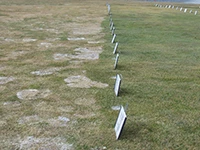
To help, they publish pictures, as well. Once you find your threshold, then only look at those treatments that meet that threshold. For example, if your threshold is 5 percent, then only focus on treatments that kept snow mold below 5 percent.
To lessen chances of seeing snow mold, Kerns said to avoid a late-fall fertilization - nothing after Halloween in temperate climates. Also, a fall clean-up application in late September or early October in climates that are similar to Wisconsin, is recommended.
“We have observed that a fall clean-up reduces the risk for Microdochium patch development the following spring,” he said. “The key is to not go into winter with damage.”
If too? What then?
“For Typhula blight, prevention is about the only way to successfully manage the disease,” Kerns said. “However, if the preventative application is missed, the best thing to do is to start plant growth as quickly as possible. This can be achieved with vertical mowing, aerification and fertilization.”
This is not recommended because the recovery time maybe substantial.
Microdochium patch is fairly easily maintained with applications of fungicides curatively, according to Kerns.
“If preventative applications are missed, I would suggest contacting your local turfgrass extension specialist for local recommendations. In the Midwest, we see great results with Iprodione, QoI fungicides (Heritage, Insignia, Compass), DMI fungicides (especially propiconazole) and thiophanate methyl.”