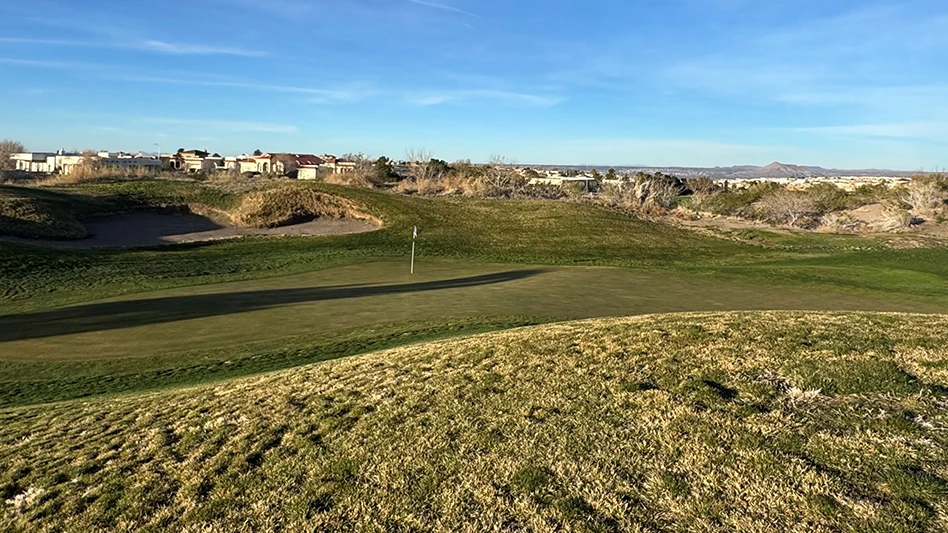
Mike Armstrong, superintendent at Mendon Golf Club in Western New York for the last three years, is no stranger to the adverse effects of winter. With annual snowfall ranging anywhere from light to very heavy (50-100+ inches), snow mold is a real concern.
The peak snow mold season runs from Nov. 1 to April, so he has to use a program that protects surfaces for at least 120 days.
“Once the snow arrives in late November it’s usually here to stay,” Armstrong said. “Reapplication in mid winter is usually not an option. Typically it is not until mid to late March when we can get out on the surfaces again."
“In my opinion, this application is the most important one we do all year,” he added. “Having healthy disease-free turf in the spring is the launching pad for a successful season.”
When his staple product, which gave 85-90 percent control, was taken off the market, he was forced to reevaluate his snow mold program.
“It was a little scary at first when your go-to was taken way,” Armstrong said. “After talking with superintendents, salesmen and looking over countless research studies, I came up with a new snow program.”
Armstrong uses a three-way fungicide combination on his three acres of Poa/Bentgrass greens. Typically one application of Instrata at 11 oz/M around the second week of November.
“This lasts the entire winter with no breakthrough,” he said. “I also add in an adjuvant to help with coverage and drift control, and one of the UV/Stressguard dyes that are available. I just started adding the dye this past winter and found that the grass is much healthier and greener come spring.”
He also does a clean-up spray, typically Halloween week, with a DMI and a contact. He feels this helps knock down the snow mold fungus population in the soil prior to the final application and helps with the longevity of control.
The 26 acres of Poa/Bent tees and fairways are the surfaces where he had to adjust from his prior product.
“I have had great success with using a two-way combination of a high rate of propiconizole and chlorothalonil,” he said, noting that the past two seasons have seen 90-95 percent control. “I think we are seeing better control than what we saw from PCNB. We are also seeing healthier turf in the spring.”
In the past, he would get more yellowing and it seemed to take longer for the turf to get going in the spring.
Like the greens, he is adding an adjuvant to help with coverage and drift control, and one of the UV/Stressguard dyes that are available.
“Now that PCNB is back on the market I won’t be going back,” Armstrong said. “The price of PCNB is significantly higher then in the past. You can apply the two-way combination with a dye and adjuvant for roughly the same cost as PCNB and come out of the winter with healthier turf.”
He does a clean-up spray on tees with a similar approach as on greens, but not on fairways due to budgetary constraints.
Gearing up for snow mold season
The peak snow mold season runs from Nov. 1 to April, so design a program that protects surfaces for at least 120 days.