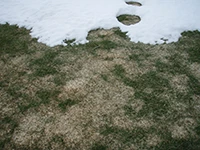
Matt McKinnon, superintendent at The Legacy Courses at Craguns in Brainerd, Minn., has faced his fair share of snow mold.
McKinnon, who started at The Legacy in March of 1998 as an assistant superintendent and became superintendent in 2000, said course design has played a role in their battles.
“We have a lot of areas that are low-lying and shaded due to being carved out of a forest,” he said. “Some of these areas, the snow doesn’t melt on the cart paths for days after we open the course, so we have to plow off the snow in order to get carts around. Most of our snow mold problems start there.”
He identifies pink snow mold by the pink mycelial threads, which generally appear during cool, wet weather in spring and fall. Grey snow mold - with white-to-grey mycelium - happens when the snow is melting, he said.
As for prevention, McKinnon said the process has remained the same even as the components have changed.
“We first started spraying for snow mold prevention just after we were built [and] we have always used a combination of products, but have changed the combination over the years,” he said. “No real steps in combating snow mold. Just try to make good decisions managing the course.
“All chemicals work. Some combinations work better than others, but there is a lot that can change the success of your applications - like operator error, equipment, wind and rain,” McKinnon added.
Fortunately, when the soil temperatures rise the problems generally go away fairly fast, according to McKinnon. This year, however, most areas took a little longer since temperatures weren’t good for recovery through spring.
University studies are playing a significant role in the fight against snow mold.
“In the fall we spray two applications using a combination of chemicals with wetting agents,” McKinnon said. “In the spring we also apply at least one application of a product for pink snow mold and hopefully the weather warms up sooner than later. Since the last few years we have had the U of Wisconsin and the U of Minnesota doing testing for snow mold prevention, we have been able to see what works and the timing of the applications.
“I believe that most combinations work well, but the timing of the application is the key,” he added. “I have learned that spraying when the plant is still active gives us the best result. I used to wait until the bitter end before I would spray and the results were not always good.