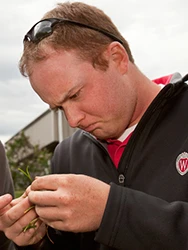
Paul Koch, M.S., associate researcher and turfgrass diagnostic lab manager at the University of Wisconsin – Madison, talks about diagnosing, treating and preventing snow mold.
What’s the cause behind snow mold?
Snow mold is an umbrella term that refers to several different types of fungi that can cause disease on turf, but three are most common: Pink snow mold (Microdochium nivale), gray snow mold (Typhula incarnata), and speckled snow mold (Typhula ishikariensis). Pink snow mold does not require snow cover to cause disease - rather prolonged periods of cool and wet conditions - and can be observed nationwide and even as far south as Texas and Mississippi. Gray snow mold requires approximately 60 days of continuous snow cover to cause disease, and is commonly seen throughout much of the Great Lakes region, Ohio Valley and northern New England. Speckled snow mold requires approximately 90 days of continuous snow cover to cause disease and is the most severe of the snow molds because of its ability to infect the crown of the turf. It’s commonly observed in the upper Midwest and in the Rocky Mountain west. The importance of the snow cover is not related to the snow itself, rather to the ability of the snow to insulate the soil surface to a temperature slightly above freezing to allow for the fungi to grow and infect.
What are you seeing that's new with research?
Because these fungi (especially the Typhula fungi) are slow-growing and cause disease only in winter, there isn't a tremendous amount of research that goes into snow mold diseases relative to summer diseases. However, Dr. Rossi at Cornell has research showing an increase in the amount of snow mold observed following late fall potassium applications, Blunt et al. at Colorado State have shown that removing snowfall in the spring did not reduce overall snow mold and also showed that one fungicide application was just as effective as two in most cases at suppressing snow mold. In addition, we have also done work here at Wisconsin showing that snow mold fungicides degrade rapidly during snowmelt or rainfall events but persist otherwise if the soil remains frozen. We also completed a study showing that one late fall fungicide application targeting snow mold does not have a significant impact on dollar spot the following summer, though making an additional application three weeks earlier in the fall did significantly delay and reduce dollar spot the following summer.
How can a superintendent diagnose snow mold in the field? Is it often confused with other turf problems?
Snow mold of all three major types following snow melt is usually roughly circular, tan to bleached in color, and 1-3 feet in diameter. The key identifying characteristic to distinguish between the snow molds is the presence of sclerotia (which are long-term survival structures produced by the fungus). Pink snow mold does not produce sclerotia, but gray snow mold produces large, red sclerotia that will be embedded in the leaf tissue. Speckled snow mold produces small, black sclerotia that are also embedded in the leaf tissue.
Are there certain turfgrasses that are more/less susceptible to snow mold?
Bentgrass is the most susceptible, bluegrass and fine fescues are less susceptible but will still get snow mold. Among the bentgrass cultivars, we conducted a project showing that 'Declaration' and 'Memorial' were somewhat resistant to gray snow mold compared to other cultivars, but not enough to avoid fungicide applications.
On what part of the course is it most commonly found - greens, tees, fairways, roughs?
Snow mold can be found everywhere but is usually most severe on putting greens, followed by tees and fairways.
Is it more common in different parts of the country?
As far as gray snow mold, areas that get more snow get more snow mold. So it’s more common in the Great Lakes and Rocky Mountain west. As for pink snow mold, it is still most severe in areas that get the most snow but can be very problematic anywhere that is cool and wet and can be especially severe in the Pacific Northwest and northeastern United States.
What can be done to prevent an outbreak? Something done at end of summer or fall?
The primary cultural practice that will reduce snow mold development is reducing nitrogen fertilization in the late fall. Late fall nitrogen applications will prevent the turf from going into dormancy before snowfall, and leave the turf susceptible to heavy disease development. Proper surface and subsurface drainage and proper thatch management will also limit snow mold development. But in areas of significant snowfall or prolonged periods of cool and wet weather, fungicides will be required for acceptable snow mold control. Fungicides are typically applied in late fall a few weeks before typical snow cover. In areas of heavy disease pressure, 2-4 active ingredients should be applied for the most effective control, but there are several combinations of active ingredients from several different fungicide producers that will provide excellent control. In areas of lower disease pressure, one active ingredient should suffice.
Once spotted, what can be done to combat snow mold?
It depends on the snow mold. If it's pink snow mold, which can be very active even in the absence of snow, a fungicide application can be made to limit further disease development. If it’s gray or speckled snow mold and the snow has melted, no further disease will develop and it’s a matter of promoting recovery through timely fertilization and cultivation and potentially overseeding. Unfortunately, in the fickle and often cold spring weather, this can often take a significant period of time.
Any advice you can provide to a superintendent?
Preventing snow mold can be daunting because we usually only get one shot at preventing it prior to snowfall and there are so many effective fungicide combinations available to control snow mold. My advice is to plan well in advance, look over university fungicide research trials from your part of the country (UW's can be found at http://www.tdl.wisc.edu/research.php), and discuss with a trusted fungicide representative to find the combination that will provide effective, affordable snow mold control at your facility. Because of the differences in disease pressure, financial capacity, and expectations at each facility there is no one fungicide treatment that works well for everyone.