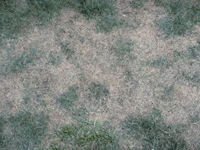
| A hot, wet May means another summer in danger of an outbreak of Pythium, weakening turf from the root to the point that the heat of the season or other pathogens are even bigger dangers. While some Pythium is easy to spot with the oily greens, root rot does its damage long before symptoms are visible. Keeping greens well-drained and aerated helps keep Pythium at bay, but when weather works against the turf, superintendents say a fungicide program, whether preventative or curative, is the way to fight. Pine Meadows Golf Course Superintendent Tom Savage considers the 18-hole Pine Meadows Golf Course of Mundelein, Ill., one of the top high-end public courses in Illinois. To him, the bentgrass fairways, bentcross and Poa annua greens and blue ryegrass roughs are one of best in the Chicagoland area. But that turf didn’t look as great last year when a warm, wet spring gave Pythium a way in. “It was the worst weather we had in 55 years,” says Savage. “It was over 85 degrees for 45 days. Before, it was just grease spots, but it started dying back fast with root rot. They got nailed. It just wiped them out.” Though Savage keeps up fungicide applications, he hadn’t found a program to combat the pathogen wearing his turf out at the roots. A colleague recommended Stellar to him and he used it to beat back the disease, following with a second application to maintain the push until the end of the season. “Around the fourth of July, we try to get out and spray when we start seeing Pythium,” says Savage. “That’s how good it is. Last year, we went out on June 25 and put down an application to take care of it, and then another in three weeks.” Savage sprayed all the tees and fairways with Stellar, everywhere he knew root rot would try to claim his turf. “We’ve been here for 25 years, so we know where those spots are and we’ll spray those hotspots,” says Savage. “Being here that long, you know when it’s going to cycle. You can go out to treat it just to protect, but if you let it in, you’re just going to do battle from then on.” Though Pythium fungicide can be applied as a preventative when the pathogen is active against turf roots early in the season, Savage waits until the heat starts rising to start the program. For him, taking on Pythium when it shows up is more cost-effective with the Stellar program than spraying without knowing where the worst spots will be. “In this economy you can’t just keep spraying everywhere. It just gets expensive fast,” says Savage. “Last year, to fight it off, you were just spraying until you ran out of money. We’ve got great owners, though, who understand there are bad years and you have to take care of your turf.” Having made it through last year with his turf intact, Savage recognized another wet spring season coming in when he planned his budget. “This has been the worst spring in the Chicagoland area,” says Savage. “I’ve already got two applications scheduled, and we’ll hold off until we can put those down. That’s really where Stellar comes into play for me; you can hold off a bit. With others, you have to get it into the ground right away or you’re dead.” River Run Golf & Country Club When the burning sun stressed out turf throughout North Carolina last year, superintendent Ron Ritchie kept fairly cool along with the A1 bentgrass greens at the 18-hole course. The private River Run Golf Course & Country Club in Davidson, N.C., has 125 irrigated acres, one of the largest irrigated spaces in the state. But even when turf all around started to choke, Ritchie managed his water usage more, and that control helped protect his course, he says. “We didn’t lose any of our turf to Pythium last year because of our water practices,” he says. “We only water every third day with our heads. The rest of the time we just check around with hoses and do hand watering.” Without any moisture sensors, he depended on watching the turf for signs of disease, since a well-drained profile is one of the better cultural defenses to Pythium. “I knew how much water to use from working with bentgrass for 30 years,” says Ritchie. “I don’t water as much as other people. I like to keep more control on the situation, only putting water where it’s really needed on the course.” Ritchie’s area of North Carolina saw 93 days above 90 degrees last year, triple the past annual average. He pushed his cultural practices to sustain the turf in the heat while still allowing air in the soil profile, with three core aerification programs through the year, a constant topdressing program from February to May and a hydroject aerification program every other week. “It keeps the green breathing through the summer,” says Ritchie. He backs up his cultural practice with a heavy fungicide rotation throughout the summer from May 15 through Sept. 15 of Signature, Stellar, Insignia, Subdue and Segway. Each week a new fungicide is sprayed to protect the greens. With each application targeting root rot, it needs to be watered in to get the treatment into the soil as a best practice. It’s a big cost for the summer, but he provides for the program in his budget just as a guarantee his greens won’t be put out by Pythium. “Most courses at our level in North Carolina are set up for plan like that,” says Ritchie. “We were one of the few courses in the area that didn’t lose turf to Pythium last year. I got a lot of compliments from members. They were very happy with the situation.” This year, he’s preparing the same program. Though he exceeded on his fungicide budget last year, he would rather cut elsewhere before holding back in that area. “If I had to cut somewhere, it probably wouldn’t be in the fungicide program,” says Ritchie. “The most important part of the course is the greens. If I had to cut back anywhere, it’d be something else; I’d cut back on the tees or the fairways before I’d cut back on the greens at all.” Winding Creek Golf Course Though Winding Creek Golf Course is where bentgrass saw a lot of damage in last year’s sweltering summer, as a municipal course, the budget is as much of a challenge as the weather in fighting off disease. Without the money to prevent pathogens, superintendent Allen Crockett wasn’t surprised to see Pythium taking on his Crenshaw bentrass greens. “The weather pattern we had last summer, we had thunderstorms in the afternoon, then the sun would come out and it’d get hot and humid before evening. It was the perfect breeding ground for Pythium,” says Crockett. “I saw a lot of root rot. I think that’s what really hurt me last year. You had to try to hit that on a curative basis as well as a preventative basis after it started happening.” In order to keep the 18-hole course running smoothly on a shrinking budget, Crockett had to make some tough decisions. “About mid-July, we started seeing some yellowing and weakening of the grass,” he says. “As the summer progressed, we started seeing some other problems come in. It became a vicious cycle because you tried to dry out the greens to take care of the Pythium and you’d get rained on and something else would show up, like algae. Once the turf is stressed, it just opens up that door for disease.” Crockett opened up his cultural practices to try to assist his fungicide program, taking knife tines or needle tines to his greens every couple weeks. He also held back on mowing two to three days each week, rolling the greens to preserve their speed. “We were just trying to get the soil to breathe, try to get some air into the ground,” says Crockett. “When it comes on in June, that’s my 90-day countdown to make it to try to get to the end of summer. You just have to stay cool, calm and collected, try to go through measurements and change the environment so that the grass can survive the added stress.” Though he does use regular fungicide applications, his budget to support the turf isn’t as large as some other courses’. “It’s getting tighter every year,” says Crockett. “We got less money last year and coming into this year I was asked to cut another two percent. It makes you think about what’s involved, and what we can do with the fungicides that are available to us. We try to work what we can in.” Even with a tighter budget, the fungicide program covering Pythium and other diseases won’t be pulled back if he can help it, he says. “If I don’t have grass on the greens, that’s going to cost us money. That’s one area of my programs I’m just not cutting back,” says Crockett. “I look at what the chemicals do before I look at their cost. I’ve got regular chemicals I use but I’m always looking at different mixes and different coverages.” Even as fuel prices continue to rise and municipal water usage continues to be a large line item, Crockett keeps the budget in perspective of his turf. “You have to be conscious and aware of what you’re doing,” says Crockett. “I’d take care of the greens first, tees come second and fairways third. There’s doing agronomic practices and keeping surface water off the turf and letting the ground breathe. It all comes down to needing to maintain healthy turf.” |
Latest from Golf Course Industry
- Sod Solutions welcomes Australian Turf Solutions
- Evergreen Partners announces new president
- RISE hosts industry issues update at GCSAA Conference
- Construction complete on Dhoho Golf Club
- Rod Mortimer joins Bernhard and Company
- Toro’s Intelli360 adds parts ordering functionality
- Ecorobotix announces collaboration with GEO Sustainable Golf Foundation
- Textron E-Z-GO launches Labor Portal