Guy Cipriano
Golf is an outdoor game played on varied landscapes. A course has no defined dimensions. Weather determines how — and sometimes if — the game can be played.
Hockey is an indoor game played on surfaces with defined dimensions. A standard North American rink measures 200 feet long by 85 feet wide. Weather has no impact on when the game can be played … until the business and marketing folks decide to play outdoors.
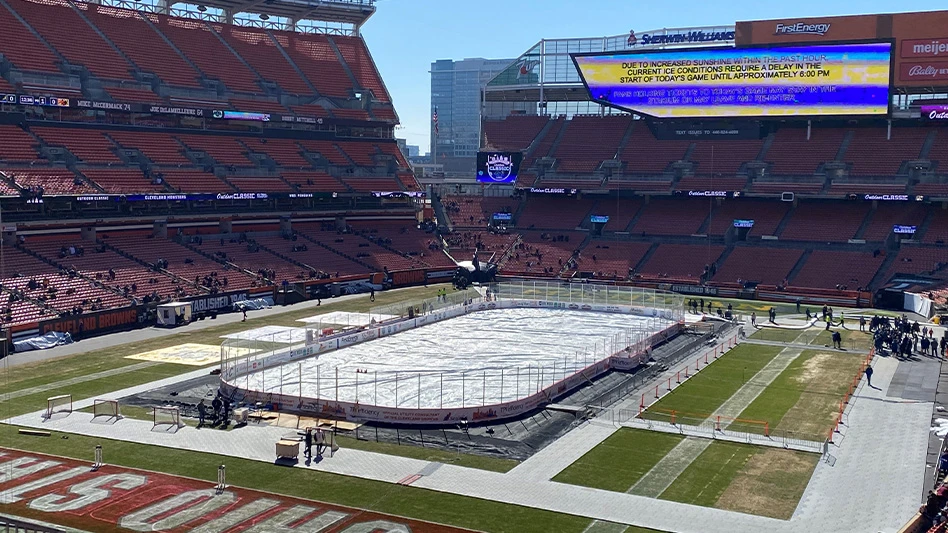
Managing editor Matt LaWell and I attempted to watch our local American Hockey League team, the Cleveland Monsters, play an outdoor game at the home of the Cleveland Browns on the first Saturday afternoon in March.
Cool idea (no pun intended). Market the heck out of playing hockey outdoors in an NFL stadium. Get a few extra thousand eyes on your product. New fans have fun watching a fast-paced spectator sport. They later attend a few indoor games. Emulating the marketing appeal of the annual NHL Winter Classic, the game was called the Cleveland Monsters Outdoor Classic.
Following a pancake brunch and paying $20 to park (such is a day out in the city!), Matt, his daughter and I walked into the stadium around 12:20 p.m. We watched a pregame skate, purchased a few drinks and settled into our seats like thousands of other fans, many of whom either never or rarely attend Monsters games.
The game was scheduled to start at 1 p.m. Something seemed amiss around 1:20 p.m., when the teams remained in their respective locker rooms and a crew scurried to cover the ice with a tarp. Something also seemed amiss in how the franchise’s management handled the situation. Nobody communicated to customers why a game scheduled to begin at 1 p.m. was being delayed.
Finally, around 1:40 p.m., the public address announcer told the crowd the start of the game had been postponed until 6 p.m. at the earliest, because afternoon sun caused the ice to deteriorate, thus creating unsafe playing conditions. Fans were told they could remain in the stadium or leave and use their ticket to re-enter. Anybody with something else to do that day besides attend a hockey game was out of luck. No refunds. No use of the words “sorry” or “we regret to inform” you in the announcement.
A one-hour delay? OK. A two-hour delay? Fine. A five-hour delay? Now you’re treading deep into personal schedules. Matt, his daughter and I, plus thousands of other fans, were gone — not only for the day, but perhaps for good.
Participant or spectator safety should never be compromised for commerce. Similar weather decisions are made daily at golf courses. A spoiled Saturday afternoon inside a stadium led to me pondering ways golf operators can effectively handle and communicate weather-related dilemmas without peeving customers.
Put yourself in the customer’s spot
Golf, sporting events, movies and concerts. No discretionary spending activity is forced upon a consumer. People are choosing your course over doing something else. Some might be choosing your course for the first time. Acknowledge the time and financial sacrifice a consumer makes to patronize your business. An afternoon at the course might be the norm for you. It could be an event circled and highlighted for months on somebody else’s calendar.
Upfront communication works
If frost, wet conditions or a threat of severe weather are going to delay a tee time or outing, begin notifying customers via text, email and social media. Let’s say you know at 6 a.m. that frost won’t lift until at least 9 a.m. Start the communication chain immediately. Customers will be thankful they won’t need to waste time waiting at the course. Upfront communication about the sun’s potential effect on ice could have saved fans time and $20 in parking.
If weather issues arise when customers are already at the course, be honest, thoughtful and proactive with in-person communication. Use empathetic words when addressing customers whose plans are altered by weather. A superintendent visit to the clubhouse or grill to explain the situation can’t hurt. Nobody communicates the hows and whys surrounding weather better than a good superintendent.
Trust the technical guru
Outdoor hockey games must align with favorable weather to be safely contested. The ordeal in Cleveland could have been avoided by not scheduling the game during the sunniest parts of the day.
Completely trust the expertise and input offered by the people responsible for maintaining the playing surface. Owners, general managers, pros, boards and committees must listen intently to the superintendent’s thoughts on starting times. And the superintendent must speak up when the commerce doesn’t make enough sense for the likely conditions. Plan for the fallout if a worst-case scenario develops.
Scheduling a lucrative outdoor golf event at 7 a.m. before a crew can fully prepare playing surfaces or nine days following an aerification might not be worth the short-term revenue boost. Businesses willing to play the long game when handling customers almost always flourish.
Be flexible with refund policies
Policy is policy, and you might not be legally obligated to refund customers when weather goes awry, Again, this is where it’s important to think long term.
Sometimes what you’re required to do and what you should do are separate ideas. Giving somebody something — a full refund, a discount on later events or tee times, shop or food/drink credit — makes customers think their feelings were considered in the decision-making process.
A successful business wants repeat customers. Giving somebody a reason to come back will likely make them forget the initial inconvenience.
Guy Cipriano is Golf Course Industry’s editor-in-chief.