Courtesy of Country Club of North Carolina
Director of agronomy Ron Kelly has seen his handful of heavy storms and rainfall in his 35 years at the Country Club of North Carolina. But on July 6, as Tropical Storm Chantal hammered the private 36-hole facility in the Sandhills of North Carolina, Kelly knew this storm was intense.
“I started looking at the rain gauge, and it went from about an inch and a half to five inches within like three to four hours, and I'm like, there’s definitely something that's going on that's not normal,” Kelly says.
A few hours later, once the storm had passed and the course began drying, Kelly’s team discovered land once part of the Dogwood course 11th hole was now a fraction of what it used to be. Dogwood is one of the facility's two 18-hole layouts, the Cardinal course being the other.
Flooding submerged the area. The course is a local watershed collector, so thousands of acres of property direct water to the land. Water levels flowed above the course’s newly installed bridge over a spillway; irrigation and drainage pipes were washed out and three-quarters-of-an-acre of sod was rolled up. “It was just in big rolls of carpet it looked like,” Kelly says.
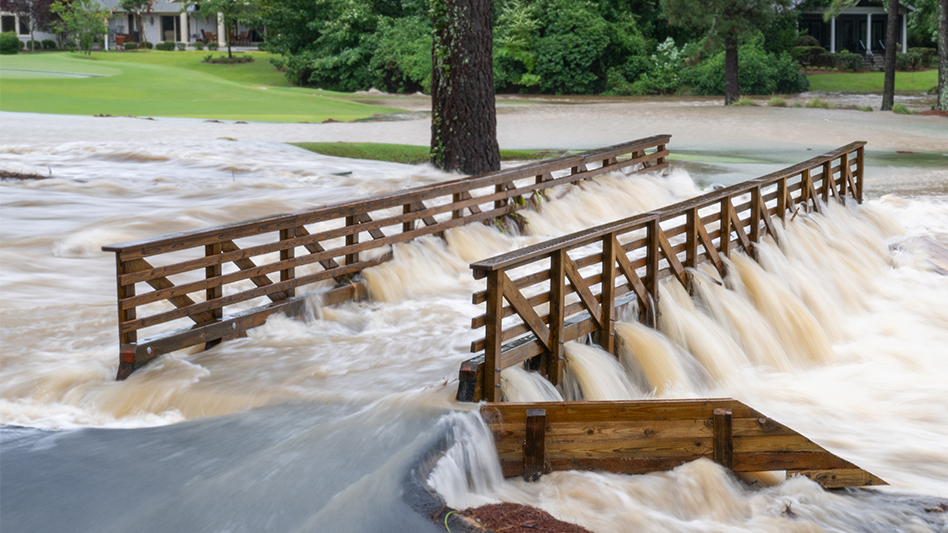
Kelly and his team didn’t dwell over the damage. The team got straight to work. Kelly assembled a construction crew within five days to assess and fix any bridge and spillway damages. Shortly after, the damaged sod was cleaned up. Contractors were hired to assist with both tasks.
“Once we got all that done, we could go back to putting it back together,” Kelly says. Within six weeks of the storm, the 11th hole had been restored and ready for play.
The maintenance team rebuilt the hole while continuing to maintain the other 35 holes, all which remained open for play following the storm. Kelly’s crew assisted in cleanup, reinstalled drainage and irrigation, and a sod company replaced the hole’s turf. “Our staff, we worked on it continually, doing what we could,” Kelly says.

Superintendent Josh Weston assisted with work and coordinating staff, and crew members Jamie Ratliff and Steve Scarborough were instrumental in excavation and construction work. But in the end, the entire team was crucial to the success of the restoration.
“Pretty much the whole staff got involved with it, because there's just a lot of little things that had to be done,” Kelly says. “We'll still be continuing to work on the hole, it's hard to put something back together that's washed out. There's always something, something will change, like drainage, and you'll have to put in some little extra drains, probably to catch some of the work water, underground water.”
Development in surrounding areas has resulted in Country Club of North Carolina experiencing greater impact from storms. “The amount of building and development in our area is probably just getting all that water on us that much quicker,” he says.
To prevent and minimize future storm damage, the facility installed stone boulders to prevent the area from eroding to level it did following the July storm. Other stabilization options are also being considered. The hole reopened for play in August.
“It makes you feel good to accomplish something that was unexpected and get it behind you and move on to something else,” Kelly says.
Kelsie Horner is Golf Course Industry’s digital editor.
Latest from Golf Course Industry
- Tartan Talks 116: Doug Smith
- Audubon International adds 127 golf courses to Monarchs in the Rough
- USGA’s GAP preps for fourth year
- Protect your vehicles from rodent damage
- VIDEO: Fun with fairways
- From the publisher’s pen: Humble giving
- Syngenta adds two to western U.S. team
- The Aquatrols Company introduces soil surfactant for Canada