Adobe Stock
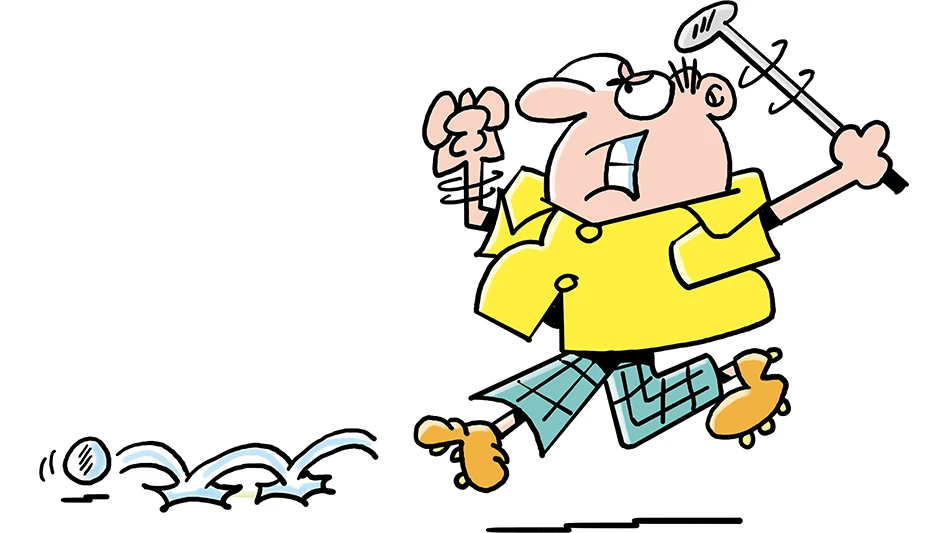
They’re out, waving Scotty Camerons, demanding answers about wilted turf and tamer green speeds, and wondering why their course exhibits discoloration. The warped ones are using ChatGPT to learn what went wrong or Google Earth to compare conditions among neighboring golf courses.
Too much information leads to nonsense, especially when the uncontrollable becomes consuming.
Such is turf life in 2025. Job pressures amplify when the weather, people, technology or macroeconomics get weird. Answers, at least according to the warped ones, reside on devices inside pockets. Trained professionals understand why conditions in 2025 might not resemble previous years. But warped people don’t know what they don’t know.
Who should explain why the course might not look or play like it did in 2024, or why the 14th green next door looks and putts a little better than the 14th green at their course?
Let’s rephrase that question: Who do you want to explain why the course looks and plays different than previous years, or why the 14th green might not be like the 14th green next door?
More than fungicide rotations, herbicide treatments, growth regulation, mowing schedules or moisture levels, how a golf industry pro escapes a year like 2025 hinges on words and optics, two areas where, sadly, portions of the industry struggle.
Emails, meetings, text messages and practice range interactions likely didn’t attract somebody to becoming a golf course superintendent. Failing to grasp the importance of these modes of communication can sour a turf optimist on a rewarding and increasingly lucrative career.
The solution to retaining goodwill among golfers during a stretch when the turf might not be as vibrant as they remember it being is straightforward. Control the club narrative with more communication.
Nobody suggests spending 11 hours per day crafting messages, responding to texts and emails, and standing on the range. But if you know something will be wrong, especially for an extended stretch, own it, explain it, and share and reshare what you’re doing to correct it. More communication means more chances to thwart 19th-hole narratives that damage reputations established through years of exhaustive and exemplary work.
Think of a year like 2025 as a tennis match. Mother Nature smacked powerful attacks that landed inside playing boundaries. That doesn’t mean unanticipated haymakers need to lead to unforced errors, which could include:
- Hibernating anywhere you won’t be spotted by a golfer. Everybody loves the coach who answers questions and relishes praise following big wins — until he or she starts ghosting supporters and critics following tough losses. Be as visible during a tough year as you were during your best year.
- Failing to respond to calls, texts and emails. Nobody can answer the tough turf questions about how uncontrollable factors impact playing conditions and experiences than a trained turf manager.
- Not exploring all available communication avenues, including email, newsletter, social media platforms, and in-person and virtual meetings, to share the behind-the-scenes story of what golfers notice on the course. Consider this another instance where more words, images, postings and engagement can induce less angst.
- Failing to ask others inside and outside your network for help. It’s very likely that the issues your course might be experiencing this year stem from substandard course infrastructure. There’s no harm in obtaining third-party documentation of those issues. Professionals who visit dozens of golf courses offer assurance you’re not the only place in town with some rough spots. Taking initiative by calling or messaging trusted confidants can help put you and your course in a fortuitous position again.
Even solid communicators and purposeful overcommunicators won’t reach everybody. We all know people who blame their Scotty Cameron for continually four-jacking flat greens.
Fortunately, reasonable masses far outnumber warped foursomes. Diligence with written and spoken words should help put an agronomic year like 2025 in the past.
Guy Cipriano is Golf Course Industry’s publisher + editor-in-chief.
Latest from Golf Course Industry
- Tartan Talks 116: Doug Smith
- Audubon International adds 127 golf courses to Monarchs in the Rough
- USGA’s GAP preps for fourth year
- Protect your vehicles from rodent damage
- VIDEO: Fun with fairways
- From the publisher’s pen: Humble giving
- Syngenta adds two to western U.S. team
- The Aquatrols Company introduces soil surfactant for Canada