Braden Hanson Photography
A booklet rested on the counter of a Georgia pro shop throughout 2021. Whenever staff at Champions Retreat fielded a question – or handled a misconception – they referred the inquisitor to the thoroughly researched document.
Flip a page. See the names of prominent Southeast golf facilities supporting TifEagle Bermudagrass greens. Flip another page. See more names.
All in a member’s hand. All to reinforce a significant business decision: converting 27 greens from bentgrass to TifEagle.
Champions Retreat doesn’t reside in Just Anywhere, Georgia. It operates 15 miles from the most heralded course in the world with bentgrass greens. Champions Retreat even helps host a global tournament with its famous neighbor. Since the event’s inception in 2019, Champions Retreat has served as the first- and second-round site of the Augusta National Women’s Amateur. The first two versions of the event – the tournament was cancelled in 2020 – were conducted entirely on bentgrass greens. The third version, which begins March 30, will feature two rounds on Champions Retreat’s new TifEagle greens.
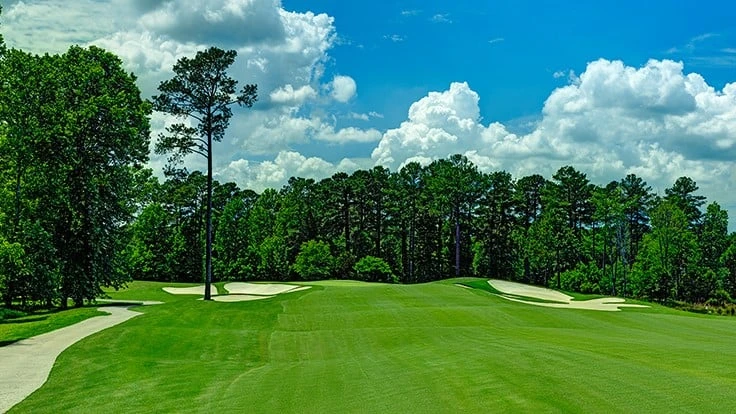
Through the heat of last spring, summer and early fall, superintendent Craig Walsh and the Champions Retreat team hustled to convert the greens on its Bluff, Island and Creek nines to TifEagle. The Bluff and Island, designed by Jack Nicklaus and Arnold Palmer, respectively, are used for the Augusta National Women’s Amateur. Gary Player designed the Creek nine.
Turf and high-level greens can be a perplexing mix in the Transition Zone. Champions Retreat opened in 2005 with Jones Dwarf Bermudagrass greens that lasted just 18 months before the club opted for bentgrass. The Jones Dwarf, though, proved pesky as it competed with the bentgrass, according to general manager Cameron Wiebe.
“While a true stand of bentgrass can last 15 to 20 years, it was in constant competition with this old grass that wasn’t fully eradicated,” Wiebe says. “We started to get some real contamination issues. We’re certainly a seasonal club and in the heat of summer maintaining bentgrass is stressful enough. It was coupled with competition that was introduced from this previous grass and we were losing that battle.”
Walsh, a veteran of the Transition Zone private club turf scene, arrived in late 2019 and documented the growing struggles throughout the summer of 2020. Walsh, Wiebe and director of golf Mike Rymer researched options to present to ownership. Their search for a practical and high-performing turf variety for the club, which experiences spikes in play and member activity in spring and fall, led them to TifEagle.
“It’s tried and true,” Walsh says. “It has been around for a long time, and it has stayed pure for many years vs. the other ultradwarfs. We didn’t want to take the risk of some of the contamination you’re seeing with other ultradwarfs. We wanted to take that out of equation. We kept coming back to the TifEagle.”
The bentgrass vs. Bermudagrass discussion has shifted over the past decade, as more facilities’ members see splendid putting conditions on ultradwarf surfaces on television and experience them in their travels. For remaining bentgrass-or-nothing believers, there was the booklet.
“Certainly, there’s an emotional connection to bentgrass,” Wiebe says. “People had that question, ‘Wait, we’re going away from bentgrass?’ because there’s this perceived perception of what bentgrass is in terms of excellence. But our members also had the opportunity to see bentgrass when it’s not performing. It was a short conversation. They lived that conversation with us. We did a lot of research to show what other great clubs, especially here in the Southeast, have TifEagle. They start to see the names of some of those clubs and it’s like, ‘Those are places that aren’t sacrificing excellence, either.’ Maybe 20 years ago we would be having a different conversation.”
While perceptions surrounding different turf varieties are changing, the rigors of a renovation are unyielding. Neither acquired knowledge nor technology have made the process easier for practitioners. Ownership approved the work in February 2021 and the conversion commenced May 10 on the Bluff. It concluded Oct. 1 when the Creek reopened. Champions Retreat is part of a 1,500-acre community and a portion of membership uses the club year-round, so the club kept either nine or 18 holes playable throughout the project.
“That’s where Craig’s team was tested,” Wiebe says. “Not only do you either have one or two nines closed for a project, which has its own challenges with a really aggressive timeline, but we have expectations in terms of performance and daily operations on the other nine or 18. They did an amazing job of balancing those two things.”
The conversion, according to Walsh, was executed via a process that involved removing two to three inches of turf and greens mix, fumigating the surface and tilling new sand into the profile. The TifEagle was installed via sprigging, a process Walsh used at a previous club. Walsh engaged a cadre of professors and industry professionals to help him build an agronomy play for the grow in. His team also received an assist from the most volatile component of a renovation. “Mother Nature was great,” he says. “We made our plant dates without any thunderstorms that impacted the grow in.”

The Bluff reopened July 1. Calming Wiebe as the nine’s unveiling to the membership approached developed into one of Walsh’s non-turf tasks. “We had stress because I’m the one that didn’t have the education,” says Wiebe, referring to his construction and grow-in experience. “Craig said, ‘Don’t worry about it. This is good. It’s going to turn out nicely.’ If you saw this process, we were at one point three weeks from when we thought we were going to open in July and I looked at it and I thought, ‘That’s dirt. We’re not playing on that.’ When they started to grow out, you can’t believe how quickly they become a puttable surface.”
After the grow in of two more nines, Champions Retreat had all 27 holes open for the peak fall season. Walsh and his team nurtured the greens during the TifEagle’s first winter, raising the height of cut. A few 80-degree days in February added to the excitement surrounding the Augusta National Women’s Amateur. The spring showcase means Champions Retreat will become the rare course to host televised tournaments in consecutive years with different turf species on its greens.
“I’m very pleased with the situation we have right now,” Walsh says. “We’re very fortunate and they are only going to get better.”
Based on early returns and its expanding profile as a key site in women’s golf, Champions Retreat will now be listed in somebody else’s pro shop literature.
“This is a serious undertaking,” Wiebe says. “It’s very expensive. It’s a lot of human capital for your team. There’s some understanding that needs to happen from a membership. You put yourself under a microscope real quick and it takes you about a year to live through that.”
Guy Cipriano is Golf Course Industry’s editor-in-chief.
Latest from Golf Course Industry
- Tartan Talks 116: Doug Smith
- Audubon International adds 127 golf courses to Monarchs in the Rough
- USGA’s GAP preps for fourth year
- Protect your vehicles from rodent damage
- VIDEO: Fun with fairways
- From the publisher’s pen: Humble giving
- Syngenta adds two to western U.S. team
- The Aquatrols Company introduces soil surfactant for Canada