Courtesy of Starline, a Legrand company
Golf courses across the country are facing an infrastructure problem that has little to do with turf, drainage or tee times. As facilities increasingly adopt electric cart fleets and transition to modern, battery-powered maintenance equipment, many are discovering that the real challenge lies in their power distribution systems. The electrical layouts that once supported a handful of chargers are now being overwhelmed with the power needs of dozens of carts, an array of landscaping and turf maintenance equipment, and ever-evolving lithium-ion battery technologies.
This is a growing challenge for golf course superintendents that will only get worse. The golf course maintenance robot market alone is expected to double from $286.4 million in 2025 to $607 million by 2035. Golf cart and maintenance facilities, however, are usually at the bottom of the list of capital improvement projects. Money tends to first go to investments that enhance the customer experience, such as clubhouse renovations or course improvements. The maintenance facility and the cart barn, on the other hand, are often out of sight, out of mind. Not only are these buildings often decades old, they also were not designed for today’s demands, creating significant hurdles in managing the inevitable shift from gasoline.
The answer to meeting the immediate and future power needs in these facilities is overhead track busway systems. They offer a practical, flexible and scalable alternative to the rigid constraints of conventional conduit and wire, giving superintendents more control over their operations and future-proofing their facilities against the total operational costs of gasoline and fixed wiring.
What’s driving the change to electric
The gas to electric transformation starts with advancing battery technology. Lithium-ion technology has rapidly improved, allowing longer runtimes, faster charging and higher power density to tackle demanding turf tasks that once required combustion engines.
At the same time, manufacturers are sending a clear signal about where the industry is heading. Major brands are steadily phasing in hybrid and fully electric drivetrains across their product lines.
The benefits of going electric are numerous, particularly for grounds crews and golf course operations. Air pollution is no longer a concern, creating a noticeably cleaner and safer environment. Likewise, noise pollution is eliminated. This is a major advantage because it allows ground crews to get started in the early morning hours without negatively impacting nearby residential areas.
Then there are practical, everyday efficiencies. Eliminating gasoline removes an entire layer of logistics — no more handling fuel, no more storage concerns, no more compliance headaches. What used to be an everyday operational chore becomes one less thing to think about.
The infrastructure bottleneck: When old facilities meet new technology
The key barrier to fully electrified operations is the disconnect between legacy electrical design and modern operational needs. Superintendents are expected to run large electric cart fleets, and grounds crews are beginning to transition to battery-powered equipment — from mowers and sprayers to utility vehicles. What’s more, autonomous food and beverage delivery robots are delivering on-course refreshments while electric caddies are following golfers around with their clubs in tow.
In older barns and maintenance buildings, the existing electrical infrastructure simply cannot support today’s modernized charging requirements. Attempting to extend charging capabilities with outdated infrastructure often leads to:
- Labor waste and cart rotation: Barns were not designed with electric golf carts in mind, and often require rotation to cycle all carts through limited charging stations.
- Safety hazards and inefficient use of space: Limited outlets and fixed wiring lead to excessive use of extension cords and inflexible layouts, putting carts and equipment in the way of efficient movement of equipment and staff.
- High costs of change: Making a simple change — like adding a few new outlets — requires calling in an electrician and incurring high labor costs and potential multi-day disruptions.
Even facilities that could otherwise be considered state of the art face serious limitations due to the rigid nature of traditional power distribution with pipe and wire. They’re unable to adapt to future needs as more gasoline-powered equipment is replaced with electric counterparts. Even if there are enough outlets available, they’re in fixed locations, which leaves them unable to change their layout as conditions change.
The busway solution: Flexible power on demand
Conventional pipe and wire solutions are inherently rigid systems that require outside support to make even simple modifications. The solution lies in moving away from a fixed power supply toward a continuous, modular system: track busway.
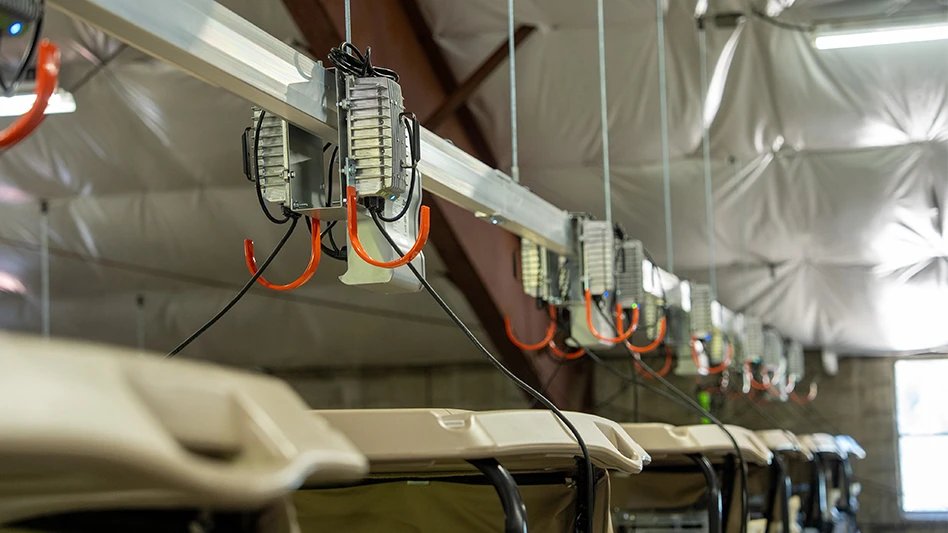
A busway system provides an overhead electrical track or channel that runs the length of the cart barn or maintenance facility. This track contains the live conductors, offering continuous electrical access along its entire path. Power is delivered via plug-in units that connect directly into the channel at any point, providing power where it is needed, without the need for rewiring or tapping into the main conduit system.
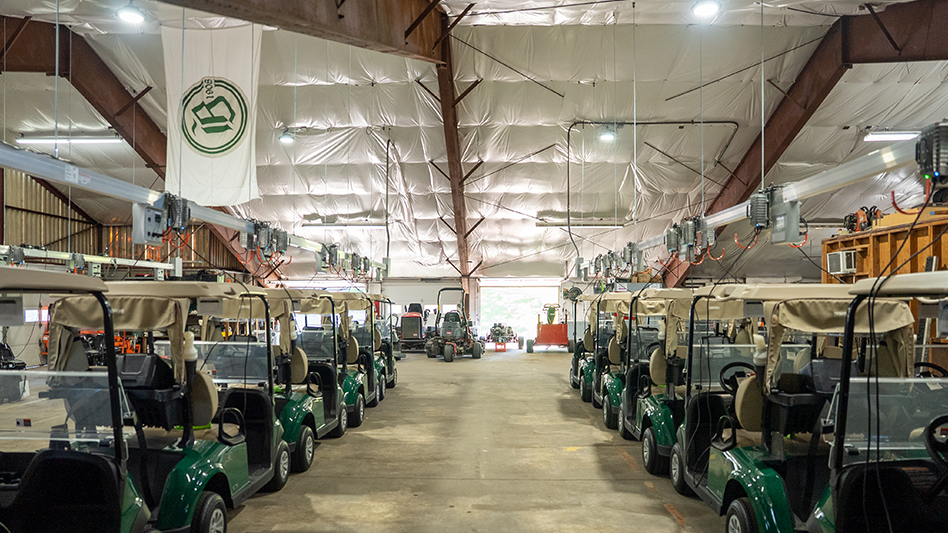
This busway approach transforms the superintendent’s ability to manage space and equipment. Track busway provides maximum flexibility and resilience through:
- Modularity and scalability: Unlike conventional wiring —where an outlet’s location is permanent— a busway system allows superintendents to reconfigure layouts and move power outlets in minutes. If a club expands its cart fleet, the electrical system can scale up instantly by simply adding more plug-in units to the existing track. This modularity makes fixed-access power distribution obsolete.
- Enhancing safety and simplifying layouts: By installing the busway overhead, all power cords and distribution lines are lifted off the floor, reducing tripping hazards, improving clearance and use of space. Furthermore, customizable charger mounting brackets enable facilities to hang chargers directly from the busway.
- Resistance to moisture: In the golf industry, power distribution must account for the presence of moisture. Cart barns and maintenance facilities often include spray-down areas. Ruggedized busway systems are designed to address this with robust casings that are sealed and gasketed to achieve a high degree of ingress protection, such as IP54, ensuring the system can operate safely and reliably even near water or moisture-prone zones.
Immediate benefits, dividends down the road
The implementation of a busway system is not merely an electrical upgrade; it’s a strategic investment that yields measurable returns in time, labor and capital.
For facilities managers and superintendents, the installation advantage is clear: busway’s modular design minimizes installation time, disruptions, and labor costs compared to running new rigid conduit and wire. A typical system can be installed in one to two days with minimal disruption to the club’s daily operations. The system’s modularity also ensures future changes are fast and cost-effective.
Beyond installation, busway transforms power delivery into a flexible, scalable solution. Track busway provides universal power access, supporting not only golf cart charging but the entire fleet of electric equipment, including utility vehicles, mowers and leaf blowers, and small shop tools.
For golf courses planning the shift to electric carts and equipment, busway is an essential piece of infrastructure. It provides a simple pathway for future expansion, avoiding the costly rebuilds associated with fixed conventional wiring. As autonomous technology, such as robotic mowers and robo caddies, becomes more prevalent, busway’s scalable power backbone will be ready to support growing power demands. In short, busway is more than power—it’s a future-proof strategy for managing operational efficiency and evolving technology.
Golf legend Gary Player once quipped, “Golf is a puzzle without an answer.” The same could be said about maintaining and operating a course. It’s a never-ending process subject to the whims of Mother Nature. That’s why it’s critical to control the things you can control.
Ben Kushner is a product manager for Starline, a brand of Legrand, specializing in flexible power distribution solutions for commercial and industrial applications, including golf facilities.
Latest from Golf Course Industry
- VIDEO: 'It's their livelihood'
- Reel Turf Techs: TJ Vollmar
- Bernhard and Company names G.C. Duke as North American Distributor of the Year
- Course at Sewanee picks KemperSports for management
- WiTricity expands wireless charging technology
- Shining star
- SiteOne Landscape Supply acquires Reinders
- Talking Turf Weeds 17: Waking up your course after winter with Yusif Jaouni and Matt Herrmann