Courtesy of Ron Furlong
I never had a very good relationship with bunker rakes. Safe to say we (bunker rakes and I) got off on the wrong foot. We’ve never really recovered since.
As many of us know, the first place a new golf course maintenance worker often starts is in the bunkers. Which, in itself is odd, as bunker conditioning tends to be one of the things golfers notice the most on a golf course, often only behind the condition and speed of the greens. But, for whatever reason, bunker maintenance seems to be treated as the dregs of course conditioning.
As a new golf course worker 32 years ago, and a new Bunker Tech (let’s give the job a proper title), I immediately discovered a couple things about bunker rakes and their relationship to golfers. One, they are quite often completely ignored by golfers, who leave the bunker with their lasting footprints behind as an obvious, fairly obnoxious testament to this. And two, if they are actually used by the golfer, they are more often than not placed in the wrong location. Most golf course have decided on a specific policy for where to place the rake after use, either back in the bunker or along the edge outside of the bunker. The USGA has decided it is up to each golf course to decide which of these two to use on their course. Bunker stickers are usually placed on the rake to tell the golfer which of these two to abide by. At our course, we ask the golfer to place the rake outside the bunker. Guess where they most often end up? I’ll give you a hint: it’s not outside the bunker. And funny enough, when I’ve worked at courses that asked the golfer to put the rake inside the bunkers, of course, they mostly ended up outside the bunkers. Ugh.
These two things, golfers not using the rakes at all, or placing them where we (the golf course) don’t want them, have stayed in my thoughts over these last 32 years. It’s brought me to a place in my mind of not particularly caring for bunker rakes on the golf course. Or, to be completely truthful here, even believing bunkers themselves don’t really need to be on a golf course.
If you think about it, when golf first came into being back in Scotland hundreds of years ago, the bunker was a very different thing than it is now. On those first golf courses, including at the home of golf, St. Andrews, sand blew across the course and would end up in pits that became known as bunkers. They were not manicured or well-maintained hazards. They were rugged and more than anything they were natural. They were a part of the land. They were not the artificial, man-made, overly manicured, expensively maintained, often grossly overbuilt things they have become today.
However, I am not naïve enough to think bunkers are miraculously going to disappear from golf courses in the future. They are, whatever your feelings about them, here to stay. But that doesn’t mean the way we maintain them or, to be more to the point, the use of (or need for) the bunker rake itself cannot change.
One of the byproducts of this summer of COVID-19’s result on golf courses – and golf course maintenance in particular – has been the removal of bunker rakes from most golf courses. The reason for this is obviously to remove as many touchpoints as possible for people playing the game. Just as we’ve modified flagsticks, and removed ball washers, water coolers and other touchpoints on the course, bunker rakes have been gathered and stored in the maintenance shed.
As you can no doubt guess, when we removed the bunker rakes from our course here in western Washington, I most certainly did not shed a tear. I have welcomed with open arms the removal of bunker rakes from the course.
This summer of no bunker rakes has been a great trial for me in seeing how our bunkers have fared without rakes. And the results of this trial are fairly thrilling to me. As I’ve suspected all along, golf courses really don’t need bunker rakes.
Even with bunker rakes on the course, consider only about half the golfers at best were actually walking over to a rake, bending over to pick it up and even then only making a half-hearted attempt (we’ve all seen the one handed chicken scratches) at smoothing out their footprints. Bunkers, with rakes available, were a mess at the end of the day. A golfer landing in a bunker, especially by the end of busy day, was almost as likely to land in a footprint before rake removal as they are now without the rakes on the course.
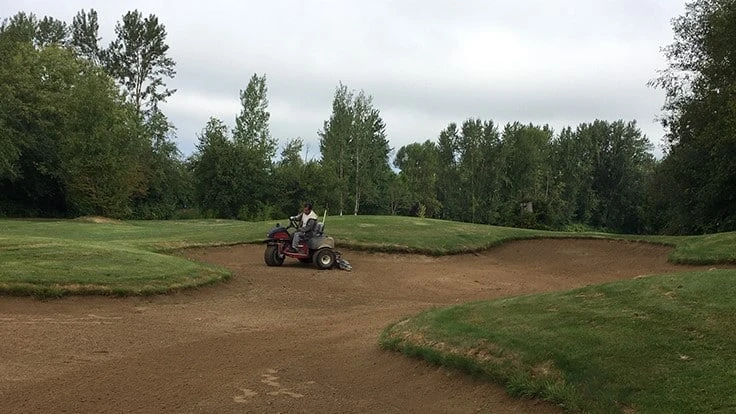
The wonderful removal of the rakes has not made the bunkers much different than they were before we all happily pulled them from the course in late spring. Maintenance crews still all rake them with trap rakes in the morning. Their outcome at the end of the day has changed little.
What has changed is less money spent on replacing rakes, as well as labor time spent moving the rakes to their proper location. But perhaps the No. 1 advantage to no rakes on the course is this little gem: Bunker rake removal has sped up the game. That fact alone should be enough to keep rakes from returning to the course.
It is an understatement to say this has been a tough year. It has been the most challenging year most of us have endured. But finding something positive in this year of negativity can mean so much. For me, and I think for the game of golf, perhaps, we’ve stumbled upon a little something positive going forward: No more bunker rakes.
At least I can dream …
Ron Furlong is the superintendent at Avalon Golf Links, a 27-hole daily-fee facility in Burlington, Washington, and a frequent Golf Course Industry contributor.
Latest from Golf Course Industry
- Tartan Talks 116: Doug Smith
- Audubon International adds 127 golf courses to Monarchs in the Rough
- USGA’s GAP preps for fourth year
- Protect your vehicles from rodent damage
- VIDEO: Fun with fairways
- From the publisher’s pen: Humble giving
- Syngenta adds two to western U.S. team
- The Aquatrols Company introduces soil surfactant for Canada