Officials at the venerable course are adding finishing touches for the U.S. Senior Open. They hope to attract another major tourney soon.
The 25th U.S. Senior Open at Bellerive Country Club will be the first played on a course as long as 7,117 yards. The championship will be the first played on fairways carpeted with zoysia grass. Perhaps most importantly, for Bellerive and the golf community in St. Louis, it could be the first of more major championships to come.
"Bellerive made it part of its mission statement in the mid-1990s," said Jerry Ritter, Senior Open tournament chairman. "Our objective is to bring a major championship event periodically to St. Louis. We don't define periodically, but I think you can interpret that as every five to 10 years."
When Bellerive agreed to host the 2001 World Golf Championships-American Express Championship, it did so on a spontaneous basis. A change in WGC plans opened a window of opportunity and the club jumped in. That window closed in tragic fashion when the World Trade Center buildings were attacked on Sept. 11, 2001, the Tuesday of tournament week. The event was canceled just as it was beginning.
But the Senior Open on July 29 through Aug. 1 has been on the radar since the fall of 1999. The embracing of this USGA championship has been more calculated, more strategic. "This is the one we've really been planning and looking forward to," said course superintendent Tony Mancuso, who came to Bellerive in December 1998. "This is the reason that I came to Bellerive."
The Senior Open is a treasured jewel, but it also is a seed planted to produce more fruit. It has been nearly 40 years since Bellerive conducted the 1965 U.S. Open, won in a playoff by Gary Player. Bellerive also hosted the 1992 PGA Championship.
The club makes no secret of its dreams of presenting another major tourney, or to do so more frequently, and has submitted an application to host a U.S. Open, with 2011 being the first possible date.
"We have made an application for a future event and they're aware of it," Ritter said. "You usually get an indication one way or another on these things, and we have not had any negative response. I think it's fair to say we are being considered in a positive way."
In town for the Senior Open media day on Monday at Bellerive, USGA president Fred Ridley offered no commitments, but no discouraging words either.
"There have been a number of Senior Open venues that have hosted U.S. Opens," said Ridley, 51, who played in the 1981 U.S. Mid-Amateur Championship at Bellerive. "But that's a process that stands on its own. As big as a Senior Open is - and it's a big event - it's measurably smalle r than the U.S. Open, and those are things that have to be considered.
"But certainly the primary issue with the U.S. Open, the first thing the USGA looks at, is the quality of the golf course and whether it will test the best players in the world. I think through the years Bellerive has shown it will do that."
In less than two months, the stately 18-hole layout will test the best 50-and-older players in the world. That group will include Hale Irwin, Tom Watson and Gary Player. The field will bring new senior stars such as Belleville native Jay Haas, Craig Stadler and Fuzzy Zoeller. The field will have legendary stars, perhaps Jack Nicklaus and Arnold Palmer.
With the events of 2001 unforgotten, with a USGA plum and emotional do-over visible on the horizon, and with long-range aspirations riding on the event, Bellerive is poised to put its best foot forward.
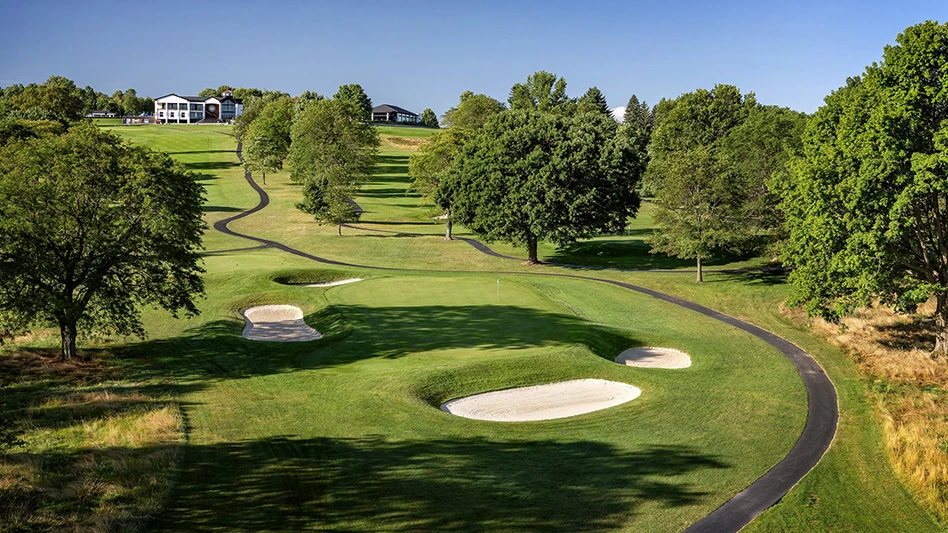
Mancuso and his staff, which includes agronomy interns from Australia and England, have removed nearly 100 trees, replenished and rehabbed sand bunkers, pampered greens, tucked fairways and applied superintendent science to put Bellerive into pristine shape. The golf course was peaking for the American Express Championship three years ago. Weather cooperating, it should be equally robust come late July.
Tim Moraghan, USGA director of championships agronomy, was on site on Monday and found Bellerive in fighting shape.
"I think it will be an excellent test of golf," he said. "The course is wonderfully conditioned. It is very close to being tournament ready right now."
All that remains is eight weeks of sod maturation and about 6,000 ground passes to sell.
Plenty of attention has been given to aesthetics, but the USGA has asked for few modifications to the actual playing surface that weren't in place by 2001.
"They have not 'told' us to do anything," Mancuso said. "The USGA has been extremely cordial to work with and the suggestions they have made have made a lot of sense for the future of the golf course. I really do think they have an interest in making sure the golf course they leave behind is better than it was when they got here."
There have been no radical changes for tees, greens or bunkering. The most significant tinkering has involved the narrowing of fairways, which have been squeezed as tight as 20 yards in some spots. Changing the width of the fairways was no small undertaking because the fairways are zoysia grass, while the perimeter rough is a mix of fescue. One grass had to be removed and another implanted.
In 1965, a brand-new Bellerive was labeled as "massive and merciless" by Time magazine. By today's standards and with today's technology, the Robert Trent Jones design isn't quite as imposing. Still, it will be the longest path contested by a Senior Open field - a par-71 with three par-5s from 545 to 575 yards and four par-3s from 148 to 225 yards.
By tournament time, the USGA wants green speeds to run in the 12-foot range on the stimpmeter and the "U.S. Open rough" to be soupy thick.
"They will get them at 12 before the tournament starts and then they'll just let them go," said defending Senior Open champion Bruce Lietzke. "By Sunday afternoon Aug. 1, the greens will be lightning fast and they have just the right amount of undulation to make them seem even faster."
Source: St. Louis Post Dispatch
Latest from Golf Course Industry
- Tartan Talks 116: Doug Smith
- Audubon International adds 127 golf courses to Monarchs in the Rough
- USGA’s GAP preps for fourth year
- Protect your vehicles from rodent damage
- VIDEO: Fun with fairways
- From the publisher’s pen: Humble giving
- Syngenta adds two to western U.S. team
- The Aquatrols Company introduces soil surfactant for Canada