Sometimes the bees can benefit a golf facility’s mission more than birdies or pars.
Jay Neunsinger is in his second year as the superintendent at Boundary Oak Golf Course, a municipal facility in Northern California’s East Bay. Looking to bolster the course’s already strong environmental reputation – Boundary Oak was designated a certified Audubon Cooperative Sanctuary in 2012 – and improve the game at the entry levels, Neunsinger explored the possibilities associated with a skill he started developing before arriving at Boundary Oak.
With the help of a volunteer marshal and self-taught beekeeper from his previous course, Carla Filippone, Neunsinger works with two other Bay Area courses to establish hives with sales of honey harvested benefitting Bay Area junior golf programs. The hives and pollinator areas Neunsinger has established since arriving at Boundary Oak are an extension of the core values promoted by the facility’s operator CourseCo with support from the course’s owners, the City of Walnut Creek, Neunsinger says. The partnership between CourseCo and the City of Walnut Creek harbors the commitment of community inclusion. Boundary Oak also has a junior-friendly reputation with the First Tee of Contra Costa, the LPGA/USGA Girls Golf, and the City of Walnut Creek Junior Golf Camp programs running at the course.
Funds from the honey sale will benefit multiple Bay Area junior programs. The initial windfall is expected to be modest, but Neunsinger has spoken with area superintendents who want to establish hives in 2017.
“We thought that maybe by selling the honey produced at the courses we could help some of the junior programs so they are not struggling for supplies or equipment to enhance their programs,” Neunsinger says. “Let’s say it’s $500 to start for a couple of organizations, that would be pretty cool. We are running with the idea and it has the potential to raise a lot more money while also providing opportunities to teach the kids about the importance of bees while teaching golf.”
Neunsinger considers the effort a “mom and pop” operation. His interest in beekeeping stemmed from reading articles about the benefits of pollinators and with Filippone’s help, they used a demonstration hive to introduce the importance of bees to a group of high school students participating in an Oakland Turfgrass Education Initiative study tour. To pique his own curiosity, Neunsinger attended free classes, joined a local beekeeper society and worked with Filippone to set up multiple hives and get hives donated by beekeepers living near Boundary Oak.
Boundary Oak has three hives, all located near the maintenance facility wash pad. Neunsinger says the equipment needed to establish hives costs less than $400, and he tells other superintendents the time commitment is minimal.
“It’s an absolute piece of cake,” he says. “There are many free classes I have attended to listen about native bees, pollinators and honey bees. The one thing I have always taken home is that if you have a hive, don’t try to mess with it too much. I think a lot people feel like it’s this harboring hobby where they always have to check on their hive and see what their bees are doing. I get in there once a month. It takes me 30 minutes. I pop my head in and see what they are doing.”
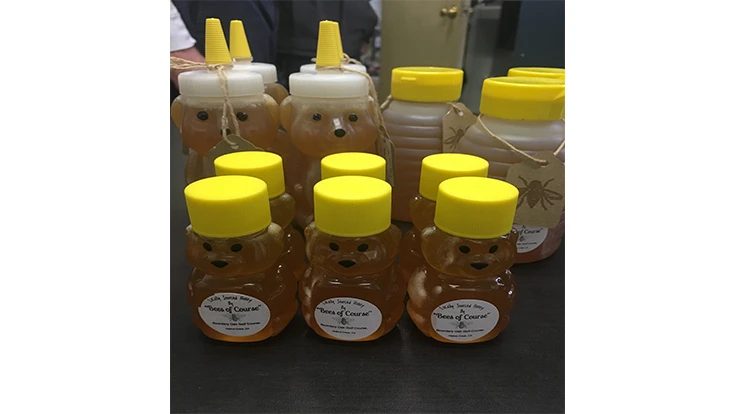
The hives produced 80 pounds of honey this fall, a total Neunsinger expects to increase as Boundary Oak obtains additional hives and he becomes a more experienced beekeeper. The honey is packaged in bear-shaped jars he received from an uncle living in Minnesota who works for a plastics company. The jars are sealed and labeled, and children will sell the honey at on-course stands during a pair of upcoming events benefitting Bay Area junior golf programs. A long-range goal involves collecting enough honey to sell the sweet substance at local farmers’ markets.
“I would like to expand it,” says Neunsinger, who recently received the ELGA chapter award for Northern California. “Right now we are at the beginning stages. The more golf courses we can get online, the easier it would be to have a volume available for purchase.”
Guy Cipriano is GCI’s associate editor.
Jay Neunsinger is in his second year as the superintendent at Boundary Oak Golf Course, a municipal facility in Northern California’s East Bay. Looking to bolster the course’s already strong environmental reputation – Boundary Oak was designated a certified Audubon Cooperative Sanctuary in 2012 – and improve the game at the entry levels, Neunsinger explored the possibilities associated with a skill he started developing before arriving at Boundary Oak.
With the help of a volunteer marshal and self-taught beekeeper from his previous course, Carla Filippone, Neunsinger works with two other Bay Area courses to establish hives with sales of honey harvested benefitting Bay Area junior golf programs. The hives and pollinator areas Neunsinger has established since arriving at Boundary Oak are an extension of the core values promoted by the facility’s operator CourseCo with support from the course’s owners, the City of Walnut Creek, Neunsinger says. The partnership between CourseCo and the City of Walnut Creek harbors the commitment of community inclusion. Boundary Oak also has a junior-friendly reputation with the First Tee of Contra Costa, the LPGA/USGA Girls Golf, and the City of Walnut Creek Junior Golf Camp programs running at the course.
Funds from the honey sale will benefit multiple Bay Area junior programs. The initial windfall is expected to be modest, but Neunsinger has spoken with area superintendents who want to establish hives in 2017.
“We thought that maybe by selling the honey produced at the courses we could help some of the junior programs so they are not struggling for supplies or equipment to enhance their programs,” Neunsinger says. “Let’s say it’s $500 to start for a couple of organizations, that would be pretty cool. We are running with the idea and it has the potential to raise a lot more money while also providing opportunities to teach the kids about the importance of bees while teaching golf.”
Neunsinger considers the effort a “mom and pop” operation. His interest in beekeeping stemmed from reading articles about the benefits of pollinators and with Filippone’s help, they used a demonstration hive to introduce the importance of bees to a group of high school students participating in an Oakland Turfgrass Education Initiative study tour. To pique his own curiosity, Neunsinger attended free classes, joined a local beekeeper society and worked with Filippone to set up multiple hives and get hives donated by beekeepers living near Boundary Oak.
Boundary Oak has three hives, all located near the maintenance facility wash pad. Neunsinger says the equipment needed to establish hives costs less than $400, and he tells other superintendents the time commitment is minimal.
“It’s an absolute piece of cake,” he says. “There are many free classes I have attended to listen about native bees, pollinators and honey bees. The one thing I have always taken home is that if you have a hive, don’t try to mess with it too much. I think a lot people feel like it’s this harboring hobby where they always have to check on their hive and see what their bees are doing. I get in there once a month. It takes me 30 minutes. I pop my head in and see what they are doing.”
The hives produced 80 pounds of honey this fall, a total Neunsinger expects to increase as Boundary Oak obtains additional hives and he becomes a more experienced beekeeper. The honey is packaged in bear-shaped jars he received from an uncle living in Minnesota who works for a plastics company. The jars are sealed and labeled, and children will sell the honey at on-course stands during a pair of upcoming events benefitting Bay Area junior golf programs. A long-range goal involves collecting enough honey to sell the sweet substance at local farmers’ markets.
“I would like to expand it,” says Neunsinger, who recently received the ELGA chapter award for Northern California. “Right now we are at the beginning stages. The more golf courses we can get online, the easier it would be to have a volume available for purchase.”
Guy Cipriano is GCI’s associate editor.
Latest from Golf Course Industry
- Tartan Talks 116: Doug Smith
- Audubon International adds 127 golf courses to Monarchs in the Rough
- USGA’s GAP preps for fourth year
- Protect your vehicles from rodent damage
- VIDEO: Fun with fairways
- From the publisher’s pen: Humble giving
- Syngenta adds two to western U.S. team
- The Aquatrols Company introduces soil surfactant for Canada