Guy Cipriano (2)
I can’t stop staring at two pictures on my phone. Trust me, it’s not what you think.
On a dreary, late-May afternoon in Mendota Heights, Minnesota, a desirable inner-ring Twin Cities suburb, I spent an hour watching machines collect yellow balls from the compact Mendakota Country Club practice range. The hour wasn’t consumed in solitude, as two Toro officials and Mendakota superintendent Tom Schmidt joined the observational exercise.
We chatted behind evergreen trees lining the left side of the range. Upper Midwest denizens represent a hearty lot — light drizzle and temperatures in the low 50s don’t alter golf plans — so balls inundated the range for the entire hour. Golf fact: 31 percent of Minnesota households have at least one golfer, according to the Minnesota Golf Association.
The trees provided enough cover to stay safe and allowed us to be within 20 feet of a platform where a Toro Range Pro 100 dispenses balls into a collection bin. The platform also supports a charging station for the unit. The Range Pro 100 operated continuously throughout the hour, only straying from collection routes to dump balls into the bin.
The Range Pro 100 is an autonomous ball picker. Toro debuted the ground-level machine earlier this year alongside the Turf Pro 300/500, a similar-sized autonomous mower. As we watched the Range Pro 100 collect balls at Mendakota, we viewed maps and data on a mobile app from autonomous machines operating elsewhere. The real-time activity demonstrated Minnesotans aren’t the only golfers who enjoy hitting hundreds of balls at 2:45 on a weekday afternoon.
Neither engine nor golfer noise accompanied the ball picker’s shift. The machine is all-electric; golfers would rather discuss golf swings and playing experiences than machines.
But that doesn’t mean it’s been all quiet on the range maintenance front. Members initially asked Schmidt a few questions about what they were seeing on the range:
- How many balls does it hold? Answer: Around 350.
- How many hours does it continuously work? Answer: It heads to the charging station when the battery is running low.
- How does it know when to return to the platform? Answer: When it’s full.
The best work often goes unnoticed. Machines should be invisible to golfers honing yardages and correcting ball flights. The golf swing will always be more complex than any technology spotted on the course.
Rangebots and mowbots will become a quiet, subtle part of club life in the next three to five years. I’m sure of this because of those two photos on my phone.
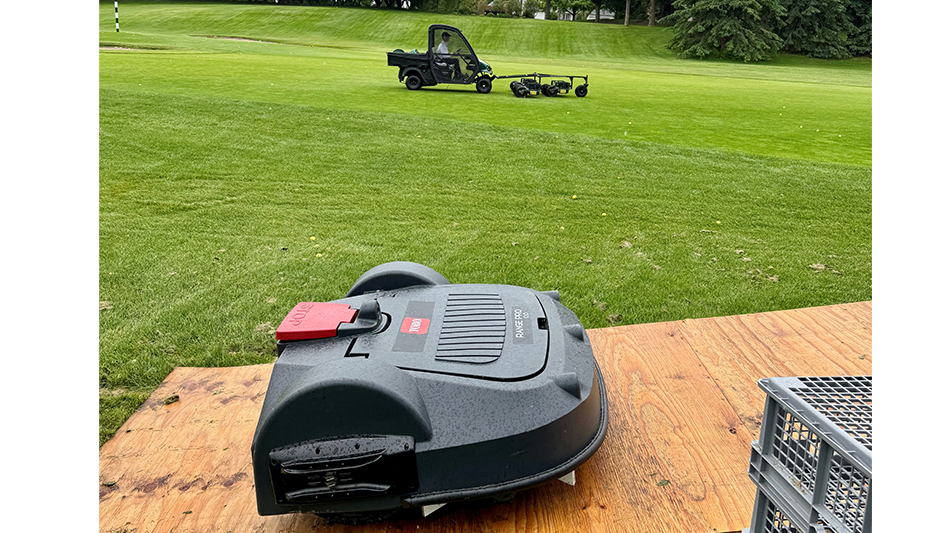
One features a Range Pro 100 returning to the platform in the foreground. A traditional riding range picker operated by a young employee lurks in the background.
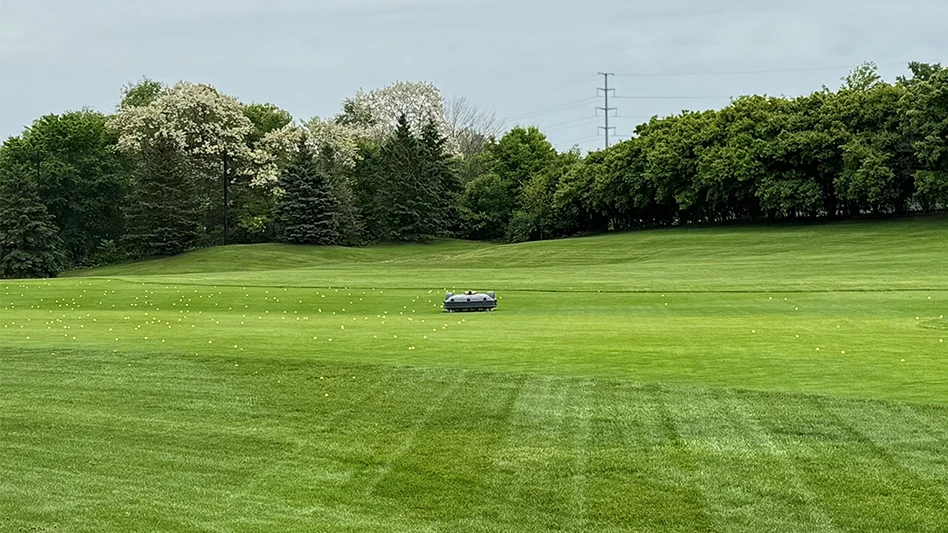
The other photo (story display image) is a wide shot of the machine at work. On the right is picked turf range. On the left is a soon-to-be picked swath.
Pictures must be worth around 350 quietly and cleanly picked range balls these days.
The photos foreshadow how emerging technology can supplant tedious practices on one part of a golf course. The possibilities become immense as more creative and curious minds study similar photos.
We’re still on the practice range of the industry’s autonomous evolution.
Guy Cipriano is Golf Course Industry’s publisher + editor-in-chief. Contact him at gcipriano@gie.net with examples of how your course is exploring or embracing technology.
Latest from Golf Course Industry
- Tartan Talks 116: Doug Smith
- Audubon International adds 127 golf courses to Monarchs in the Rough
- USGA’s GAP preps for fourth year
- Protect your vehicles from rodent damage
- VIDEO: Fun with fairways
- From the publisher’s pen: Humble giving
- Syngenta adds two to western U.S. team
- The Aquatrols Company introduces soil surfactant for Canada