Asylon
Late at night, two white lights sweep past acres of land, checking to see if doors are locked and searching for any disturbances. The source of this light is a black-and-white, futuristic device with lean robotic limbs low to the ground as it surveils the property.
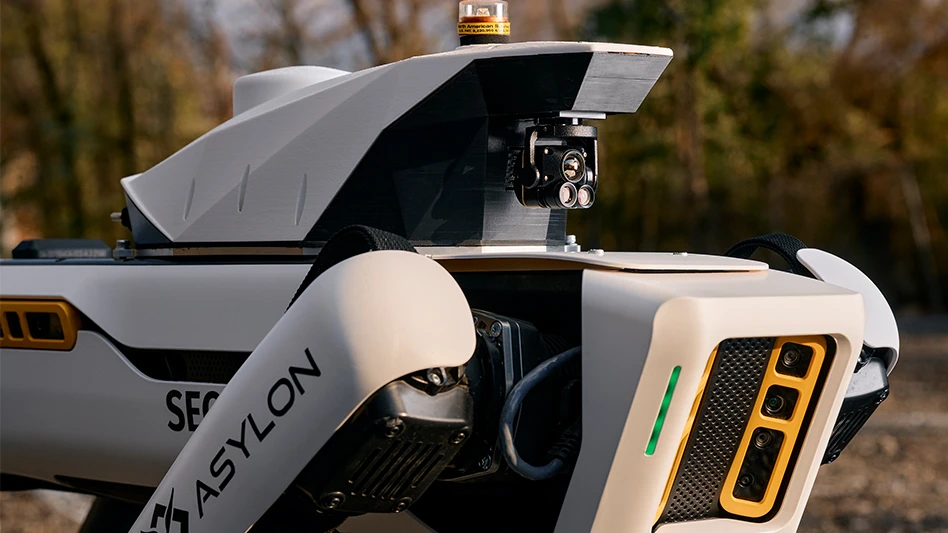
DroneDog is a robotic guard dog created by Asylon, a company providing clients with devices like drones for security purposes, and Boston Dynamics, which specializes in creating robots. It autonomously patrols properties for safety concerns.
Asylon vice president Dennis Crowley says the company is now encouraging golf courses to invest in the guard dog.
“If you have multiple security officers on site” he says, “this becomes a cost-effective solution for you because of the rising cost of labor.”
The dogs have not started working at any courses, but Crowley is talking with a few that are interested.
For expensive courses with wide stretches of acres, DroneDog can substitute existing security practices.
“Being able to deploy a dog, a DroneDog who doesn’t call in sick, doesn’t fall asleep,” Crowley adds, “that’s going to be at a lower cost than a human. You’re still getting a human in the loop. You’re just getting, in often cases, a higher skill team in the loop that is sitting in our command center.”
Though the robot can be trained to walk pre-determined routes, the Robotics Security Operations Center in Norristown, Pennsylvania, controls the dog, helping it make decisions when threats arise.
The RSOC is staffed with trained security professionals with military, law enforcement and gaming backgrounds. “All those times I yelled at my children for playing too many video games, now it’s a skillset for a future job — or not even a future job, a job now,” Crowley jokes.
When the dog is confronted with an intruder, the professional takes over, talking to them through the robot. The operator also ensures there are no false security alarms that occur.
“As it walks, it’s going from Point A to Point B, it’s recording everything it sees and does,” he adds. “The operator is looking at multiple units on there and is trained to be able to identify things that the human is good at; the robot and AI are not there yet.”
In addition to programmed inspections, DroneDog can also be instructed to surveil courses at certain times, conducting nightly rounds but none during the day when golfers are out.
From the collaboration with Boston Dynamics, the guard dog offers obstacle avoidance using infrared lights and 360 cameras, Crowley says. “The light goes out, hits, something comes back and it determines, ‘OK, this is under 16 inches in height. That’s a step. I can step over that.’”
With its stability control, the dog can withstand falls and other attacks. It is also equipped with a PupPack payload, allowing the RSOC center to send commands to any location where LTE signal can be picked up.
In addition to the PupPack, it also comes with a 20x optical zoom camera with thermal capabilities reading heat signatures, an advantage for nighttime searches.
Although DroneDog can be a new expense line item, the protection it offers as well as with Asylon’s Guardian drone, a drone that can be paired with the robotic dog, will keep courses safe, especially from a legal standpoint with recordings.
“If I spend x amount of dollars on a security guard, I’m only going to get so much value,” he says. “Now, if I spend x amount of dollars on a DroneDog, a Guardian drone or a combination of the two, the value in the return from that risk management perspective is going to be greater.”
Adriana Gasiewski is Golf Course Industry’s summer editorial assistant.
Latest from Golf Course Industry
- From the publisher’s pen: Respect the side hustle
- Super-Scratch events to expand nationally
- Beyond the Page 78: Labor solutions, AI talk and mayhem
- Construction progresses at The River Club
- VIDEO: A century of innovation
- Sentosa Golf Club preps next generation of turf pros
- Western turf leaders honored by GCSAA for advocacy efforts
- The Canary flies out of the mines