.jpg) .jpg) |
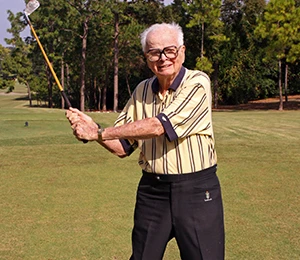
Brookfield, WI-E. Lawrence (Larry) Packard, a Past President and Fellow of the American Society of Golf Course Architects (ASGCA), died Jan. 28, 2014. He was 101. Golf industry leaders and ASGCA members are taking note of both Packard’s design work across the globe and his legacy of service to ASGCA and the profession of golf course architecture.
Packard began his golf architecture career in Illinois in the 1940s with one of the founders of ASGCA, Robert Bruce Harris. Packard started his own firm in 1954 with Brent Wadsworth. Wadsworth would go on to a successful career as a golf course builder, receiving the ASGCA Donald Ross Award in 1993.
Packard’s work included: Innisbrook Golf and Country Club in Palm Harbor, Fla., where he designed three 18-hole courses in addition to a nine-hole layout; Turnberry Country Club, Crystal Lake, Ill.; Lake Barrington Shores, Barrington, Ill.; and Countryside Country Club, Clearwater, Fla.
“Larry Packard was a pioneer in the game of golf,” ASGCA President Rick Robbins said. “Those who influenced his work date back to the 1800s, and the courses Larry designed still stand today and will for decades. Those who play the game will be positively impacted by Larry Packard for generations to come.”
Not limiting his work on more than 600 golf courses to North America, Packard also designed and renovated many courses internationally, working in countries such as Egypt, Guatemala, South Korea and Venezuela.
Born Nov. 15, 1912 in LaGrange, Ill., Packard received a Bachelor of Sciences degree from the University of Massachusetts and became an ASGCA member in 1964. The moniker “Father of the Modern ASGCA” was given Packard by former ASGCA Executive Director Paul Fullmer due to Packard’s service to ASGCA and its members. Packard was ASGCA president in 1970-71, one of the first architects to vocally address environmental concerns, an early advocate for using effluent for course irrigation.
Latest from Golf Course Industry
- Tartan Talks 116: Doug Smith
- Audubon International adds 127 golf courses to Monarchs in the Rough
- USGA’s GAP preps for fourth year
- Protect your vehicles from rodent damage
- VIDEO: Fun with fairways
- From the publisher’s pen: Humble giving
- Syngenta adds two to western U.S. team
- The Aquatrols Company introduces soil surfactant for Canada