Workers commute via ferry and barges are needed to haul supplies to Bald Head Island Club, a community on North Carolina’s southernmost barrier island. The efficient movement of people and materials are only part of the conundrum facing the team responsible for maintaining the club’s 18-hole golf course.
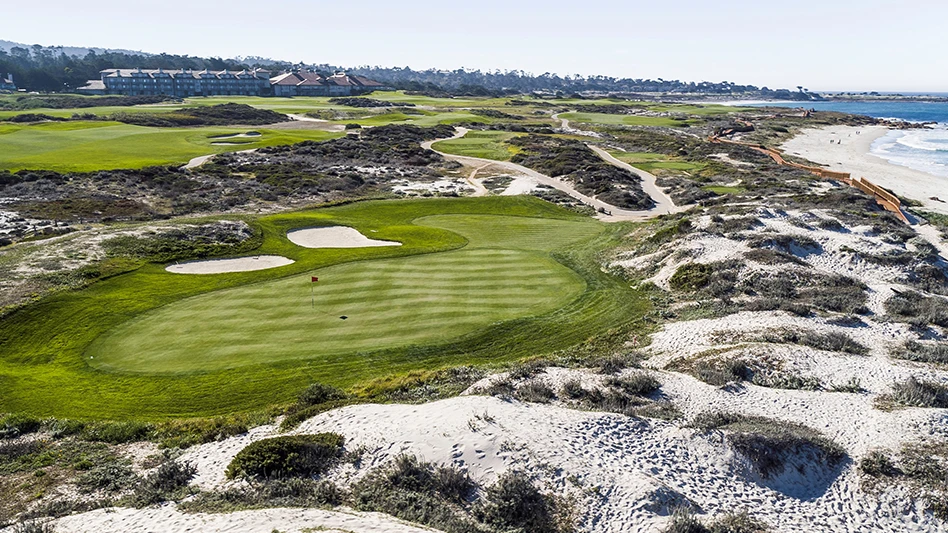
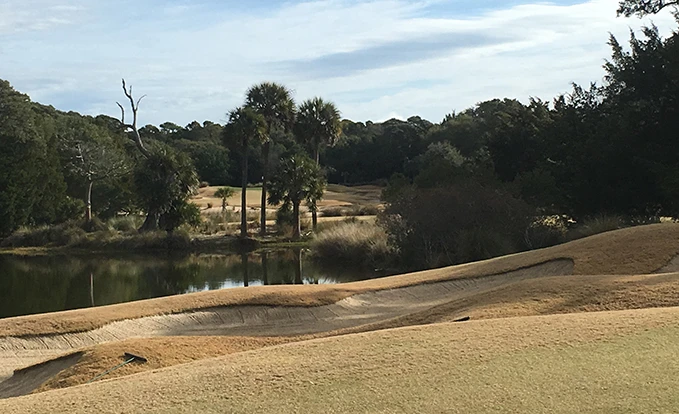
Opened in 1974 and renovated in 2010, the George Cobb-designed and Tim Cate-enhanced golf course on Bald Head Island includes distinctive features such as lagoons, ocean views, sabal palms and sandy soils. Strolls around the course offer above-ground curiosities – the club is a certified Audubon Cooperative Sanctuary and conservancy for the American alligator – and below-ground challenges.
The club wanted to build USGA specification greens during the renovation, but hauling mix from the mainland wasn’t feasible. Sifting and making mix from materials mined allowed the club to construct USGA greens, although the natural sand is very coarse and calcareous because of abundant seashells on the island. The renovation timeline resulted in greens being sodded with MiniVerde Bermudagrass.
Superintendent Adam Bachmeier, who arrived in late 2016 after a stint as an assistant at nearby inland gem Eagle Point Golf Club, says coarse, sandy soils and high percolation rates make building a significant organic layer challenging. Finding seashells as shallow as 2 inches below the ground is a common occurrence when taking a soil profile, he adds.
As of April 2017, the only irrigation sources are lagoon water and reclaimed water from the utilities plant on island. The pH levels of the water irrigating Bald Head Island Club’s 75 acres of maintained turf exceed 8. Cation Exchange Capacity (CEC) suffers because of the sand soils, low organic matter and poor water quality. “When we do get rain, it rains hard and our soil can leach really easy and, ultimately, we don’t have a lot of nutrient holding capacity because of that low organic matter and low CEC,” Bachmeier says.
In his first full year at Bald Head Island Club, Bachmeier worked to increase potassium and calcium levels on the 3½ acres of greens and the club’s 1-acre Seashore paspalum croquet greenswards. The process involved the frequent use of AQUA-AID’s Verde-Cal granular products. Bachmeier applied Verde-Cal K Plus monthly at five pounds per 1,000 square feet. Verde-Cal K Plus is a blend of sulfate of potash and Verde-Cal G enhanced gypsum and amino acids. Bachmeier also applied Verde-Cal G bimonthly at eight pounds per 1,000 square feet. The gypsum (calcium sulfate) within Verde-Cal G is combined with the agent thCa, making it more readily available for soil or plant use without effecting or raising the pH.
Spoon feeding Verde-Cal, instead of large applications of raw gypsum, is an effective management practice for Bald Head Island Club’s environment, Bachmeier says. The course is surrounded by the Cape Fear River and Atlantic Ocean. “Knowing nutrients are going into the right place, knowing they are staying in the thatch, being solubilized and being taken up by the plant is big for us,” he adds. “The proof is in our water quality tests, tissue samples and soil quality tests.”
Proper nutrient levels are helping Bald Head Island support 19,000 rounds per year. The club receives a mix of member and guest rounds, with players of varying skill levels enjoying the course. Producing smooth, durable greens with a vibrant appearance throughout this past season excites Bachmeier about what awaits, above and beneath the surface.
“Initially, the first thing that I noticed when we were winding toward the end of this season and looking back at our observations and our notes was how much better the greens appeared to hold up through wear and tear,” Bachmeier says. “I directly relate that to the ability for the plant to create protein, to defend itself, to hold up against stress, heat, and the wear and tear of the golfers. That’s one of the benefits we are looking for when using a product like Verde-Cal.”
Guy Cipriano is GCI’s senior editor.
Opened in 1974 and renovated in 2010, the George Cobb-designed and Tim Cate-enhanced golf course on Bald Head Island includes distinctive features such as lagoons, ocean views, sabal palms and sandy soils. Strolls around the course offer above-ground curiosities – the club is a certified Audubon Cooperative Sanctuary and conservancy for the American alligator – and below-ground challenges.
The club wanted to build USGA specification greens during the renovation, but hauling mix from the mainland wasn’t feasible. Sifting and making mix from materials mined allowed the club to construct USGA greens, although the natural sand is very coarse and calcareous because of abundant seashells on the island. The renovation timeline resulted in greens being sodded with MiniVerde Bermudagrass.
Superintendent Adam Bachmeier, who arrived in late 2016 after a stint as an assistant at nearby inland gem Eagle Point Golf Club, says coarse, sandy soils and high percolation rates make building a significant organic layer challenging. Finding seashells as shallow as 2 inches below the ground is a common occurrence when taking a soil profile, he adds.
As of April 2017, the only irrigation sources are lagoon water and reclaimed water from the utilities plant on island. The pH levels of the water irrigating Bald Head Island Club’s 75 acres of maintained turf exceed 8. Cation Exchange Capacity (CEC) suffers because of the sand soils, low organic matter and poor water quality. “When we do get rain, it rains hard and our soil can leach really easy and, ultimately, we don’t have a lot of nutrient holding capacity because of that low organic matter and low CEC,” Bachmeier says.
In his first full year at Bald Head Island Club, Bachmeier worked to increase potassium and calcium levels on the 3½ acres of greens and the club’s 1-acre Seashore paspalum croquet greenswards. The process involved the frequent use of AQUA-AID’s Verde-Cal granular products. Bachmeier applied Verde-Cal K Plus monthly at five pounds per 1,000 square feet. Verde-Cal K Plus is a blend of sulfate of potash and Verde-Cal G enhanced gypsum and amino acids. Bachmeier also applied Verde-Cal G bimonthly at eight pounds per 1,000 square feet. The gypsum (calcium sulfate) within Verde-Cal G is combined with the agent thCa, making it more readily available for soil or plant use without effecting or raising the pH.
Spoon feeding Verde-Cal, instead of large applications of raw gypsum, is an effective management practice for Bald Head Island Club’s environment, Bachmeier says. The course is surrounded by the Cape Fear River and Atlantic Ocean. “Knowing nutrients are going into the right place, knowing they are staying in the thatch, being solubilized and being taken up by the plant is big for us,” he adds. “The proof is in our water quality tests, tissue samples and soil quality tests.”
Proper nutrient levels are helping Bald Head Island support 19,000 rounds per year. The club receives a mix of member and guest rounds, with players of varying skill levels enjoying the course. Producing smooth, durable greens with a vibrant appearance throughout this past season excites Bachmeier about what awaits, above and beneath the surface.
“Initially, the first thing that I noticed when we were winding toward the end of this season and looking back at our observations and our notes was how much better the greens appeared to hold up through wear and tear,” Bachmeier says. “I directly relate that to the ability for the plant to create protein, to defend itself, to hold up against stress, heat, and the wear and tear of the golfers. That’s one of the benefits we are looking for when using a product like Verde-Cal.”
Guy Cipriano is GCI’s senior editor.
Latest from Golf Course Industry
- Tartan Talks 116: Doug Smith
- Audubon International adds 127 golf courses to Monarchs in the Rough
- USGA’s GAP preps for fourth year
- Protect your vehicles from rodent damage
- VIDEO: Fun with fairways
- From the publisher’s pen: Humble giving
- Syngenta adds two to western U.S. team
- The Aquatrols Company introduces soil surfactant for Canada