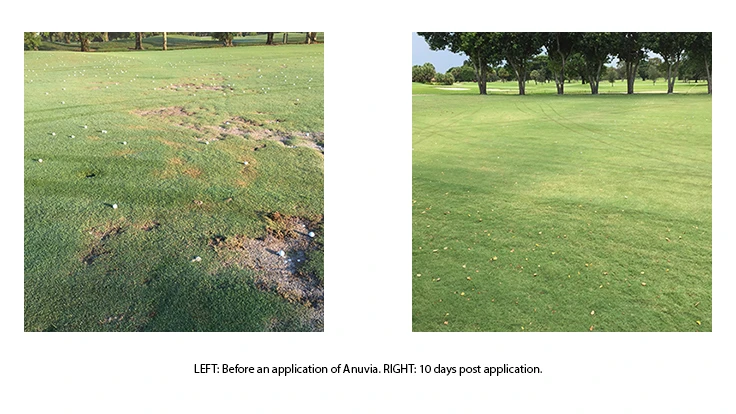
After spending a year working with PhD researchers and product distributors in attempts to cure bare spots on his driving range, superintendent Todd Ingram finally saw results when he used Anuvia Plant Nutrients’ GreenTRX fertilizer. “I put a strip out, it looked good, and then I did the whole range and, boy, it just took off,” says Ingram, who oversees maintenance at Fort Lauderdale Country Club in Fort Lauderdale, Fla. “It’s the only thing I’ve used out of the probably 40 test strips I have here that has given me what I needed.”
Up until that point, Ingram had tried applying everything from manganese to magnesium to ammonium sulfate to various fungicides. “When your fertility reports look the same, there’s no [one] thing that jumps out at you,” he says. “You start going down different avenues. We were exploring all those avenues and not being able to really get any answers.”
Because the bare spots were out in the middle of the driving range, members didn’t see them. But they bothered Ingram, so he brought them up with his greens committee.
Dr. John Cisar, who worked at the Fort Lauderdale Research and Education Center but has since retired, put the first strip of GreenTRX on one of the driving range’s tees. Ingram has also used the fertilizer with his Harrell’s representative, David Plunkett, and Harrell’s research and development manager, Dr. Raymond Snyder.
This spring, Ingram used a rate of about 280 pounds of GreenTRX per acre. “The first application was incredible, our color and growth,” he says. Since then, he has put out an application about every four or five weeks. On Oct. 20, he reduced the rate to about 240 pounds per acre.
Crew members apply the fertilizer with a large rotary spreader, Ingram says. “I’d recommend if you have an area that you can’t get to go, I would probably run a test strip across it and I would use the highest rate on the label and adjust from there.”
GreenTRX is comprised of dry, homogenous granules composed of organic matter. Virtually any organic substance can be converted into the product, anything from food wastes, to waste water, to animal waste. The foundation of the product is its Organic MaTRX technology that allows the turf and the surrounding soil to absorb nutrients more efficiently. The Organic MaTRX features electrostatically charged amino acids that provide "docking sites" for various nutrients, such as nitrogen, iron, and sulfur. In layman's terms, the product mimics what happens with organic matter in the soil.
Much of the iron applied today is not in a form the plant can use directly. It may be able to take it in but it can't utilize it internally until it converts it. GreenTRX has the iron in a form where it can use it right away. Green TRX utilizes an ammonium form of nitrogen, which minimizes potential issues with leaching, ammonia volatilization, and leaf burn.
Built in 1926, Fort Lauderdale Country Club has had some unrelated issues with toxicity. Fairy ring has also popped up. Ingram still works with researchers and distributors to try out different materials and practices to curb those issues and improve turf quality.
The driving range continues to clear up because of GreenTRX, which has left a lasting impression on Ingram. “I’m thrilled with it because of what it’s done here,” he says.
Ingram has not yet seen the results of what GreenTRX can do for his turf that is already healthy, but he has plans to use the fertilizer on his course in the future. “That would be my next step with it, see if we can take a good fairway and make it better,” he says.
Patrick Williams is a Cleveland-based writer and frequent GCI contributor.