Courtesy of Anthem Country Club
Anthem Country Club experiences summer temperatures in the high 90s and the low 100s, 5 to 10 percent humidity, and a lack of rainfall, making water conservation key to the course’s budget.
Avoiding overwatering turf is always on Nevada superintendents’ minds, but the need to decrease water use came to the forefront in 2022.
“At another place in the country, irrigation is almost supplemental,” Anthem director of agronomy James Symons says. “They have thunderstorms, we don’t get that here, so water is of the utmost importance and how we manage it is critical.”
In 2022, the Southern Nevada Water Authority decided to reduce water allotment for courses in Southern Nevada from 6.3 acre-feet per year to 4.0, a 35 percent decrease in water availability. If courses were unable to decrease their water use by the end of the year, they would be fined.
Anthem was rebuilding its greens when SNWA made the decision, so Symons spoke to the course’s general manager and board about converting their fairways to non-overseeded Bermudagrass during the reconstruction.
 Courtesy of Anthem Country Club / Komo Golf
The Henderson course sits high on a hill facing south of the Las Vegas valley, looking down toward the Vegas Strip and creating different hole elevations throughout the course. “Just a beautiful spot,” Symons says. “Just being in Vegas and having a whole valley is tremendous.”
To meet the SNWA’s new restrictions, Anthem had to cut down on its water use by a little over 25 percent because they were using only 5.25 acre-feet.
Symons and his team replaced 15 acres of turf with desert landscape to decrease irrigation, saving them at least 75 percent of the water they had been using.
“If you convert the turf, like in our situation, from cool-season grass like ryegrass, and you convert it to Bermudagrass, you can save 25 to 30 percent potentially because it’s a more warm-season grass,” Symons says.
Since Bermudagrass does not require much water and can grow in drier conditions, the course’s fairways were replaced with Bermudagrass.
“It’s just generally more aggressive,” Symons says. “Divots fill in faster and things like that, so it just has its own appeal. It’s a little different though.”
The course uses moisture meters and soil sensors to keep track of its water use. Symons also stopped overseeding tees, using Bermudagrass and painting the surfaces to keep them green during the winter.
“The practice of overseeding tees, fairways, rough, whatever you do, … it takes a lot of water in the fall to actually get it to establish from growing it from seed,” he says.
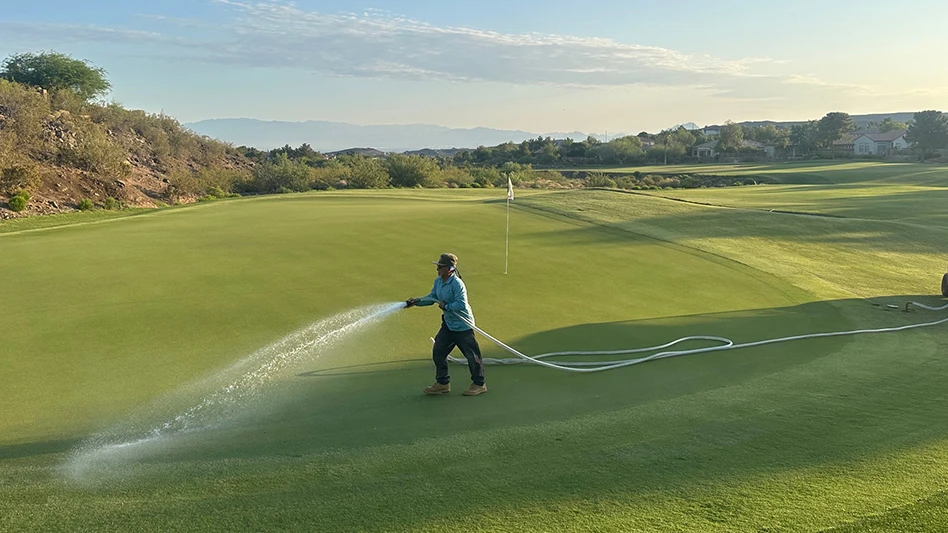
They also hand water playing surfaces, but this practice and others become a challenge with the weather.
In 2024, Anthem’s first year of implementing its water conversation efforts, Henderson experienced one of its hottest years on record: In July, temperatures averaged around 103.5 degrees with a high of 117 degrees on July 7. Three years earlier, July temps averaged 103.65 degrees with a high of 115 degrees on July 10.

Courtesy of Anthem Country Club / Komo Golf
Symons, who is from Virginia, moved to Nevada to work for different courses, including The Revere Golf Club, before taking a job at Anthem in 2018. Although he grew up in colder and more humid conditions, he is accustomed to Henderson’s weather, tracking water usage to ensure Anthem stays on budget.
As the heat stretched further into July, he became concerned.
“It was just a lot of extra stress of not only trying to maintain a golf course, make it playable, survive the summer and all of the heat and everything else. But now you got to worry about these impending fines at the end of the year,” he says. “It adds just another element of stress, just what every superintendent needs.”
With support from his manager and board, Symons and his team were able to continue decreasing their water usage. Anthem used 50 million fewer gallons of water in 2024 compared to 2021. Henderson awarded Anthem the inaugural City of Henderson Water Conservation Award in 2023, making them the “flagship for water conversation in the entire valley.”
Although the pressure from the SNWA encouraged the course to cut back on water, Symons says the industry needs to have input in future legislation.
“What we’re learning from this is not only ways to save water, but maybe there needs to be a larger discussion about what is reasonable for the golf industry. Because I think if they continue to squeeze us for more water, it’s going to put clubs out of business.”
Symons plans to further voice his concerns through his position in the Nevada Golf Alliance, hoping for a compromise.
“Everywhere you go in the country, golf is just busy and doing really well,” he says. “We need to make sure we re-enforce that reality with the legislatures, and they don’t forget about golf.”
Moving forward, the course will soon install TurfRad technology that scans turf, creates heat maps of water content in fairways and detects hot spots before visible grass wilting.
“The job’s not done,” Symons says. “All that it reveals is that we still have work to do.”
Adriana Gasiewski is a Kent State University senior and Golf Course Industry’s summer editorial assistant.
Latest from Golf Course Industry
- VIDEO: 'It's their livelihood'
- Reel Turf Techs: TJ Vollmar
- Bernhard and Company names G.C. Duke as North American Distributor of the Year
- Course at Sewanee picks KemperSports for management
- WiTricity expands wireless charging technology
- Shining star
- SiteOne Landscape Supply acquires Reinders
- Talking Turf Weeds 17: Waking up your course after winter with Yusif Jaouni and Matt Herrmann