Courtesy of Harbour Ridge Yacht Club
In the golf club mecca of Florida’s southeast coast, environmental sustainability has become a key component of many potential club members’ decision on where to join, play and live. They want to be part of something big on every level, and taking care of the land, water and air certainly qualifies.
Harbour Ridge Yacht Club has been big, with both of its golf courses members of the Audubon International Cooperative Sanctuary for Golf family.
Established in 1992 on the north fork of the St. Lucie River just inland from Hobe Sound and Jupiter, Harbour Ridge’s River Ridge and Golden Marsh courses achieved certification with the not-for-profit stewardship leader in 2000 and have maintained their status ever since. Their latest recertification was in November 2024, after Dr. Bonnie Wells, commercial horticulture agent for the University of Florida/IFAS Extension, reviewed best practices on Audubon International’s behalf.
“She was so impressed,” director of golf course maintenance Tim Cann said. “She works for the University of Florida as a county extension agent, and she couldn’t believe how great our property was with the littoral plantings on the lakes and natural areas that the developers left intact. She hadn’t realized that such a good job could be done.”
Cann has been on property since the beginning, oversaw its original ACSP for Golf certification and has worked with Audubon International to affect every recertification since. “Being certified is a big deal for us,” Cann said, “but it's an even bigger deal for the membership. They are 100 percent behind it.”
Wildlife forward
Harbour Ridge members also love taking part in such Audubon International programs such as BioBlitz, a month-long, golf course-based “wildlife census” that returns May 15 through June 15.
“We did BioBlitz a number of times, but we had such a good showing two years ago that they actually won the number of species identified — that was the residents getting out there,” Cann said. “And the employees in the past had done that effort. But the membership, the residents were the ones that really carried that to another level.”
Their interaction with Harbour Ridge’s natural environment — a delicate balance of woods, wetlands and riverfront sharing space with its golf course that, through Cann’s leadership, maintains as much natural acreage as possible — doesn’t stop there. In fact, it’s only intensifying as development surges outside the community’s gates.
“We haven't seen the wildlife disappear; there’s probably even more with us than in the past,” Cann said. “We’ve got everything that Florida offers.”
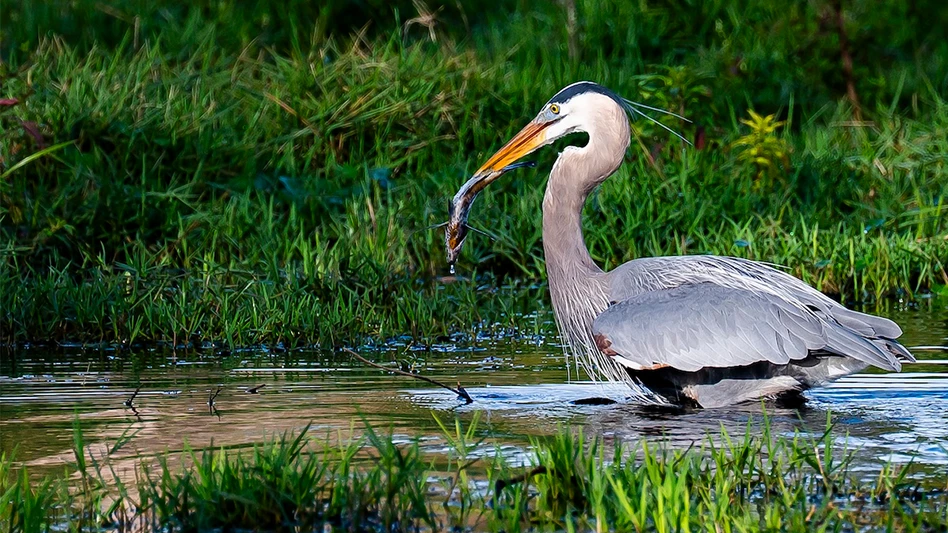
Cann adds that “almost on a daily basis” residents post pictures of blue herons on the club’s Facebook page.
“There’s a 10-foot gator that they photographed the other day,” he says. “And we’ve got a large birders club, which is a big plus for the support of Audubon International. We’ve got raccoons, deer, wild boar, coyote, otters and bobcat families that'll show up from time to time. We have an area that we call the rookery. Thousands of birds fly to the rookery every afternoon, close to dusk, and roost there all night long. It’s amazing. Every morning, we can see the birds flying out, dozens at a time, to the river feeding area.”
That leads Cann to mention sections of the golf course that he’s set aside for migrating butterflies — to take part in another Audubon International program, Monarchs in the Rough, which involves planting spans of milkweed, the only plant on which the creatures will lay their eggs. “We’ve got one bed with a lot of milkweed, around a 6,000-square-foot bed. It was an old tee (box) that was moved to another location.
“We also have lots of osprey stands in dead trees called snags. If we get a pine that dies, we won’t necessarily cut it down. We’ll determine whether it might be a good host for a nest at some point, and almost every time that’s (the case). We take some of the branches off — if they’re able to lay some branches in there and build a nest, we try to make it accommodating so they can build a nest and not have a lot of lanky limbs leftover. One osprey stand that we thought might be a good spot lay vacant for a number of years, but this year, there’s a nest of horned owls, which is amazing. It’s really cool to have those around.”
Irrigation and turf science
Combined with these simple methods of attracting wildlife are technologies to keep both golf course turf and the water that feeds them healthy and efficiently maintained.
“We’ve upgraded to a computer-driven irrigation system that has allowed us to increase unirrigated area by 20 percent,” Cann said. “Both courses are now fully irrigated computer systems, state-of-the-art Toro Links controls. We’re constantly adjusting the times daily. We are hands-on. They’ve got a lot of tools out there nowadays that can measure soil moisture, but we go out and actually feel the turf — we’re more ‘farmers’ with the handheld test equipment.”
Homeowners do their part to conserve and clean water, as well. Runoff from home lawns and the golf courses end up in collection lakes that allow the water to settle out, spill out through outfall structures, then pass through vegetation that’s located in sloughs.
“There’s seven sloughs on property that all end up into the North Fork of the St. Lucie River,” Cann said. “We also focus on split applications of slow-release, organic fertilizers 10 or 12 months a year, so if we get a big rain, we don’t have rapid leaching or runoff problems.”
Old wetlands, new trees
Harbour Ridge’s riverside setting means there’s plenty of aquatic plant life to keep in check, keep algae from spreading and keep the property’s water in balance. That led to the club investing in a special weed harvesting boat called a WeeDoo.
“It’s a pontoon boat with a front-end loader attachment,” Cann said. “It’s got rakes and screens and fingers on the attachments. If we’ve got blue algae outbreak, we can skim the lake rather than cast in a bunch of copper sulfate out there to try to control it. We’re going in a little different direction, harvesting some of the exotics rather than spraying them with a Roundup product, which kills the plant, decays and adds a nutrient load to your lakes and wetlands. Again, this investment is a result of support we got from the membership.”
Then there’s the flip side of too much vegetation: tree loss due to storms. Though southeast Florida hasn’t suffered a direct hurricane in more than a decade, Cann remembers back-to-back storms that took a serious toll. In 2004, four hurricanes barreled through parts of Florida, and in the aftermath of Frances, Harbour Ridge lost more than 1,000 trees.
“Fortunately, the county offered landowners trees because they realized that the whole area was devastated,” Cann said. “So, we took advantage of that and got a lot of pine trees and oak trees that we planted. Over the years we’ve continued buying from the forestry department, little slash pine saplings. We would grow those out a thousand at a time. It takes a while to put that many trees up once we find a place for all of them.”
Bringing it all together
When it comes to finding a partner in every stewardship measure his exemplary club takes on, Cann continues to stand behind his longtime relationship with Audubon International. Over the decades, through every natural challenge and technological advance, they’ve provided the know-how and detail-oriented direction to make sure Harbour Ridge attains its sustainability goals.
“They’re always helpful,” Cann said. “Whenever we’ve got a project coming up, they’re always there to lean on if you need them. They’ve been really good partners.”
Latest from Golf Course Industry
- Reel Turf Techs: TJ Vollmar
- Bernhard and Company names G.C. Duke as North American Distributor of the Year
- Course at Sewanee picks KemperSports for management
- WiTricity expands wireless charging technology
- Shining star
- SiteOne Landscape Supply acquires Reinders
- Talking Turf Weeds 17: Waking up your course after winter with Yusif Jaouni and Matt Herrmann
- From the publisher’s pen: Respect the side hustle