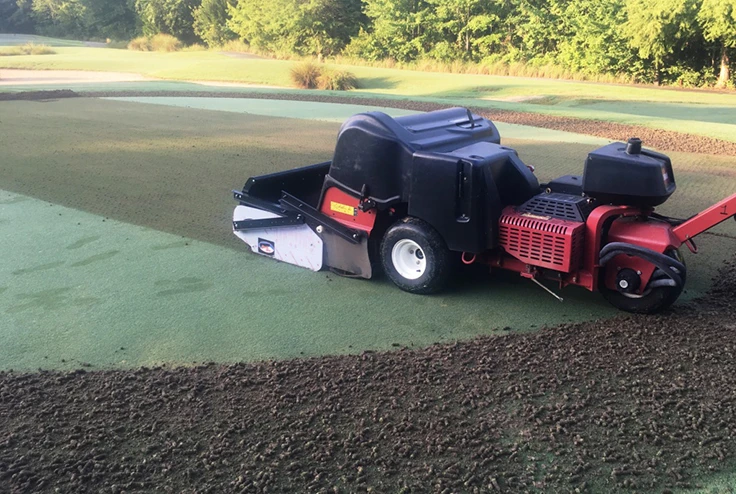
If it were a viable option, Dick Zepp would manually remove aeration cores again. As superintendent of Cyprian Keys Golf Club, a 27-hole municipal course in Boylston, Mass., he has more than 40 years of experience leading maintenance crews. He mechanically collects his cores after aerating because of the labor and time constraints he associates with manual collection. “When you’re doing it by hand, you get it pretty clean right down to the turf,” he says. “It doesn’t really matter with us so much because our greens are only 18 years old and we’ve got good soil, so I’m not worried about necessarily having to remove the old soil, but it just makes it a little bit cleaner during the cleanup.”
Meanwhile, Matt Hughes, superintendent of Rockwind Community Links, an 18-hole municipal course in Hobbs, N.M., doesn’t see any benefit to manually collecting cores. He has only collected them by hand in spots where he couldn’t reach with his John Deere TC125 Turf Collection System. “What I’ve seen from doing it manually is you actually cause more damage because you’re pushing shovels along to try to pick stuff up,” he says. “But with the sweeper, it picks it up and throws it right directly into the hopper, so you’re not having a lot of your cross contamination that you see when you’re manually doing it.”
Although some superintendents prefer manual core collection, the state of the industry is driving most of them to mechanically collect cores, and suppliers are offering products to fill their needs.
In his previous position as superintendent of Whitinsville Golf Club in Whitinsville, Mass., and for a while after he came to Cyprian Keys in 1997, Zepp manually removed cores. The crew at Cyprian Keys still collects some cores manually from green collars because the machine doesn’t work as well on higher cutting heights.
Some superintendents who worry about contamination of the collar can first aerate the collar and then collect cores on the green using plow technologies, says Rich Behan, president of Nordic Plow. The company’s Core Solutions rounded-edge lightweight plastic snowplow blades attach behind the Toro Procore 648, Procore 864, John Deere Aercore 800 and Aercore 1500. Nordic Plow also sells blades that attach to walk-behind mowers.
Superintendents who choose to topdress prior to aerating can take advantage of Nordic Plow’s brushing technology, which sweeps much of the topdressing into the holes, Behan says. Another benefit to topdressing first: superintendents don’t put as much pressure on the green as they would if they drove a tractor or utility vehicle on top of the holes. “By them topdressing first, they’re actually driving on a very firm green, and they’re not causing ruts—they’re not harming the turf because it’s solid,” he says. “And it’s really solid before they aerate because that’s why they aerate.”
Mowing early in the morning can remove dew from the turf prior to aeration and can also reduce mud buildup, Behan says. “The process would be mow, throw the topdressing down, aerate, then go back and brush the balance of the topdressing back into the holes, then move onto the next hole,” he says.
Other core collecting technologies function differently than plows. The TC125, for instance, can attach to a ProGator or other utility vehicle or tractor with compatible hydraulics, says Brooks Hastings, product marketing manager for John Deere. It not only picks up cores, but also leaves, pine cones and other debris. With a 25-cubic-foot hopper capacity, it can clear an average-size, 6,500-square-foot green in 15 minutes.
When he used to work as an assistant superintendent, Hastings manually removed cores. “They would aerify, we would push by hand and then we would shovel by hand to get it off the greens,” he says. “Mechanical is so much faster, especially if the collector is set up properly to where the brush is at the proper height, you’re able to do a really good job on collection and not disturb the turf or damage it.”
The six acres of greens at Rockwind Community Links would be a headache to clean off with shovels, Hughes says. Another potential issue is that if employees were piling up cores off the side of the green, sand would start to build up.
The entire process of aeration can be problematic, but it is necessary, Hughes says. Once the holes are in the ground, the crew works hard to grow them back in and improve playability.
Patrick Williams is a GCI contributing editor.
No more results found. Meanwhile, Matt Hughes, superintendent of Rockwind Community Links, an 18-hole municipal course in Hobbs, N.M., doesn’t see any benefit to manually collecting cores. He has only collected them by hand in spots where he couldn’t reach with his John Deere TC125 Turf Collection System. “What I’ve seen from doing it manually is you actually cause more damage because you’re pushing shovels along to try to pick stuff up,” he says. “But with the sweeper, it picks it up and throws it right directly into the hopper, so you’re not having a lot of your cross contamination that you see when you’re manually doing it.”
Although some superintendents prefer manual core collection, the state of the industry is driving most of them to mechanically collect cores, and suppliers are offering products to fill their needs.
In his previous position as superintendent of Whitinsville Golf Club in Whitinsville, Mass., and for a while after he came to Cyprian Keys in 1997, Zepp manually removed cores. The crew at Cyprian Keys still collects some cores manually from green collars because the machine doesn’t work as well on higher cutting heights.
Some superintendents who worry about contamination of the collar can first aerate the collar and then collect cores on the green using plow technologies, says Rich Behan, president of Nordic Plow. The company’s Core Solutions rounded-edge lightweight plastic snowplow blades attach behind the Toro Procore 648, Procore 864, John Deere Aercore 800 and Aercore 1500. Nordic Plow also sells blades that attach to walk-behind mowers.
Superintendents who choose to topdress prior to aerating can take advantage of Nordic Plow’s brushing technology, which sweeps much of the topdressing into the holes, Behan says. Another benefit to topdressing first: superintendents don’t put as much pressure on the green as they would if they drove a tractor or utility vehicle on top of the holes. “By them topdressing first, they’re actually driving on a very firm green, and they’re not causing ruts—they’re not harming the turf because it’s solid,” he says. “And it’s really solid before they aerate because that’s why they aerate.”
Mowing early in the morning can remove dew from the turf prior to aeration and can also reduce mud buildup, Behan says. “The process would be mow, throw the topdressing down, aerate, then go back and brush the balance of the topdressing back into the holes, then move onto the next hole,” he says.
Other core collecting technologies function differently than plows. The TC125, for instance, can attach to a ProGator or other utility vehicle or tractor with compatible hydraulics, says Brooks Hastings, product marketing manager for John Deere. It not only picks up cores, but also leaves, pine cones and other debris. With a 25-cubic-foot hopper capacity, it can clear an average-size, 6,500-square-foot green in 15 minutes.
When he used to work as an assistant superintendent, Hastings manually removed cores. “They would aerify, we would push by hand and then we would shovel by hand to get it off the greens,” he says. “Mechanical is so much faster, especially if the collector is set up properly to where the brush is at the proper height, you’re able to do a really good job on collection and not disturb the turf or damage it.”
The six acres of greens at Rockwind Community Links would be a headache to clean off with shovels, Hughes says. Another potential issue is that if employees were piling up cores off the side of the green, sand would start to build up.
The entire process of aeration can be problematic, but it is necessary, Hughes says. Once the holes are in the ground, the crew works hard to grow them back in and improve playability.
Patrick Williams is a GCI contributing editor.