Being hired as an intern at Oakmont Country Club felt like transitioning from Little League to Major League Baseball overnight for Stephen Hicks. Having grown up as an avid Boston Red Sox fan in a small New Hampshire town, Hicks’s mentor, John Zimmers, once surprised him with tickets and a few days off to see them in the playoffs. Through his actions and words, Zimmers taught Hicks, now the superintendent at Bull’s Bridge Golf Club in Kent, Connecticut, plenty. Zimmers will tell you, as would those who worked for him, that his wife, Tracey, has always been fully supportive, making work feel more like family.
So. Much. To celebrate!
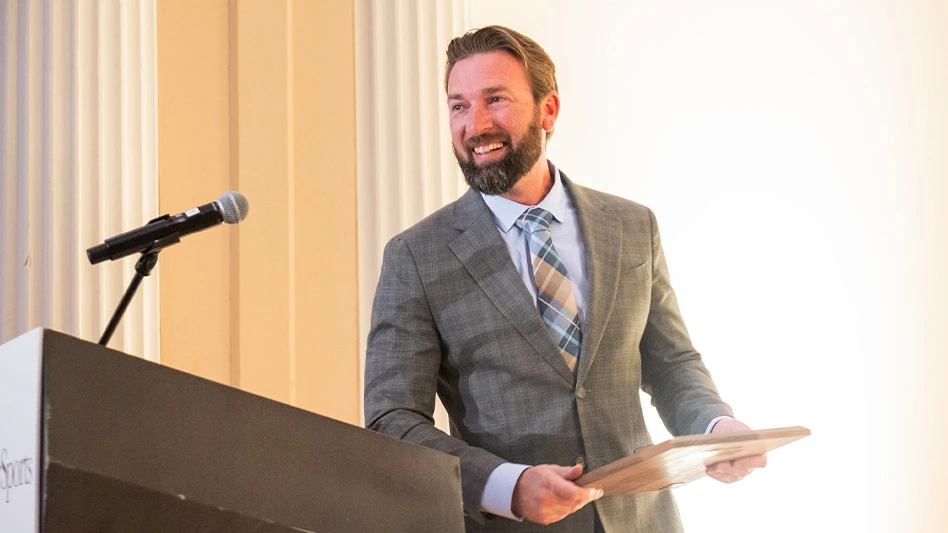
And speaking of celebrations, Zimmers, who’s preparing for his ninth season leading the agronomy team at famed Inverness Club in Toledo, Ohio, will be honored as part of the inaugural class of Excellence in Mentorship Award recipients presented by Golf Course Industry and The Aquatrols Company. The 2026 ceremony begins at 2:30 p.m., Feb. 4, at The Aquatrols Company booth #2341 during the GCSAA Conference & Trade Show in Orlando. Every mentor or mentee — and anybody looking to share a drink, story or laugh with the industry’s most giving people — is encouraged to attend.
Following a brief ceremony honoring 2026 recipients, Zimmers will join Ansley Golf Club’s Courtney Young and Aspire Golf’s Tim Moraghan for an educational panel discussion about mentorship and guiding people led by Golf Course Industry senior editor Matt LaWell. The discussion will begin around 2:40 p.m. The event concludes at 3:05 p.m. with a celebratory toast to mentors everywhere.
We spoke with Zimmers and Hicks to learn about the importance of guiding others and the mentor-mentee relationship.
John Zimmers, Inverness Club
Why is it important to focus time and attention on developing people?
Well, that’s pretty easy. Somebody did that for me, meaning Paul R. Latshaw, including his son, Paul B. Latshaw. I have been blessed, because I have been taught the right ways. There are many ways to do things, but when you are young and someone takes the time to teach you watering, applications, fertilizers, working with people, budgeting, and including you in meetings, that’s truly mentoring. For me, I sincerely hope that I had a huge impact on jump-starting the careers of the people that worked with me, and more importantly, that our work changes their lives. Tracey and I have probably been to more weddings than we could ever count, and then you see them start a family and they have gone on to do remarkable things. That’s the most rewarding thing.
How do you balance developing people with regular job tasks?
I am a big believer if they have the desire, and they want to continue to learn, I think that you can really make sure that they understand every single job duty. Everything from mowing the greens, to raking a bunker, to mowing a fairway and cutting a hole, and then you just watch them develop. If they can’t do it, they are going to have a really challenging time to get someone else to do it to the quality that you expect them to do it, and in the amount of time that you expect. I still live by that philosophy. I think it’s so important, especially when they are growing and developing, and they know that they might have to go on and make decisions. It’s so important that they understand the equipment, what this brand does or that brand doesn’t, the pros and the cons, because they will be in a position if they are growing or aspiring to be a superintendent that they are going to have to make those big decisions. When you get to the level that you want to manage, it’s about safety, and you know that this should get done in this amount of time, and if not, that’s a challenge. The No. 1 expense in any grounds operation is normally the payroll. Time and people management is a big, big thing that you have to learn how to do.
Stephen Hicks, Bull’s Bridge Golf Club
What is the biggest lesson you learned from John?
The biggest lesson I learned from John is to have a sense of urgency and follow-up skills. Make sure everyone gets the communication and the information when they are expecting it. I learned all the agronomic stuff, but definitely the urgency and sense of professionalism needed at Oakmont and for the rest of your career. It’s not putting things off, it’s doing things as they come to you, responding to every email and being proactive. Don’t be complacent.
How do you apply what you learned from John in how you develop people?
I try to let the staff see everything that I am doing. John was really big on that — I saw every email that came into his inbox, and I responded to many of them with him over my shoulder. I try to do the same thing, to just be really transparent so that everybody knows what I am dealing with and what the bigger goals are. Hopefully, everyone can make the best decisions on their own and get it all done. It’s the same sort of routines, the staff meetings, management meetings, morning meetings — all those things that seem like second nature now that I wouldn’t have known how to do if I didn’t spend that time at Oakmont with the organization, the planning and getting the assistants involved.
This year, I am taking my mechanic to the Golf Industry Show. John would always look for opportunities to broaden our perspective with educational events and networking opportunities, having me introduce myself to other people in the industry. John took me to Interlachen for a pre-visit before we were going to host the U.S. Open. That was really cool. He was a tough boss, demanding, and he expected a lot, but I’ll give you an example: One fall day, we were wrapping up a busy morning of maintenance and he comes to me and says, “Hey, you’re getting the afternoon and tomorrow off and you and some buddies, you’re going to Cleveland to watch the Red Sox playoff game.” I was a Red Sox fan from New Hampshire. It’s little things like that that he did, trying to take care of his team. When I’m thinking through big decisions, I think, “What would John do?”
Lee Carr is a northeast Ohio-based writer and senior Golf Course Industry contributor.
Latest from Golf Course Industry
- Super-Scratch events to expand nationally
- Beyond the Page 78: Labor solutions, AI talk and mayhem
- Construction progresses at The River Club
- VIDEO: A century of innovation
- Sentosa Golf Club preps next generation of turf pros
- Western turf leaders honored by GCSAA for advocacy efforts
- The Canary flies out of the mines
- VIDEO: Reflections on 100