At this time of year some golf course superintendents are looking forward to the longer nights and cooler temperatures while their counterparts in the South are gearing up for the invasion of the snowbirds. But no matter where superintendents live, fall is the beginning of football season. Many cheer on their Alma maters because quite a few of the turf programs where we were students are universities considered to be major players in NCAA football.
In case superintendents think that growing grass in the summer is difficult, then think about the stadium managers that have the challenge of having their product on TV September-December when many venues have dormant grass that takes a beating. Like any turf managers, stadium managers have challenges different than what golf course superintendents are accustomed to.
AMY FOUTY – SPORTS TURF MANAGER
.jpg) |
Amy Fouty is the sports turf manager for Michigan State University and a 1996 graduate of the turfgrass management program. She is not just in charge of the football field at Spartan Stadium, but a variety of other sports venues, including baseball and soccer fields. Her roots began in golf and then she switched over to sports turf where she has had a meteoric rise to one of the top jobs in the profession.
Amy is one sharp turf manager and knowing that a two-year degree was a good foundation she has been involved in continual education over the last two decades and achieved CSFM (Certified Sports Field Manager) designation from the STMA in 2004. Additionally, she pursued and completed her bachelor of arts at Michigan State in psychology in 2014. “This business is not just about grass,” she says. “It is important that you understand people, know how to communicate, understand your challenges and be a problem solver.”
Early beginnings for Amy were like many in the industry. She began working at a golf course when she was 17 taking care of the clubhouse grounds. That led to eight years on the golf side and ultimately earning a turfgrass management degree. In those days, it was common to become an assistant superintendent right after graduation, and Amy did that and then moved up to superintendent for several years. In 1999, Amy was given the opportunity to take on new challenges, down the road at archrival University of Michigan. She took care of the daily operations for football and soccer field management. She held that position for five years.
A combination of hard work, great skills and maybe some good karma brought Amy back to her Alma mater in 2003. As the new athletic turf manager, she was beaming as she had found her dream job. “It was such an honor to represent my Alma mater,” she says.
Along the way, more than a few accolades have been bestowed upon Amy. STMA honored Michigan State with the Collegiate Football Field of the Year award in 2005. Amy then received the Dick Ericson Founders Award from the STMA in 2012. This award is given annually to a sports turf industry professional that embodies Dick Ericson’s spirit and positively impacts the sports turf industry. Amy received another award from STMA in 2013 for Collegiate Baseball Field of the Year. As you can see, she is no ordinary sports turf manager and excellence is her norm in all that she does.
MAJOR RESPONSIBILITIES
When I asked Amy what all her job entailed, I soon found out it was quite broad and very busy. Overall, Michigan State has nine fields and four facilities that require maintenance. If it involves sports and turf, it is probably under the jurisdiction of her department. While golf is a different entity at Forrest Akers Golf Course, they do take care of landscape areas at the course. There are even a few areas of landscape where the Michigan State rowing team operates and those are on the list as well.
.jpg) |
Here is a list of the various fields, activities and venues:
--Grass practice football field
--Artificial turf practice football field
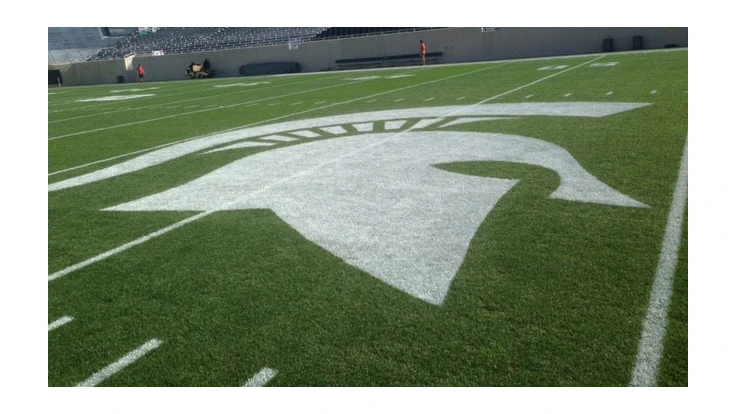
--Stadium grass football field
--Grass practice soccer field
--Grass soccer game field
--Grass softball field
--Baseball stadium
--Hitting and pitching building
--Indoor football practice facility
--Overall landscaping surrounding any and all of those facilities
--Field renovation of all of the above
--Facility renovation as needed
--Concert preparation and planning
As with a golf course, the maintenance part is easy as you often know what to expect. It is the unexpected things like a U2 concert that tend to throw a curve at you.
GRASS … REAL AND ARTIFICIAL
While artificial turf is typically foreign to most golf course superintendents, it is something that sports turf managers must work with because their teams often play on that type of turf at away games. It is important to be able to mirror the experience that teams will have for those away games by providing it for practice.
The field at Spartan Stadium returned to natural grass in 2002. That was a relief for many Michigan State turfgrass graduates. I am sure it was a happy time for the many fine professors at Michigan State who are the top in their fields as well. Amy indicated that it was important for the university to remain true to the history of games that were played on that field and also for the safety of the student-athletes.
Amy’s experience goes back to the early 2000s, having worked with a variety of artificial turf fields. There has been a lot of research related to the fields and how the athlete and surfaces interact together. While the practice fields are necessary, the athletes say they much prefer natural grass as it is so much easier on their bodies over the many years they play the sport.
SPORTS TURF
With the rising demands and expectations placed upon teams to win, the atmosphere in and around the teams has risen rapidly. On game days, not only are the teams highlighted, but also the pageantry and presentation that encompass that day. Many announcers and writers nationally and locally comment upon a great deal more than just the game. Facilities, fields, players, coaches, staff and their families all seem to trickle into today’s 21st century game experience at every level.
 |
The spotlight is even more prevalent at Michigan State, which boasts a fifth-ranked football team and a perennial powerhouse in basketball. Michigan State is the first land grant institution in the country and the grass field is considered to be the crown jewel to the university and its agricultural roots. When Amy was asked what it was like to manage the field at Michigan State compared to managing a golf course she says, “It is like hosting a major seven times a year”.
THE TEAM
Amy has her own team taking care of the many fields at Michigan State. That includes one assistant and two temps – all Michigan State graduates. Undergrads, interns and student-athletes round out a staff that peaks at 10. Like many other great industry people, Amy is proud of those former staff members who have gone on to work for the Boston Red Sox, Iowa State University and the San Francisco Giants.
MENTORS AND SUPPORT
Quite often we learn from others the many traits that make us successful in our chosen careers. Amy is no different in that case as she credits her grandparents for teaching her about hard work, honesty and how to treat others as she would like to be treated.
.jpg) |
Amy’s husband, Mike, is well aware of what the job takes at Michigan State. Through their 16 years of marriage, he has been there to provide support. Mike is a general manager/superintendent of a golf course, so he truly understands what it is like to be married to one’s job.
Jerry Kershasky also stands out as a superb mentor to Amy. “He was an intense, tireless, hardworking, wicked smart person to work for,” she says. “If you could keep up with him, you could do just about anything.”
Michigan State deputy athletic director Gregory Ianni is another friend and mentor. He has provided guidance, patience and support that has allowed Amy to see and understand the bigger picture. Diplomacy is likely the best skill Ianni has taught Amy over the last 10 years.
SEVEN GAMES AND MORE…
The public sees the seven games played and televised from Spartan Stadium each year. But there is quite a bit more going on in addition to those highlighted days. While it is not the same level of pomp and circumstance, it is surely a lot of wear and tear on the field when you have a spring game and an additional five full game scrimmages a year. Add to that football camp and a concert or two, and you have some significant challenges.
Stadiums are a business and as such need to generate revenues. The damage created is not unexpected. It’s just a part of the sports turf manager’s job today. It takes several days to set up such an event and also the same amount of time to tear it down. Many sports managers say the field is rarely taken into consideration, yet the preparation and recovery are an art and science that few have mastered. Amy is happy to say that at Michigan State the sports turf manager is involved in the planning process and ample financial support is provided to get the field back to game-day condition as soon as possible.
PROUD AND HUMBLE
If you spend a few hours with Amy, it is easy to see how successful she is. She never forgets her roots and all the people that were influential along her career path. Actually, she prefers to speak to the people the mentored her and the lessons learned rather than speaking about herself. She truly appreciates the opportunities that have come her way and she has made the most of them.
Michigan State has long been considered a great school for academics and athletics. Most would recognize MSU as having one of the finest turfgrass programs in the country. Having one of the best sports turf managers and a super role model seems to go hand in hand.
Latest from Golf Course Industry
- Tartan Talks 116: Doug Smith
- Audubon International adds 127 golf courses to Monarchs in the Rough
- USGA’s GAP preps for fourth year
- Protect your vehicles from rodent damage
- VIDEO: Fun with fairways
- From the publisher’s pen: Humble giving
- Syngenta adds two to western U.S. team
- The Aquatrols Company introduces soil surfactant for Canada