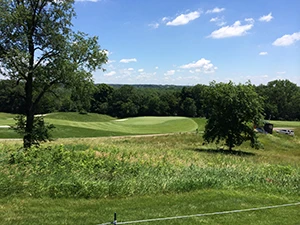
Andrew Foy golfs once a week. He doesn’t loft drives and stroke putts to relax or satisfy competitive desires.
Foy squeezes regular play into a crammed schedule for work-related purposes. His job as the superintendent at the Valley Club of Montecito requires him to satisfy the golfing desires of the California club’s members.
 |
“I don’t play for fun,” Foy says. “For me, it gives you a different aspect. From the agronomy side, you are going out there and looking at certain stuff. When you are actually playing, you are looking and hitting the ball from some areas that I would never normally go into. I might hit it from behind a tree and see something that I would never see. When I do go out and play, it’s to get a different vantage point.”
Foy joined superintendents and club managers from 23 states and six countries on July 7 to experience tournament golf from a participatory perspective as part of the John Deere Golf Pro-Am at the TPC Deere Run in Silvis, Ill. The pro-am coincided with the PGA Tour’s John Deere Classic and paired superintendents with a tour player.
Superintendents didn’t play the back tees like the pros – 500-yard par 4s aren’t for everybody – but they hit from the same fairways, rough, bunkers and greens. Playing the D.A. Weibring-designed course the week of its annual PGA Tour appearance represented a once-in-a-career opportunity for many participants. “The attention to detail is just top-notch,” says Kurt Strother, superintendent at Eagle Ridge Golf Resort in Galena, Ill. “You don’t get out and see tournament-style courses all the time. It blows you away instantaneously.”
Strother, like Foy, spent part of his round analyzing TPC Deere Run’s agronomic features, which included firm fairways, lush rough, tour-quality sand, managed native areas and smooth, receptive greens. The maintenance shed behind the fourth tee and pump station along the fifth hole were parts of the course ignored by pros yet admired by superintendents. Those with wandering eyes gazed at sprinkler heads and bunker edging. TPC Deere Run superintendent Alex Stuedemann mingled with colleagues and made himself available to answer questions about the scenic property, hosting a PGA Tour event and golf course maintenance.
“I enjoy watching them play golf,” Stuedemann says. “If they have a comment or a question, I’m happy to give it. But we golf course superintendents are very guilty of taking the business everywhere. I figure on this day, let them play golf, and if they want to talk shop, I’m right here, ready and willing.”
 |
Golfing on a regular basis represents an item on a superintendent’s to-do list that often doesn’t get accomplished. Superintendents live hectic lives, balancing intense work schedules with family and personal demands. Spending four more hours on a golf course following an 11-hour workday is difficult to justify. But superintendents agree that golfing should be part of their job description.
Shawn Emerson, director of agronomy at Desert Mountain, a 108-hole facility in Scottsdale, Ariz., asks his superintendents to walk the course with putters and wedges. Even something as simple as hitting a few putts and chips can help a superintendent obtain a player’s perspective.
“We’re hurting ourselves by not doing more,” Emerson says. “We say we want to grow the game, well, we are not playing enough to grow the game. We keep saying we need people to play more golf. We need to play more golf. You see it from the perspective of the player. It makes a big difference. I played Desert Mountain a couple of days ago and saw things I wouldn’t have recognized if I wasn’t playing and just driving it. It’s very important to play your golf course.”
 |
Emerson spent two days in the Quad Cities, playing TPC Deere Run and Davenport Country Club, a C.H. Alison-designed course on the Iowa side of the Mississippi River, as part of the John Deere event. A deep trust in his staff allowed Emerson to escape Scottsdale. But he called co-workers multiple times and scoured email during the trip. “Are you ever away? Never.” he says. “But I try not to get on my phone while I’m playing golf.”
Desert Mountain hosts the Charles Schwab Cup, the Champions Tour’s season-ending event, so TPC Deere Run’s tournament setup fascinated Emerson. Climatic, topographic and turf differences make it tough for him to apply anything he saw in the Midwest to his own course. “Playing off cool-season grasses is much different than playing off warm-season grasses,” he says.
Eagle Ridge consists of 63 holes, leaving Strother with little time away from the course. But playing on somebody else’s turf in the same region energized Strother as he made the 80-mile return trip from Silvis to Galena.
“We all have the mentality that we need to play, but we don’t because we spend enough hours on the course as is,” he says. “But from our perspective, we do like to play and we need to see it from a golfer’s eyes. What you see here is not so much a comparison to the golf course that I’m working on, but it gives you a sensation of what you are doing and what these guys are doing to prepare for an event like this. You almost get a little recharged from it. You take it back to your own course and do some of the attention to detail work.”
Still, not all superintendents notice every detail when away from home.
“I try to enjoy the golf course and not think about work,” says Kasey Kauff, the superintendent at The Country Club of Orlando.
In a way, though, treks around courses such as TPC Deere Run and Davenport Country Club are auxiliary parts of the job. Two days of roaming and talking turf with colleagues can produce benefits at home.
“I think it’s really important to see what other people are doing and the way they are doing it,” says Brandon Nichols, superintendent at Fayetteville Country Club in Fayetteville, Ark. “It’s a fresh perspective. You might be able to bring something back. It’s great playing with other superintendents and picking their brains on different things.”
Guy Cipriano is GCI's assistant editor