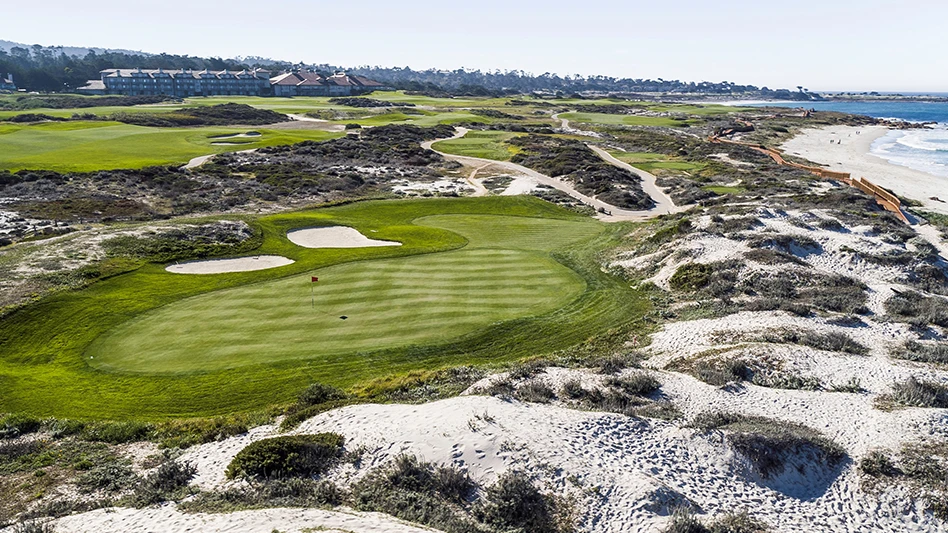
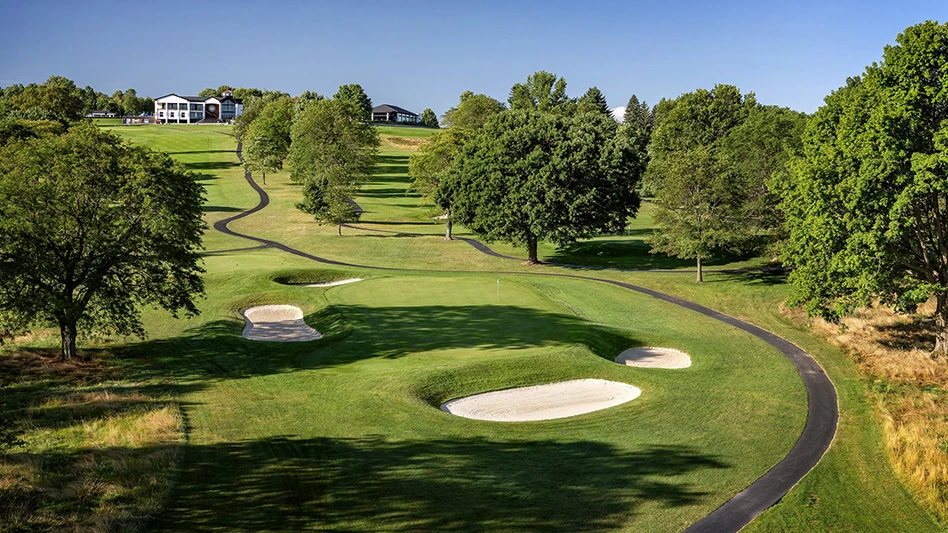
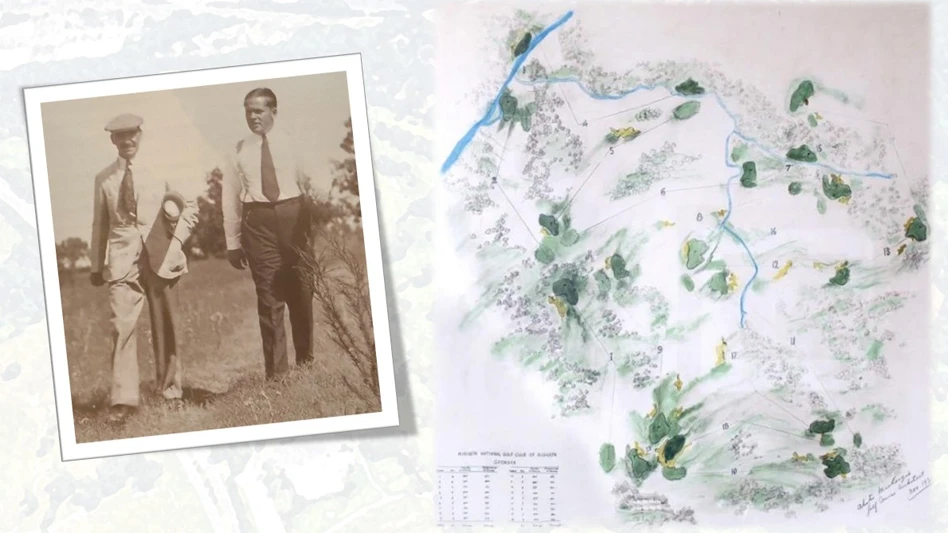
When renovating a vintage golf course, it's a rare luxury to have vintage course photography on hand. When there is vintage aerial photography, the impact is manifold.
Architect Drew Rogers has just that luxury as he and superintendent Terry Poley embark on the long-term improvement of Pine Lake Country Club, formerly known as the Automobile Club of Detroit. Willie Park Jr. laid out the original 9 holes here, in 1919, the same year Edsel Ford was named president of Ford Motor Co., succeeding his father, Henry, one of the club's founding members.
 |
"The story of this club is one of continual transformation and influence," said Rogers, who noted the club changed its name to Pine Lake CC in 1921; Park's back nine opened three years later. "To say the course has been 'tinkered with' since 1924 -- well, that would be an understatement. Holes have been repositioned. Greens have radically changed shape. Holes have been rebunkered and loads of trees planted. Today, it feels like you're playing three to four different golf courses out there.
"However, what the aerials make clear is that Pine Lake in the 1930s was still a superb, cohesive layout. My job is to refurbish the course to that high standard, while also creating a greater consistency of this vintage style and character. That's where the aerial photography is such a huge help. It gives me something to go on, in terms of hazard placement, for example. It confirms some of the observations I had already made about original shapes of certain greens, bunker placement, the alignment of fairways and the presence of vegetation, or lack thereof."
Led by Rogers, the Toledo, Ohio-based JDR Design Group is currently at work on a range of high-profile course renovation projects, at venues both classic and contemporary:
-- JDR is now directing comprehensive renovation programs at three modern clubs in Florida: Quail West and Royal Poinciana on the west coast, Mirasol on east coast.
-- On the vintage front, JDR's long association with the H.S. Colt-designed Old Elm Club, in suburban Chicago, continues in 2014 with completion of an extensive bunker restoration and a delicate re-grassing of all 18 putting surfaces; at Spring Lake CC in Grand Haven, Mich., Rogers is plotting strategic improvements to a classic Tom Bendelow design.
The work at Pine Lake definitely falls into the classic category.
"I have a lot of respect for the knowledge Drew possesses on golf course architecture and design, and have much admired his work at Old Elm Club," said Poley, superintendent at Pine Lake since 1996, having arrived from to two prestigious Michigan clubs, Oakland Hills and Point O'Woods. "With the leadership and vision Drew brings to this project, we will be able to restore Pine Lake's heritage as one of the finest golf courses in South East Michigan."
Originally founded by a group of like-minded automobile enthusiasts in 1902, the Automobile Club of Detroit included founders like John Dodge, Ransom Olds and Henry Ford. Their now iconic surnames in tow, these friends and business competitors first encountered this property when they fled the city on weekends, in their cars, destined for an overnight camping spot on Pine Lake.
In 1905, they formally acquired this picturesque property. Eleven years later, the club changed its name to Automobile Country Club. By 1917, golf had been introduced, as Park had formally planned the course along the bluffs above Pine Lake.
Rogers has been studying the property and its aerial archives since 2012. He reports that the holes closest to the clubhouse, today, are not only Pine Lake's best -- they are the ones that most resemble the Park holes featured in the vintage, aerial photography.
"That gives us a pretty good roadmap to follow, a solid base of understanding that we can use as a stylistic foundation," said Rogers, whose original design work includes the celebrated Club at Olde Stone in Kentucky, Newport National Golf Club in Rhode Island, and Oitavos Dunes in Portugal, ranked #65 on GOLF Magazine's World Top 100 list.
"Our improvement plan at Pine Lake is more than mere design. We want to overcome challenges with drainage, bunker construction, turf health, and address the clutter of trees that has grown up or been planted over the course of decades. Park was a master of the craft. His work here -- in addition to places like Olympia Fields, Sunningdale and Maidstone -- is worth preserving in any way we can. Our goal here is to mesh his legacy with the traditional design idiom in which I prefer to work."
Latest from Golf Course Industry
- Tartan Talks 116: Doug Smith
- Audubon International adds 127 golf courses to Monarchs in the Rough
- USGA’s GAP preps for fourth year
- Protect your vehicles from rodent damage
- VIDEO: Fun with fairways
- From the publisher’s pen: Humble giving
- Syngenta adds two to western U.S. team
- The Aquatrols Company introduces soil surfactant for Canada