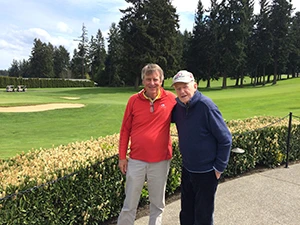
Ken Still begins a lunchtime conversation by telling a visitor his time costs “a dollar a minute.” Fircrest Golf Club superintendent John Alexander knows what awaits and he grins, quickly making the visitor who traveled 2,400 miles comfortable.
.jpg) |
Fircrest is four miles from Chambers Bay, the eight-year-old course that will become the first Pacific Northwest venue to host a U.S. Open. The Western Washington courses might as well be separated by 5,400 miles.
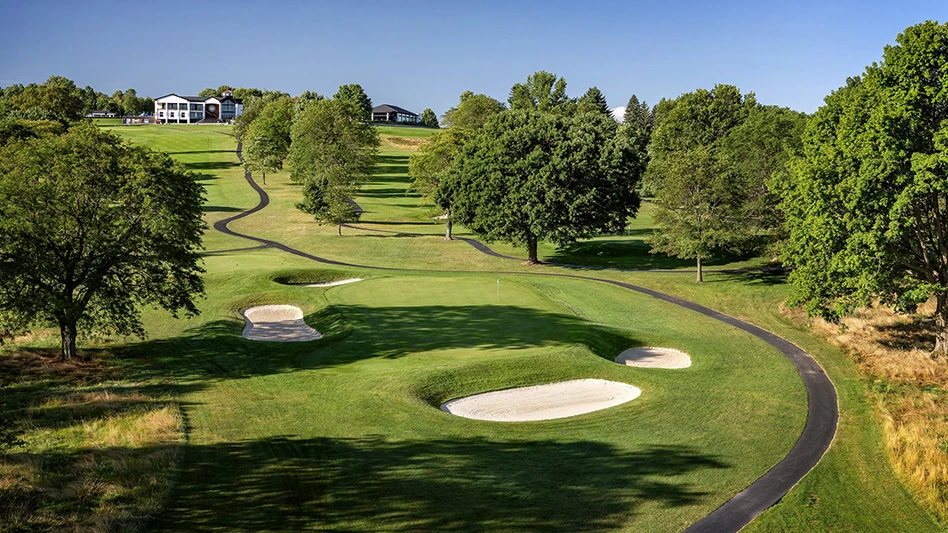
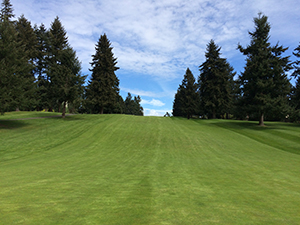
Chambers Bay is a links course that can stretch to 7,600 yards. Fine fescue covers the playing surfaces and one tree rests on the course. Fircrest’s fairways and greens are a combination of bentgrass and Poa annua and towering Douglas fir trees line the 6,600-yard course. The course, designed by lawyer-turned-golf-course-architect A.V. Macan, opened in 1923 and thanks to the recent efforts of Alexander and Canadian architect Jeff Mingay it resembles the place where Still learned the game as a caddie. “It’s a little longer,” Still says, “but it’s still the same golf course. The greens are much, much better. I’m trying to toot John’s horn.”
Alexander grins again, displaying the humble side superintendents possess. When you work for a publication covering the blue-collar aspects of the industry, you try to avoid overhyping the glitz of professional golf. The activities of McIlroy, Spieth and Mickleson mean little to your job. But after spending five minutes with the 80-year-old Still, who captured three PGA Tour titles and bumped Arnold Palmer from the 1969 Ryder Cup team, you temporarily allow the conversation to drift from turfgrass varieties, water management and labor concerns.
 |
Still says people in his region “don’t understand the impact” of hosting a U.S. Open. Organizers are estimating more than 230,000 spectators will attend the tournament, and USGA senior director of U.S. Open championships Reg Jones estimates the tournament should contribute $140 million to the Seattle-Tacoma economy. Superintendents at surrounding courses are expecting fans to develop golf itches and fill tee sheets.
“It energizes the entire Northwest for golf,” says Washington National Golf Club superintendent Trevor Broersma, whose course is 25 miles from Chambers Bay. “It’s timely. You couldn’t ask for a better spring and better winter. So now you have the U.S. Open coming and courses are in the best shape they have been in for a long time. Everybody is talking about the U.S. Open. For me, its’ an important year. We are going to see a lot of overflow because we are close and because we are a championship course as well.”
The Golf Club at Newcastle superintendent Scott Phelps, like Broersma, is bracing for a big week – if the weather cooperates. Newcastle is a Bob Cupp-Fred Couples design 45 miles from Chambers Bay.
“Everybody jokes here that the summer begins on the fifth of July because it rains on the fourth,” Phelps says. “Trying to get ready for that peak of June … You never know what you are going to get.”
Fircrest is hosting multiple outings during the U.S. Open week, according to Alexander. Mingay’s recent work was completed in time to showcase the changes.
 |
It wouldn’t be fair if the U.S. Open at Chambers Bay creates perceptions of widespread links golf in the Pacific Northwest. Our visit to the region also included stops at Washington National Golf Club, The Golf Club at Newcastle, Inglewood Golf Club and Aldarra Golf Club. Fircrest and Inglewood are among Macan’s enduring contributions to American golf, Aldarra is Tom Fazio’s first Pacific Northwest layout, and Washington National and Newcastle are part of former Microsoft executive Scott Oki’s golf stable. We didn’t see one turfgrass stand or hole that remotely resembles anything at Chambers Bay before or after our tour of the U.S. Open site. The only thing the courses have in common with Chambers Bay is a climate conducive to year-round golf.
“Chambers Bay you could easily say is a bit of anomaly,” Mingay says. “Most of the golf courses out there are playing through caves of Douglas firs and here you have this new course that prides itself on having one tree on the whole course. It couldn’t be more different than the majority of the stuff in the area.”
Perhaps nobody has a bigger interest in the portrayal of Pacific Northwest golf than Still, who had never experienced links golf until participating in a Ryder Cup at Royal Birkdale. “I hope people don’t have the impression that all of our courses are like Chambers Bay,” he says. “It’s the only links course in the area, other than that one down in Bandon.”
Bandon Dunes is six hours away in Bandon, Ore., and it’s tossed around in conversations like it resides in the golfing neighborhood. Before anybody considered building courses like Bandon Dunes and Chambers Bay, Still competed on the PGA Tour. “When I got on Tour, hell, the grass … Golf courses were horse manure,” Still says. Alexander politely interrupts Still. “Well, I would add to that Mr. Still, the whole study of turfgrass science. In those days, there were probably some guys who were amazing at what they did, but it’s just like anything else,” Alexander says. “Is an automobile better now than it was in the 1950? In some ways, it was pretty good in 1950. In other ways, it’s nothing compared to the automobile.” Still nods in agreement.
The discussion continues, and Still offers candor on the future of the game (“If it’s dying, I don’t see it. I don’t know how the hell it can die.”), green speeds (“I think the faster the greens, the better you putt. That’s my theory. I’m sticking to it.”), and Fircrest’s strong junior program (“It’s about 120 kids. It’s great. Make them feel wanted. That’s my theory.”). It’s one of those lunches you never want to end, especially considering the view of the tree-lined ninth fairway from inside the dining room. But the skies are clear and there’s a golf course to tour. Plus, the bill for Still’s time is creeping past $60.
Latest from Golf Course Industry
- Tartan Talks 116: Doug Smith
- Audubon International adds 127 golf courses to Monarchs in the Rough
- USGA’s GAP preps for fourth year
- Protect your vehicles from rodent damage
- VIDEO: Fun with fairways
- From the publisher’s pen: Humble giving
- Syngenta adds two to western U.S. team
- The Aquatrols Company introduces soil surfactant for Canada