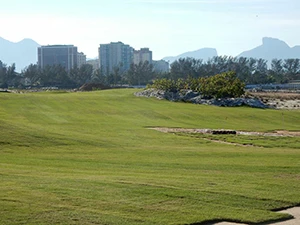
Gil Hanse has never been afraid to embrace a challenge. That would seem to be an ideal personality trait for the man charged with designing the venue for the 2016 Olympic Games in Rio de Janeiro.
.jpg) |
This marks the first time golf will be on the Olympic program since 1904 and Hanse, whose design practice is based in Malvern, Pa., outside Philadelphia, is conscious of the fact that there will be visitors attending the Games and viewers watching around the globe on TV who don’t normally follow the sport. “There will be people watching who have never watched golf or played golf,” he says.
While acknowledging that the attention of viewers and spectators should be focused on the athletes, Hanse and his design team want to give fans of the Olympics as well as golf enthusiasts a vision of “What we believe golf should look like.”
That vision will likely be a little rough around the edges and we mean that in complimentary terms. When Olympic competition gets underway next August, the competitors will see a venue that more closely resembles last year’s U.S. Open/U.S. Women’s Open venue at Pinehurst than a more traditional (by American standards) parkland-style design.
Which is fitting, because two tournaments will be contested, one for men and the other for women. Each will be conducted over 72 holes of medal play with a field of 60 that will be determined by the world rankings. A maximum of four men and four women from each country will compete.
In part because of delays in obtaining the necessary permits, the golf course took 20 months to build. At one stage of the construction process, Hanse, who throughout his career has been renowned for his hand-on approach, actually spent seven months living in Rio de Janeiro with his family.
“I think it was why they picked [Hanse Golf Design] at the end of the day,” he says. “I think that it was our commitment to being there, being in the field and while this took twice as long as usual to build, one of the benefits of that was we had a lot of time to really look and let things sort of simmer and talk about them as a team and let things mature. And if we wanted to, we could go back and edit them. There was no rush to get it grassed. We had some holes that were sitting there for nine months.”
The greens are comprised of paspalum, which is known for its high salt tolerance, while Zeon Zoysia is being utilized elsewhere. Hanse notes that the Olympics will be held during Brazil’s winter in August and the local climate is similar to that of Miami, Fla., with the area receiving approximately 80 inches of rain each year.
The Olympic course, which has no name, is located in close proximity to a number of other Olympic venues. It was built in part out of necessity; when the IOC announced in 2009 that golf would be part of the 2016 Olympic program, it became obvious that a championship-caliber course would be needed for two fields of world-class players. While there is a private club in the area, using it for the Olympics would have presented a number of logistical challenges.
Hanse, who worked with LPGA and World Golf Hall of Famer Amy Alcott on the design, created a layout that is intended to help grow the game of golf in Brail long after the Olympics have departed. It can be stretched to 7,300 yards but likely won’t play to quite that distance for the Games.
Hanse’s favorite stretch of holes encompasses the final three, a drivable par four, a short par three and a reachable par five. “I think they will add some drama to the competition,” he says.
Rick Woelfel is a Philadelphia-based writer and frequent GCI contributor.