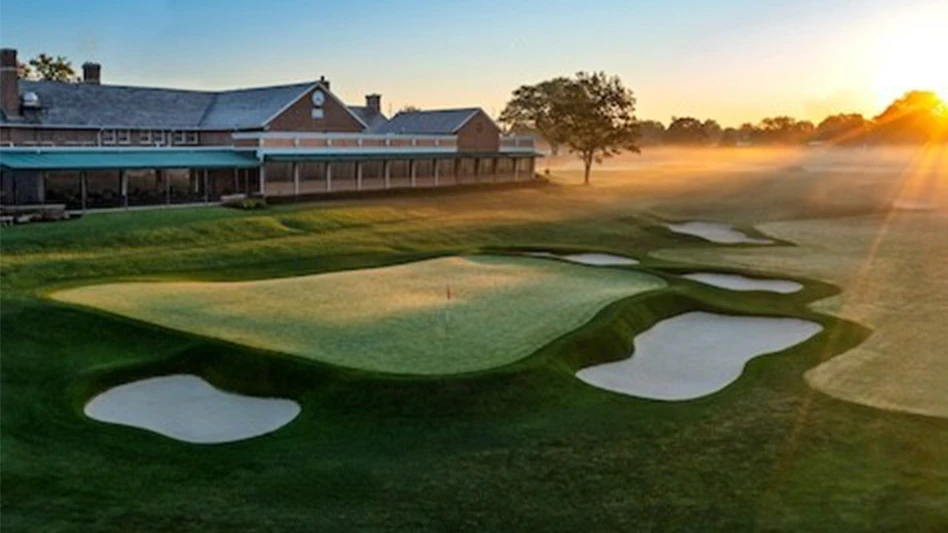
If you’re a golfer who prefers a golf course that is lush and green, you aren’t alone. Golfers of a certain age are accustomed to perfectly manicured greens and teeing areas and closely mown fairways.
But those conditions are a relatively new phenomenon. Take a look at golf course photos from the 1950s or even the ‘60s. If you think things look a little rough around the edges, you’re right. The emphasis on visual ambiance is something that has come about only in the last half-century or so.
.jpg) |
But convincing everyday golfers of that fact can be a challenging undertaking. The United States Golf Association is advocating that golf facilities use less water and addressed the topic at its just-completed annual meeting in New York. This comes in the aftermath of last year’s twin U.S. Opens at Pinehurst No. 2, the Donald Ross masterpiece restored by Ben Crenshaw and Bill Coore.
The course was set up to play fast and firm for both championships and reviews were generally positive.
“It provided a wonderful test for the best players in the world… both men and women,” says USGA president Thomas O’ Toole, Jr., “while demonstrating that a major championship golf course does need not be green to be spectacular.”
As part of the restoration, Coore and Crenshaw eliminated some 40 acres of maintained and irrigated turf. In part because of this change, annual water usage at Pinehurst declined by more than 70 percent.
The average weekend golfer may scoff at brown fairways but USGA executive director Mike Davis notes a fast, firm playing surface often works to the golfer’s advantage. “The golfer has got to learn that they will actually enjoy the game more the drier it is,” he says, “because they’re going to get more distance on their drives and they can bounce balls into greens. It just makes the game more fascinating, because you have to think, ‘What happens when my ball lands? Where is it going to?’”
But while an increasing number of golf course superintendents are open to the idea of using less water, many of their employers/members are not. This puts superintendents in, to put it kindly, in a difficult position.
“Ultimately golf courses are going to give either their members or their customers what they want,” Davis says. “So if people think that lush, green conditions are good, then that’s what’s going to be delivered. (Superintendents) are under pressure from their owner, or their president, or their green chair, or their general manager. They’re going to give what they’re told to give.”
Davis says it’s important to educate recreational golfers to the idea the game can be played and enjoyed on turf that is less than pristine. He points out that some golf facilities are already using less water out of necessity, because of local water use restrictions.
“What’s going to happen in those situations,” he says, “is they’re going to use less water and they’re going be more focused on where it’s really needed. Obviously it’s really needed on the greens, the teeing grounds and fairways, but you’re going to see less water put out on the roughs.
“A generation or two ago, that’s how golf was played and we’ve just widened out the footprint of what we maintain. I think as an association we believe we want to see that footprint narrowed back. It’s good for the game and it’s good for the environment. It’s good for the cost of the game too.”
Davis says in the end it’s a matter of educating the golfing public and encouraging them to be receptive to the idea that when it comes to water usage “Less is More.”
“I think that’s where (the USGA) can be of help,” he says. I think it’s education to golfers, it’s education to facilities, it’s education to people who have influence at those facilities about these things and ultimately I think that slowly but surely, the mindset will be changed.”
Rick Woelfel is a Philadelphia-based writer and frequent GCI contributor.