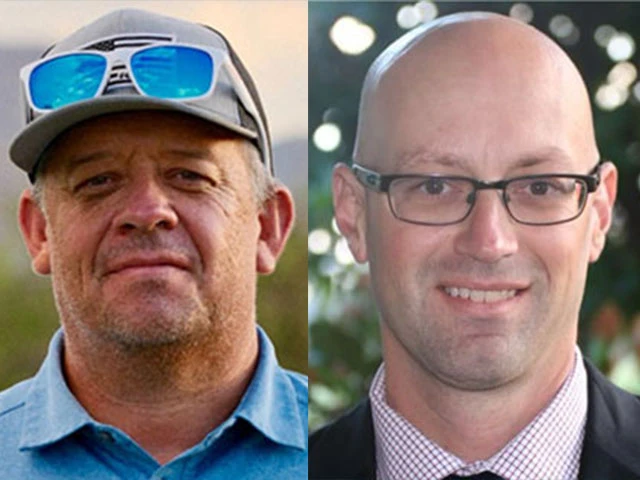
In 2007, Colin Campbell and Doug Cobos helped find water on Mars. Their latest aquatic detection efforts are considerably closer to home.
Campbell and Cobos are the president and the vice president of research and development, respectively, at METER Group, a Washington manufacturer dedicated to delivering real-time environmental data for agricultural, urban and research sectors. Their latest project — and the focus of much of their attention for the last two and a half years — has been working with the USGA to develop the best moisture meter in the world. No small task — and just as challenging as building a thermal and electrical conductivity probe that hurtled more than 127 million miles to measure soil temperature, relative humidity, dielectric permittivity, wind speed and atmospheric temperature.
“It takes a pretty special project to come and get us interested,” Campbell says. “What I’m excited about here is helping people irrigate better and use water better.”
Water management is at the core of the collaboration between METER and the USGA. The 130-year-old association wants to provide the best putting surfaces for its championships and everyday play. It also wants to help golf courses reduce their water usage, evidenced by its Water Conservation Playbook, published in March, which was a result of the 15-year, $30 million sustainability commitment from the organization in 2023.
The Moisture Meter, which was formally introduced in February at the GCSAA Conference and Trade Show in San Diego, is a big first step toward reaching that goal.
The Moisture Meter story starts nearly three years before those big days on the show floor, when hundreds if not thousands of attendees thronged the USGA’s booth. Almost by chance, Bryan Wacker, the director of new market development for METER and Campbell’s brother-in-law, struck up a conversation with Dr. Matteo Serena, then a research assistant professor at the University of California-Riverside. They talked about water, of course. They exchanged contact information. They became friends, professionally and personally. Not long after that conversation, Serena landed a position at the USGA, where he is now senior manager of irrigation research and services.
Around that same time, the USGA was fielding feedback from superintendents about its GS3 smart golf ball. According to Scott Mingay, senior director of product management and engineering for the USGA, more than a few said the ball and the DEACON app on which it operated “would be even better with a moisture meter.”
“I thought it was a crazy idea,” says Mingay, who has helped develop plenty of products during his 12 years with the association. But Mingay is pragmatic and practical. He turned to a water expert — Serena posts on X under the handle @MatteH2O — for his thoughts about developing a moisture meter.
“‘Oh!’” Mingay remembers Serena telling him. “‘I have the perfect guy for you! I’ve got to set up a meeting!’
“We’re always open to taking a phone call, hearing something out, listening to customers,” Mingay says. “I got with those guys and there was so much positivity around areas we could go.”
Nearly 2,600 miles separate METER’s headquarters in Pullman, Washington, and the USGA’s Liberty Corner, New Jersey, compound, where Mingay and most of his team are based. That geographic distance mattered not at all as early as that first phone call. The mutual respect — for science and process and a common goal — was immediate.
“‘We want to have the best greens, and we know moisture is the fundamental piece, and we want to tie it into DEACON,’” Campbell remembers hearing during that pitch meeting. His response? “OK. This is our time.”
“We realized we had something,” Mingay says. “And we wanted to build something.”
The two groups formalized an agreement and signed it in March 2024. From there, they agreed on an aggressive plan — “crazy aggressive, honestly,” Campbell says: Develop, test, and tinker with the Moisture Meter, then introduce it at the next GCSAA Conference and Trade Show.
All in 11 months.

How can a product so steeped in new technology go from blueprint to golf course green so quickly?
“You have to fundamentally understand moisture in the soil,” Campbell says. “We’ve been building really good sensors for a lot of years.” Campbell’s father, Dr. Gaylon Campbell, a longtime Washington State University professor and a research scientist and engineer at METER, and principal scientist Paolo Castiglione had worked for years on the bones of what is now the Moisture Meter. Castiglione proposed some key changes in an effort to make the new tool more accurate than its predecessors — chief among them, negating the effect salt in the soil has on moisture readings — then worked in his lab.
“You can’t do something like this without that technology being ready,” Campbell says. “Paolo’s had to do quite a bit of work. He’s a great research scientist.”
Campbell also approached the short turnaround with questions not about how he and his team would meet the deadline, but rather about what their speedy pace could mean for end users: “What are people trying to accomplish?” he remembers asking himself. “Why is the USGA interested in getting these things out the door? What will be the impact on golf course superintendents if they get these in their hands this year?”
METER produced a couple prototypes, which it shipped to Mingay and his team, who carried them on about 100 course visits throughout late 2024.
“We physically sat down with superintendents, showed them the prototypes, and asked, ‘What do you like about this? And what don’t you like about this?’” says Andrew Kamp, who jumped into the Moisture Meter project about a month after joining the USGA in January 2024 as product manager of data and tools. “We did a fair amount of research and customer feedback before deciding a final form factor. We did a ton of phone calls and online surveys that got us to where we are right now. That’s probably our strongest asset, that we can talk with the industry and they’ll tell us what they like and don’t like.”
Another strong asset? The integration of the Moisture Meter with the DEACON app — especially at clubs and courses already using the GS3 smart ball. There is a difference, Kamp says, with “a moisture meter that will map out your greens, tell you where your dry spots are, where your wet spots are, let you share that with your team, and let you make data-driven decisions.”
Over the course of a single year, the Moisture Meter evolved from prototype to product. Some iterations featured a foot pedal. There was talk about a trigger operation. In all, there were 31 hardware tweaks and another 50 software changes — average for a project of this scope, according to Mingay.
“We did a lot of ergonomic work around balance, the center of the device, how wide everything is, hand size, thumb length,” Mingay says. “All those little tweaks go into it, all those intentional things that take a lot of iterations to get right.”
Mingay started his career in automotive engineering, working for Pratt & Whitney and Ford Motor Company. He still finds inspiration there, as well as in aerospace. “When you’re in an airplane or a racecar, there are thousands of sensors,” he says. “But a pilot or a racecar driver can’t possibly look at all 1,000 sensors. So how do you take all that information and get it down to a couple interfaces that are simple to view?”
The same thinking applies to this project.
The first edition of the Moisture Meter is finished, but the job is still in progress.
METER is working overtime to meet order demands. The USGA, meanwhile, will be listening and reacting to what superintendents tell them about the product.
There will be tweaks. There always are.
The big goal remains being more aware of the water around — and beneath — us.
“In order to manage water, you have to be able to measure it,” Serena says. “My hope for the future is that we are able to generate awareness of being able to use this type of technology. I live in the Southwest, where water is a critical resource. In other parts of the country, where water is abundant, people might not care as much about irrigation. With the Moisture Meter, they can manage water a little bit better.”

Explore the June 2025 Issue
Check out more from this issue and find your next story to read.
Latest from Golf Course Industry
- Reel Turf Techs: TJ Vollmar
- Bernhard and Company names G.C. Duke as North American Distributor of the Year
- Course at Sewanee picks KemperSports for management
- WiTricity expands wireless charging technology
- Shining star
- SiteOne Landscape Supply acquires Reinders
- Talking Turf Weeds 17: Waking up your course after winter with Yusif Jaouni and Matt Herrmann
- From the publisher’s pen: Respect the side hustle