I’m not typically the jealous type, but I must admit to being more than a little envious of the tools and technology available to the golf course superintendent today. And I can’t help but wonder what the great superintendents I worked with and who trained me could have achieved with these modern resources at their disposal.
It’s human nature to compare generations: Bobby Jones vs. Tiger Woods, anyone? But at the risk of sounding like a cranky old man (which I am), I’m convinced that those who set the standards of agronomic excellence before us—Paul Latshaw, Fred Meda, Dick Bator, Brad Kocher and Matt Shaffer, among others—would still excel with today’s equipment.
But there’s a reason I’m making this point beyond patting myself and my generation on the back for what we were able to accomplish. As amazing and efficient as they are, today’s tools can limit your imagination and creativity. They’re just tools. You’re the carpenter, and it’s how you use those tools — including your brain — that will set you apart. So, as I stroll down memory lane, remember that even with our primitive playthings, we still managed to do a very good job. How would you have done with our stone-age gadgetry?
Greens
Today’s mower tech is superb, and the quality of cut is exceptional. More companies are in the game and each new product release manages to outdo one another in precision.
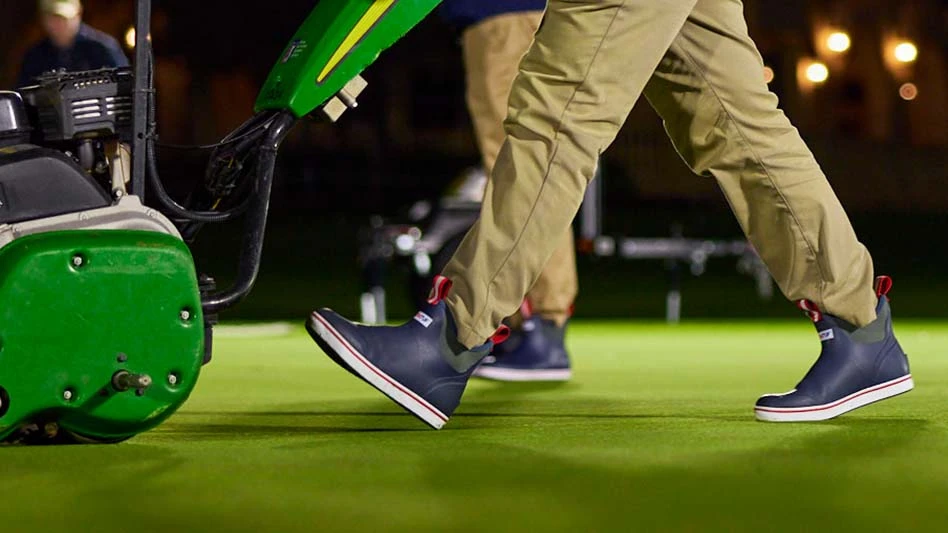
In my day, we were simply trying to put “bricks in the bucket,” double-grind thin-bed knives, fill the drums to create firmness and make multiple passes to get the speeds up. We got to push a 400-pound steel roller across greens to get firmness, while you hop onto a 500-pound roller and make graceful passes.
We didn’t have moisture meters, data balls or other tools to analyze greens. Weigh clippings? Ha! Look in the bucket and see if there are more clippings today than yesterday. Ever heard of a Clegg hammer? Look it up: It’s what we used before penetrometers At my first U.S. Open, in 1987, we used a golf tee to figure out firmness!
And yet, with all of the data and tools, we still get similar information: the greens are too soft or too firm, too wet or too dry, too bumpy or inconsistent.
Meteorology
We succeed or fail based on Mother Nature’s whims. But thanks to weather apps and sophisticated modeling, you’re much better able to predict and anticipate conditions.
My weather forecasting was digital, too: I held my digits in the air to see which way the wind was blowing.
Irrigation
Hand watering was an art that required a sense of feel and knowledge of each surface. One of our most sophisticated tools was a Toro 690 irrigation head, fondly known as the “water canyon,” which shot out water with so much pressure that we had to wrap trees in plastic to avoid having the bark blown off.
Early on, Meda told me hoses were not to be dragged. Instead, I had to roll up the 100-foot, one-inch-wide monster after each green, load it back onto the Cushman, and proceed to the next one. My forearms looked like Popeye’s.
Today’s sophisticated irrigation systems can be micromanaged from your phone. If you want to build up your forearms, you’ll have to go to the gym. But at least you won’t smell like a swamp.
Turf Research
Dr. James Beard’s book—Turfgrass: Science and Culture—never left my side. Now, thanks to USGA grants and hundreds of university researchers, volumes of data, field studies and other information is at our fingertips. Of course, caution is advised whenever you’re sourcing the internet; adapt what you read to your course and your region.
Labor
My first job paid $3.70 an hour to pull hoses, cut holes and mow. Finding laborers who would work long hours outdoors was much easier than today, when even $20 isn’t enough and most of tasks are “too hard.” This may be the only area where the old days were better.
Technology
Smartphones, AI, streaming. You have it, use it. Automation and science are only going to make your life better, safer and more efficient. Keep up with the advances, but don’t forget where the industry came from. The work was harder, but the rewards were just as great.
By the way, when I started in the business, my phone was on the wall. And sometimes I had to put dimes in it.

Explore the August 2025 Issue
Check out more from this issue and find your next story to read.
Latest from Golf Course Industry
- From the publisher’s pen: Respect the side hustle
- Super-Scratch events to expand nationally
- Beyond the Page 78: Labor solutions, AI talk and mayhem
- Construction progresses at The River Club
- VIDEO: A century of innovation
- Sentosa Golf Club preps next generation of turf pros
- Western turf leaders honored by GCSAA for advocacy efforts
- The Canary flies out of the mines