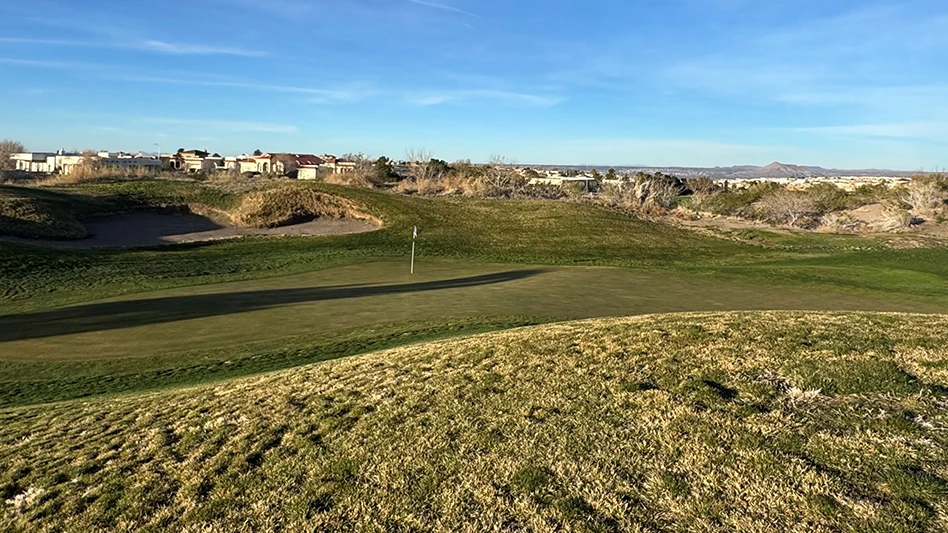
Located in Greenwich, Connecticut, just 20 miles from New York City, inside its own naturistic oasis, Fairview Country Club has been guided by superintendent Jim Pavonetti for 18 years. Built atop a gorge, golfers experience a dramatic elevation change. Surrounding land is owned by the club, the Greenwich Land Trust and the Greenwich Audubon Society. With no neighbors nearby, it’s just Mother Nature and golf course.
“You could see the Long Island Sound from our highest point and at our lowest point you could be 1,000 miles from New York City,” Pavonetti says. “You would have no idea.”
Home to an 18-hole Robert Trent Jones design, Fairview is built on “rugged,” land with no access to city water. The course relies solely on runoff from rain events to recharge its irrigation pond. The course’s watershed flows into the Byram River, which eventually empties into the Long Island Sound.
Pavonetti and his team place high emphasis on preventing inputs from entering waterways, prioritizing water quality and protecting surface run-off.
“The way we manage our ponds on the golf course, the way we manage our fertility and our chemical programs, everything has some type of environmental protection aspect to it,” he says.
Pavonetti and his team make each input decision based on data, as opposed to “feel.” Using moisture meters has allowed the club to minimize water usage and decrease gallons used on the course.
By measuring grass clippings off the greens, alongside monitoring soil temperatures and measuring growth rates, Pavonetti can fine-tune fertility programs. For example, if mowers are picking up a high amount of clippings, then “there’s no need to add extra fertility to that if the grass is already growing.”
The team strives to collect six gallons of clippings from greens a day.
After measuring clippings, the grass is added to the club’s compost pile.

For superintendents looking to make data-based decisions, Pavonetti has some recommendations:
Start with measuring your clipping yields off greens. You can even start by measuring only from one green.
Consider purchasing a soil moisture meter.
After completing the first two steps, start measuring green speeds, seeing how the measurements relate to each other.
To collect and interpret data, Pavonetti uses the USGA DEACON management system and the GS3 smart golf ball. He also uses SkimTurf, which allows him to upload all his data in one place. Pavonetti measures green speed, firmness, trueness, smoothness, soil temperature and rainfall, among other metrics.
Taking it one step at a time is the best way to succeed. After all, Pavonetti and his team’s small steps eventually led to big ones, and now the course is a Certified Audubon Cooperative Sanctuary through Audubon International. Pavonetti also earned the 2025 President’s Award for Environmental Stewardship and the 2025 Healthy Land Stewardship Award from the GCSAA.
“There’s no better time than now to get ahead of it and start now,” Pavonetti says. “Start small.”
Kelsie Horner is Golf Course Industry’s digital editor. To submit ideas about conservation-focused programs or actions at your course, email her at khorner@gie.net.

Explore the March 2026 Issue
Check out more from this issue and find your next story to read.