The staff at your nearest Waffle House is working hard to serve others, 24/7, not unlike a superintendent during a renovation. Waffle House, founded in 1955 by Joe Rogers Sr. and Tom Forkner, has expanded to 1,900 locations in 25 states. Their secret? “We aren’t in the food business,” Rogers famously said. “We’re in the people business.”
The restaurant business is competitive and so is the private golf club scene, particularly in Charlotte, North Carolina. Pine Lake Country Club, established in 1952 and located a few miles east of the city in Mint Hill, chose to invest in their course and its infrastructure with a complete renovation.
Pine Lake superintendent Will Laine has a similar take to Rogers. “We are in the smile business,” he says. “We are in the business of putting smiles on people’s faces. Seeing golfers high-fiving each other on the greens or hooting and hollering because their shots bounced right up to the cup — that’s what it’s all about.”
Smiles increase when a course is meeting expectations, and Jeff Lawrence, architect and owner of Lawrence Golf Design, listened to members to understand what they wanted. “We discussed why every hole should be memorable,” Lawrence says, “and we agreed on Pine Lake, reimagined.” A fresh design concept was developed and implemented, in contrast to the former, repetitive green complexes surrounded by repetitive contouring.
Lawrence has a breathtaking résumé, garnering years of experience with the design firms of Jack Nicklaus, Gary Player and Tom Fazio. Establishing his own firm, he is choosing projects he will fully engage with, being on-site often. Clients work with him directly, facilitating communication and efficient decision-making. The results of that dedication are easy to see at Pine Lake
“Our overall purpose was to make the course more maintenance-friendly and playable,” Laine says. “Not fun and easy, but more enjoyable for high handicappers.” Laine and Lawrence know that a great course starts with great infrastructure.

Aspen Corporation worked with the team to install truckloads of sod and helped sprig greens that increased in size by about 10 percent. They also helped with shaping and grading and were responsible for several other aspects of construction, finishing their work in July. More than 600 trees were removed to allow for more sunlight and to improve turf quality.
“We can’t provide good playing surfaces if we don’t have the means to do it,” Laine says. “With all the changes that have been made to the greens complexes, the approaches, and the additional drainage around the greens and in the fairways, the golf course is much more playable.” There are also a lot of ways to play the ground game.
Underground, there is a new Toro 2-wire irrigation system with Infinity heads, powered by a customized Watertronics pump. There are all new HDPE pipes, valves — everything — and it’s working beautifully.
In addition to the new irrigation system, the power lines across the property were moved below ground. Union Power Cooperative decided to bury them during the renovation. “From a logistical standpoint, it’s made things interesting,” Laine says. The power lines cross seven holes, the parking lot, the driving range and the clubhouse. Oh, and the cart barn and the pro shop were also renovated!
Nick Mazzella, owner of The Mazzella Partnership, a national golf course construction project management firm, calls Charlotte home and was thrilled to help assemble the project team. Mazzella also helped establish and monitor master project budgets and schedules. The extra eyes, ears and firepower have been helpful.
“Pine Lake is a great club and this project is really going to put them on the map here in Charlotte,” Mazzella says. “Kudos to Will, who has shown exceptional poise and leadership throughout the entire process. Will handled everything in stride and balanced more than most, considering the additional complexities.”
Hole improvements
Design, infrastructure and agronomic changes have all been significant. Par shifted from 72 to 71, due to No. 10 becoming a par 4 instead of a par 5. There were spirited debates about this, but the objective was to create the best hole for that location, not achieve a certain par. Besides, No. 10 is a special spot. “In the fall, you can see seven greens from here,” says Laine, smiling. “This is where I drink my coffee.”
Total bunker area has decreased by 40 percent and the bunkers are vastly improved. Previously, there were a few that some members could not physically get in and out of, and nearly $80,000 was spent annually on bunker maintenance. After heavy storms, pumps had to be borrowed to remove the water and it was taking the crew a few days to repair them. By installing an aggregate liner, bunkers can now be maintained by a single crew member in a few hours, even after severe rain events.
Moving in a different direction with turf selection has improved every hole. Laine knows that maintaining bentgrass in Charlotte is tricky, and Pine Lake opted for wall-to-wall Bermudagrass. 419 Bermudagrass in the rough and fairways made it easy to sod everything initially, and define the fairways later. Tahoma 31 Bermudagrass works for the tees and approaches, and the greens are TifEagle Bermudagrass. Covers for all 21 greens — those on the course and the three practice greens — are ready for winter.
Fortunately, the summer was ideal for growing Bermudagrass. “Honestly, I could not have scripted a better weather pattern,” Laine says. “It was very, very hot, and very, very humid. There was not a lot of rainfall, which is good for growing in sprigs because you can control your moisture.” Two thunderstorms meant that two small areas had to be re-sprigged, but the damage took little time to fix.

The lack of rainfall did translate to concern for Pine Lake’s irrigation ponds, which are replenished with stormwater runoff. “I started to sacrifice other areas of the golf course to make sure I didn’t run out of water on the greens, but everything is fine now,” Laine says. That is an example of the choices superintendents must shoulder, striving to balance resources.
There are hybrid tees on Nos. 11 and 14 and, for most players, No. 11 will be the hardest hole with a bunker directly in front of the green. No. 12 has changed the most, partially because that green used to flood and it has drainage improvements to prevent that from happening. Visuals on the 12th are also completely different.
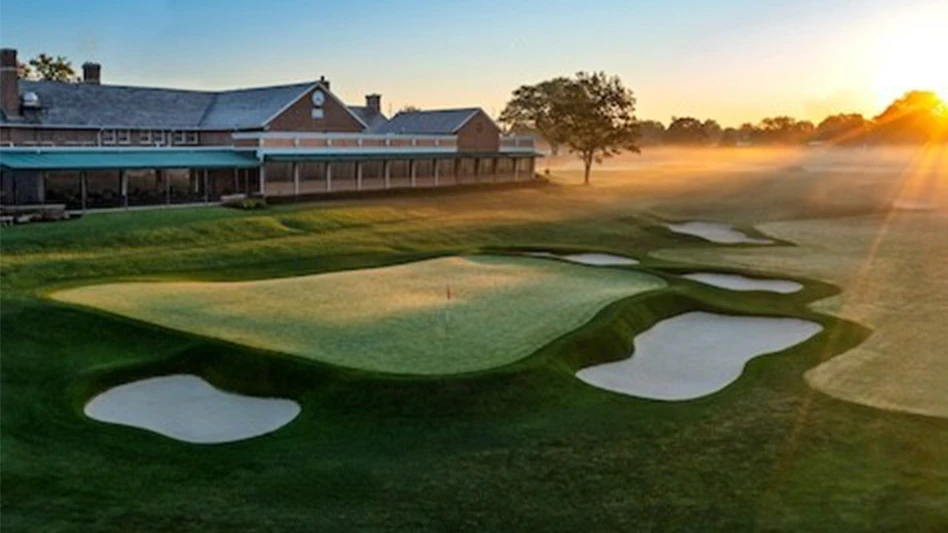
“That was the most bulldozing we did on property,” Laine says. “The green moved 15 yards to the right and the hole was shortened by 25 yards. It’s got a really cool view, framed by two bunkers, a really large pine tree and a Japanese maple behind the green. The slopes around the green, the bailouts and the short grass really frame it.”
Members talk about No. 12 all the time, frequently stopping Laine in the clubhouse with questions. Ninety-one percent of the membership voted in favor of the renovation and Laine hosted three course tours during construction. Members are invested. The maintenance team provided updates with the help of a DJI Air 2S drone (see Drone decisions, p. 20), capturing photos and video shared through the club newsletter.
“I am eager to hear how the members feel about the new design, conditioning, aesthetics, playability and more,” Lawrence says. “They entrusted me with a big undertaking, and I think the collective team effort by many dedicated people has delivered an exceptional product. The overall Pine Lake golf experience has dramatically improved, which will help the club continue their success in the competitive Charlotte market.”
Time management
One of the more difficult challenges for superintendents leading renovations is balancing competing demands for their time. “Time management has definitely been one of the hardest parts of this for me,” Laine says.
One way he coped — and navigated his way through some sleepless nights — was recognizing the need to share responsibilities with Pine Lake assistants Daniel Ritter and Alex Riesenberg. He also leaned on Scott Blair, Pine Lake’s equipment manager. “We couldn’t do it without them,” Laine says. “Those three are my core management team.” Additionally, there were 15 full-time staff working hard and the seasonal help all returned, bringing significant talent and experience to the club.
“Toward the end of the renovation, there was definitely some fatigue and burnout, and I could see that in their faces,” Laine says. “I tried to do little things here and there to boost morale.” Laine sent the crew home early on rainy days, or took them to Waffle House for breakfast, and there have been cookouts.
“I kept reminding everyone that the end is in sight,” Laine says. “I told them that we weren’t going to be hand watering sod every single day or fixing ruts from trucks driving up and down the cart paths. That stuff was ending.”
Laine was thoughtful with the crew and he was thoughtful in reflection. “It surprised me how much anxiety and stress came with it,” he says. “I knew that it was going to be a challenge, and I have always struggled with stress and anxiety. That’s something I am not afraid to admit, but there were times that I would wake up and have a little panic attack. I was wondering how we would get it all done.”
Organically, Laine developed the talented members of his team and maintained oversight. “My assistant superintendents were able to take some of the burden off my shoulders and I could delegate some of the tasks,” he says. “I’m grateful for them.” For instance, instead of Laine writing monthly for the club newsletter, he established a rotation, with Ritter and Riesenberg also contributing articles. They all operated the drone. Plus, everyone documented daily project activity in a spreadsheet. It was great for referencing what happened when on the course, and who was accountable. Spreadsheets helped accumulate agronomic data.
They also took turns as point person for the different crews on site and would meet early in the morning or before going home to ensure smooth communication. This was beneficial for the development of the assistants, as well as creating a broader balance for the project.
“As superintendents, we want everything to be perfect,” Laine says. “It’s hard to see the light at the end of the tunnel when things are dirt. Going into this project I knew that I was going to need a strong team. I didn’t know how much I was going to need them.”
Laine is looking forward to paying more attention to the details. The hours spent fixing bunkers and doing irrigation repairs can be spent focusing on acute work that makes a big impact. “We can edge curbs, or prune beds or do some tree work,” he says. “There’s a laundry list of things that we can now do that we didn’t have time to do in the past. Actually, I’m ready to dust off the clubs and go play a round myself.”
Praise should be shared widely. Laine has been resourceful and steady, nurturing the course and developing an accomplished, forward-thinking management team. With a dynamic, maintenance-friendly design by Lawrence, the members now have a course that has been reimagined. For everyone involved, whether together at the Waffle House or, better yet, while enjoying Pine Lake Country Club, it’s time to smile.

Explore the October 2025 Issue
Check out more from this issue and find your next story to read.