The Minnesota Vikings, founded in 1960 as an expansion team in the National Football League, wear bold purple and gold uniforms and compete fiercely in the NFC North. Their logo is the profile view of a scowling Viking, and their fans show support by yelling “skol” following two strong drumbeats.
“Skol” is derived from the Scandinavian word “skål,” meaning “cheers.” It’s a myth that it was ever a Viking war chant; rather, it was a toast when sharing a bowl filled with liquid. One person would take a sip, pass the bowl and say “skål” to the next person, who would take a sip and pass it on. “Skål” is a statement of solidarity and a call to action, and a similar momentum is blowing through Windsong Farm, a private club 25 miles west of Minneapolis.
Opening in 2003, the South Course at Windsong Farm was designed by John Fought and Tom Lehman. The operation faced foreclosure in 2012 before being purchased by David Meyer, retired CEO and founder of Titan Machinery. Established in 1980, Titan Machinery is a Fargo, North Dakota-based retail farm and construction equipment company with store locations in the United States, Europe and Australia. Meyer and his family have always been involved with golf.
Across the street from Windsong Farm is Pioneer Creek Golf Club, a public facility built by Meyer’s father. Meyer’s sister, Marcia Kreklow, runs this 18-hole layout, where her son, Kyle, is the superintendent.
Windsong Farm shares a mechanic with Pioneer Creek along with equipment when they need it, and Windsong Farm members receive playing privileges at the course.
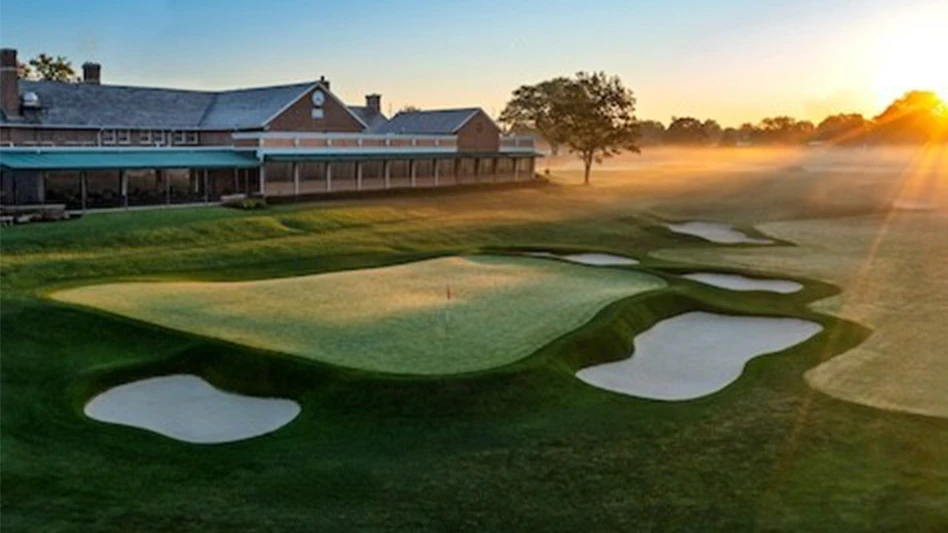
The private club is definitely growing. The property has shifted from 18 holes to 36 with the opening of the North Course, the pro shop has been expanded and refurbished, and there are ongoing improvements and expansions happening with the clubhouse.
New guest houses are also being planned, to add to the Murphy House, where members and guests are welcome to stay. With multiple en suite bedrooms; a rustic, cozy-chic décor; and spectacular views of the South Course, it is constantly booked. The firepit and lighted putting green add to the Murphy House experience.

The clubhouse staff are attentive, and artifacts and memorabilia from Windsong Farm’s history are displayed. Meyer’s wife, Kandi, is knowledgeable in sharing that history, as the property was once a horse farm. With a background in fashion, Kandi has a flair for merchandising, incorporating the new Windsong Farm logo that pays homage to that history. Make no mistake, though, this is purely a golf club.
“I don’t think I have ever had more fun on a project where the team was working for one common goal,” Fought says of designing the North Course. “The team was committed and passionate about creating a new course that not only complemented the beautiful Minnesota landscape, but was also inspired by creating some of golf’s most treasured holes.”
The North Course is vastly different than the South. The South Course is a championship layout, overseen by superintendent Austin Augspurger. Stretching to over 7,500 yards, and home of the Gopher Invitational, hosted for more than a decade by the University of Minnesota, the course has wide fairways, strategic bunkering, and greens that roll true and fast.
The North Course, cared for by superintendent Dylan Skattum, is set on approximately 125 acres. There are several template holes, including a Biarritz, Redan and Cape. Nos. 13 and 16 share a double green. With a classical design, this par-70 layout can play up to 6,492 yards. The connections are tight; shot-making is favored over long drives.
These courses are maintained by one strong team, led by director of agronomy Jon Dailing, who is both a coach and the quarterback. He directs the plays, encourages his teammates and works hard beside them. Dailing has a propensity for numbers, easily sharing quantities, volumes, dates and costs for everything. It’s no doubt part of the reason that Meyer trusts him. He’s capable, confident, honest and has a great work ethic. Meyer gives Dailing a lot of autonomy.
“It's great working with Jon,” Augspurger says. “He keeps it loose and fun while holding everyone accountable, and we couldn’t ask for a better owner. He trusts us to do our thing, which is important.”
Rounding out the team leaders are three assistants, three mechanics and four crew foremen. The staff can swell to nearly 50 people in peak season, which is a little tight for morning meetings. With more staff and more equipment to provide for two courses, there are plans to renovate the maintenance facilities.
“The three assistants rotate,” Skattum says. “We want them to get to know everything for both courses, what needs to be done and what to look for.” A property-wide mentality is prioritized over a narrow focus.
“I enjoy the strategic planning to develop and improve Windsong long-term,” Augspurger says, “and I really enjoy working with the staff and learning their strengths and weaknesses in an effort to build a cohesive team.” This paid dividends during construction of the North Course, as the crew demonstrated flexibility and depth.
North Course development
Construction of the North Course was challenging, with an incredible result. Meyer empowered Dailing to work closely with Fought. “Dave let me work with John on the design and he let me make sure that the course would be very economic and maintenance-friendly,” Dailing says.
Windsong Farm decided to move forward with the North Course in 2021, and the permitting process began immediately. Fought, Dailing, Ahren Habicht, Midwest/national general manager for Duininck Construction, who executed the work, and Rich Quisberg, a shaper from Duininck, took a trip to the Chicago area to study Golden Age courses. This provided a great foundation for conversation and understanding about the potential and objectives for the North Course.
Dailing contacted Derek Lash, from Emmons & Olivier Resources (EOR), a water-resource-based engineering and environmental consulting firm, to establish what they would need for permitting for wetland and stormwater management. Duininck and EOR both worked on the South Course, and it was helpful to have experience with key contributors.
Dailing’s least favorite part of the entire project was the permitting — and for good reason. Evening council meetings were tedious, and the process dragged. Construction was supposed to start in fall 2022, but the permitting process wasn’t complete.
Their luck changed when Duininck took a massive risk. “They brought all of their heavy equipment here in the last week of April of 2023, and we received permit approval three days later,” Dailing says. “The next two council meetings were cancelled so we wouldn’t have started until June. In a way we got lucky, but we were also four months behind. Thankfully, 2023 was dry and Duininck got us caught up.”
Duininck has its headquarters in Minnesota, not far from Windsong. “We have been a builder partner and friend to the club, ownership and staff for many years,” Habicht says. “The construction activities took seven months and the weather was about perfect. The 2024 grow-in season was met with many untimely weather events that caused the repair of washouts many times over. Being a good partner, we kept a crew on from the last day of construction all the way through grow-in.” Matt Dufresne was the Duininck superintendent, and he was a popular colleague throughout the project.
Erik Christiansen of EC Design planned the irrigation for the North Course. “He did a wonderful job,” Skattum says. They have Toro irrigation with just under 1,000 new Infinity heads, and there is a Flowtronex pump station on each course. “It’s actually kind of fun, when you can control each individual head,” Skattum adds. “Our coverage is really good. We did bore a pipe so we can directionally connect the holding ponds. If one pump station goes down, we can pump water to the other course.”
Toro was another contributor. “Toro did support us, like beyond tomorrow,” Dailing says. “They knew we would need more equipment, and they were honest that it was going to be 14 months to get it. They loaned us equipment to grow in the new golf course and that was a game changer for our mechanic. We had fairway mowers, enough to keep up, so that helped. It really did.”

Windsong Farm had great partners, but it wasn’t all luck. Great people (and a few dogs!) make a big difference. The members love the course hard and fast. “With our membership, we push the grass for the best playing conditions possible, and they are fully supportive of that,” Dailing says. Some years the rough doesn’t even get fertilized. The members prefer a brown aesthetic and about half prefer to walk.
Local and returning seasonal staff also helped the project run smoothly. “Our HR manager, Carrie Klinkner, is extremely good at her job,” Dailing says. “At a job fair this year we had almost 150 applicants show up for Windsong. She will go anywhere within 20 miles — gas stations, colleges, schools, McDonald’s, wherever, and hang fliers and ads.” Windsong is a great place to work.
“Our turnover has been low,” Dailing adds. “It helps that we hire 16-year-olds. Other courses have a minimum age of 18, but we believe there is plenty that 16-year-olds can handle. The hope is that they work for six years. By the time they start mowing, they know how to do everything. We abide by the rules, and we are honest with new hires about what they will be doing, but we are smart with our resources.” And they take care of the people they hire.
“I have been adamant,” Dailing says. “We make sure that the team is well compensated and has great working conditions. We have a safety-first culture and a focus on employee career paths. We train everyone the best we can and if they’re happy, why shouldn’t we keep them here? If they are looking for a job, I will do anything to help them get it. They know that. What I love is that we have had so many people work their way up. We have great camaraderie.”
Skattum and Augspurger both enjoy the team. “It’s really awesome. I do like working for Jon,” Skattum says. “He’s a great mentor, he’s taught me a lot. Jon’s really good about hands-on learning. He wants me to learn from my mistakes but he’s helpful with not letting me make them.”
Opening the North Course has been deliberately slow, with 20-minute tee times and cart restrictions. Both the South and North courses have bentgrass tees, greens and fairways. The rough on the North Course is bluegrass and turf type tall fescue, but the South has only bluegrass. The native on the South Course is bluestem and Side Oats, a 50-50 blend, and the native on the North Course is 100 percent fine fescue.
Around the bunkers on the North Course the turf is 100 percent turf type tall fescue, selected for its irrigation and fertility requirements. The turf type tall fescue, with zero fertility, was much greener at the end of summer than the bluegrass, which had received a pound of nitrogen. The rough, all 20 acres of it, was sodded, and the bentgrass and fescue was all seeded.
There are around 40 bunkers on the North Course, many of them rectangular, evoking throwback simplicity. Best Sand, from Ohio, is kept to a depth of four inches.
What’s happening next?
Projects for the fall include addressing a muskrat issue. “They are invasive,” Dailing says. “On the South Course, we are going to completely strip two putting surfaces, the damage is that bad. It’s crazy. We can trap in the off-season, but we are also trying alternative deterrents.”
Windsong is moving forward with cultural practices. “We are hitting it hard with verticutting and heavy sand topdressing for our kind of puffy, thatchy areas,” Skattum says. “That’s totally normal on a grow-in and things are looking really good. We have a ways to go, but I’m happy.”
The crew is excited about the flexibility 36 holes offers. This year they closed the South Course for two weeks for annual aerification. Everyone noticed the huge improvement that comes with that kind of rest and recovery.
The courses close for the winter, usually in early November. The clubhouse operates with reduced hours, but it stays open for member dining and corporate functions during the holiday season. The Murphy House remains booked and the maintenance team ensures that the property is plowed, in addition to grooming trails for the members to enjoy cross-country skiing and snowshoeing on property.
“Windsong is a very special place,” Augspurger says. “It’s a what-you-see-is-what-you-get kind of course. I truly enjoy working here and growing with the property. And because we like each other’s company so much, we decided to form a bowling team four years ago, where Dylan, myself and the three assistants spend an additional four hours together on Thursday nights. It’s something I look forward to.”
Skol.
Born of camaraderie. It’s not originally a Viking war chant but the word is powerfully unifying whenever the Minnesota Vikings are playing. With a mix of good colleagues and friends, a common purpose can bring something special into existence that wasn’t there before. That’s what’s happening at Windsong Farm.

Explore the November 2025 Issue
Check out more from this issue and find your next story to read.