
I graduated from Kent State University less than a year ago, and one of the things I felt the loss of was the classroom setting. Call me a nerd, but school and education have been a key component of my life, and I wasn’t ready to leave them behind.
When I began my role as assistant editor, I quickly realized I am still going to learn and better myself. I just have a different classroom. My textbooks became previous industry articles, my teachers became my interviewees and mentors.
Thanks to the GCSAA Conference and Trade Show, I revisited the classroom setting in San Diego. As a part of the show, educational sessions on trending topics are available for attendees and exhibitors.
At the conference, I had the opportunity to learn from numerous industry greats.
I listened to Iowa State’s Dr. Quincy Law discuss all things soil organic matter. Law walked attendees through how soil organic matter impacts turfgrass, and how to determine what your soil is lacking.
Gina Rizzi, president of Radius Sports, carried on the environmental conversation with the industry’s 2025 trends and best management practices. Trends she mentioned that will impact the industry this year include:
- Regulation and corporate responsibilities
- Energy transition and fossil fuel dependency
- Urban sprawl and loss of biodiversity
- Water scarcity and management
- Plastic pollution and waste management
Rizzi didn’t just introduce issues. She presented solutions and practices that courses and superintendents can research and implement for each trend, spawning an endless amount of story ideas for writers like me.
The “Turf Solutions” session covered an area I’m not as familiar with: soil, soil amendments, biosolids and topdressings. Inputs and its impact on irrigation and humic products had my mind running wild, but I ended the session with knowledge on what I need to study more.
After discussing inputs, Dr. Gregg Munshaw, director of agronomy at Pratum Seed Companies, discussed the pros and cons of not mowing roughs on the course. He discussed the benefits of letting your roughs grow in, and planting wildflowers in those areas. As shared in his lecture, pollinators are responsible for $29 billion in crops — and every third bite of our food. According to the U.S. Fish and Wildlife Service, due to native plants being replaced, pollinator habitats are shrinking. By planting wildflowers on your course, you can help reverse those statistics.
Munshaw described the best options for wildflower choices and how to create a seed mix that works for you. Outside of the environmental benefits of wildflowers, they are aesthetically appealing as well. And if I step on a course and see the flowers, I instantly enjoy the view.
My educational day ended with discussions on data and data-driven decisions. The industry is facing a major shift to technology in many ways. Artificial intelligence, autonomous equipment, endless inventions and improvements. Thanks to technology, access to data and information on your course is at an all-time high. Former Desert Mountain Club turf leader Shawn Emerson discussed how his team processed that data, and how it impacted the course.
Emerson used a quote during his lecture: “The world is run by those who show up.”
The quote stood out to me and is now written on a sticky note on my desk. The idea can be applied to many aspects of your life. You show up for your family, your friends, yourself. It also applies to your career. Working in an industry I knew little about has showed me that if you show up, and put forth your best effort, the knowledge and relationships you can gain are infinite.
Showing up to the trade show and educational sessions allowed me to learn more about turfgrass and the golf industry. But more importantly, it allowed me to meet so many people who make this industry so great, who can only continue to teach me more.
Kelsie Horner is Golf Course Industry’s assistant editor.

Managing editor Matt LaWell walked around the PGA Show for the first time. What did he learn that can relate to everyone who works in golf?
Somewhere, there is a list of truths about trade shows — things you need to know to survive a day or two or four on the floor:
Pick up a map — preferably printed on paper and not just available on an app on your phone — before heading in.
Bring a notebook — and a cell phone charger — along with that stack of business cards.
Wear comfortable shoes.
Spend some time standing on the padded carpet.
Remember to eat.
And remember to drink. Drink what, you ask? Morning coffee if you need it, an afternoon beer if some company or another is just giving them away, and water the rest of the day. Always water.
There is one truth that tends to be lesser known, because so many trade shows are in spots with favorable weather, and it is this: When the weather turns — and especially when the rain starts — everybody heads indoors and the show really starts to fill up.

The 2025 PGA Show was absolutely packed.
Rain had poured over Orlando for the first two days of the show, courses across a golf-crazed corner of the country were soaked, and so many people were walking around inside the Orange County Convention Center — hopefully in comfortable shoes. People in every direction, hawking clothes, selling simulators, showing off the latest tech, most dressed for an afternoon in the clubhouse. And most people were never walking at their own pace, always at the same speed as whoever was in front of them, and there was always someone in front of them. Turning left into some other aisle should have required a signal.
This PGA Show was the biggest since 2009 — the last to be booked before the Great Recession sparked financial collapse and the end of the Tiger Boom. More than 1,000 companies. More than 7,000 professionals. More than 30,000 attendees. More than — ahem — 1 million square feet of show floor space. Heaven help anybody in there who lives with ADHD and forgot to pack their medication.
The floor was so big that the show felt like three or four shows all under one roof. Just like 1980s and ’90s kids, you could choose your own adventure. Golf Course Industry publisher + editor-in-chief Guy Cipriano and I opted to spend most of our morning checking out simulators: Golfjoy. Golfzon. EZ Golf. Inrange Golf. Uneekor. SimBooth. Nvisage Technologies. Foresight Sports. Science & Motion Sports. Want to add or upgrade your indoor offerings for 2025 and beyond? No matter your budget, your physical space limitations, or your knowledge of the tech, there were hundreds of options that seemed perfect.
One simulator marketing manager told us that when he entered the space a decade and a half ago — around the time the PGA Show was last this big — you could count the simulator companies on the floor on one hand. Another told us that the simulator market is already worth more than $1 billion and will likely hit $3 billion in the next year or so. A third equated the simulator sub-industry to being not in its infancy but in its teenage years — in large thanks to the exposure that TGL has given the technology. “That alone,” he said, “has been enough to make people Google, ‘How much does a launch monitor cost?’”
And how much does a launch monitor cost? Depends how much you want to spend. Still another marketing manager compared some offerings to Honda Civics and others to Ferraris. (No surprise: he said the one he’s selling is a Ferrari.) You can get in the game for less than $10,000. If you want a new building full of bays designed to spike membership and give your club a year-round golf community, you can spend seven figures pretty quickly.
No matter your opinion about simulators, one thing that seems certain is that they’re not going away: According to the National Golf Foundation’s most recent Graffis Report, released in January and worth every second you spend reading it, among the 47.2 million Americans who played golf last year, only 11 million played exclusively on the course. Another 17.1 million split their time on and off the course. The remaining 19.1 million played only off course. And for at least the second consecutive year, every age demographic under 50 is playing more golf off course than on.
How many of those 19.1 million off-course-exclusive golfers will ever play a round on grass? That is one of the more pressing questions — if not the most pressing — for the health of the game as the 2020s march forward. But what pros and superintendents alike can do is maximize every experience in the clubhouse and from the first tee.
Late during our day on the floor, Guy turned to me and said, “If I were running a golf course, I would send the superintendent and the professional, together, to the PGA Show one year and the GCSAA Conference and Trade Show the next.”
Plenty of pros could absolutely stand to learn more about agronomy. And plenty of superintendents could become better at what they do by stepping outside the tiny — and incredibly important — part of the industry they’ve mastered.
They just need some comfortable shoes for walking around.
I saw some flashy new pairs over on the far side of the floor.
Matt LaWell is Golf Course Industry’s managing editor. He walked 23,435 steps during his one day at the PGA Show.
Tartan Talks 104
Come for the golf course architecture discussion. Stay for the hiking recommendations.

A Tartan Talks episode with Alex Hay quickly develops into an audio journey.


Hay lives in Whistler, British Columbia, was raised in the United Kingdom, and has traveled the world through a passion for the outdoors and his work with Lobb + Partners Golf Course Architects. He melds golf and nature in his work — and through his words. When he needs design inspiration, Hay simply steps outside his home.
“I feel very fortunate to live in a place where you can walk out your front door and go on some incredible hikes,” he says. “It’s a great place to hike. If I’m slow at my desk, going on a trail run helps me gather some thoughts.”
Hay shares plenty of thoughts about solving issues on urban courses, working with a 10-course operation, golfer safety, compact options, and global golf development on the episode. Like many of his peers, these represent busy times for an architect approaching the peak of his career.
“You look at where other ASGCA members are working and there are definitely some faraway, amazing places that probably wouldn’t be considered for golf a few years ago,” he says. “It wouldn’t be a surprise to get a call from anywhere.”
The audio journey can be found on the Superintendent Radio Network page of popular podcast distribution platforms.
INDUSTRY BUZZ
The USGA announced the launch of the USGA Moisture Meter. The tool is designed to provide superintendents precise data regarding soil moisture, salinity and temperature. The data instantly uploads into the USGA’s DEACON technology platform, creating a digital record that can be used to manage water usage, plant health and golf course playability. … Toro released its Intelli360, a web-based digital toolkit available for golf course managers and superintendents. The platform simplifies golf course turf equipment management and gives superintendents access to extended data for decision making. Toro also introduced a new irrigation platform and two new autonomous units. Lynx Drive is a platform designed to meet specific irrigation management needs for golf course superintendents and their teams. The company also announced its Turf Pro mower and Range Pro golf ball picker. … Tee-2-Green is rolling out Elite Bentgrass Blend, a new mix of two of their highest performing bentgrass varieties. Elite combines the best characteristics of Crystal Bluelinks and Pure Select to create a new blend. … FireFly Automatix unveiled a software update focused on starting points, boundaries and keep-out zones for the company’s Autonomous Mowing Platform. … Turf Materials announced partnerships with six sites located in Texas, Arkansas and Mississippi that will produce COMANDsand and COMANDdivot, expanding the product reach.
COURSE NEWS
The Cabot Collection is opening Cabot Citrus Farms, a 1,200-acre sanctuary among Florida’s picturesque Nature Coast. Marking the brand's U.S. debut, the property features two revitalized 18-hole golf courses, Karoo and Roost, and two unique shorter courses, The Squeeze and The Wedge. The varied 57 holes are designed by Kyle Franz, Mike Nuzzo, Ran Morrissett and Rod Whitman. … Boyne Golf in Northern Michigan is adding a new par-3 short course, Doon Brae, and a Himalayan-style putting course, the Back Yaird, both designed by Ray Hearn and scheduled to open this summer. The new short course will be Boyne Golf’s 11th course. … Construction started at Esplanade at St. Marys, a new resort lifestyle community located on the Georgia Coast, just north of Jacksonville, Florida. Esplanade at St Marys is incorporating numerous amenities into the project, including an 18-hole championship golf course designed by Chris Wilczynski. … Henderson Park, the international private equity real estate firm, acquired PGA National Resort in Palm Beach Gardens, Florida, from a Brookfield Asset Management private real estate fund. Originally opened in 1981, PGA National features a Champion Course that since 2007 has hosted the PGA Tour event once known as the Jackie Gleason Inverrary Classic. … Pizá Golf will design a 9-hole golf course based on its Wellness Golf concept at The Residences at The St. Regis Papagayo Resort in Costa Rica.
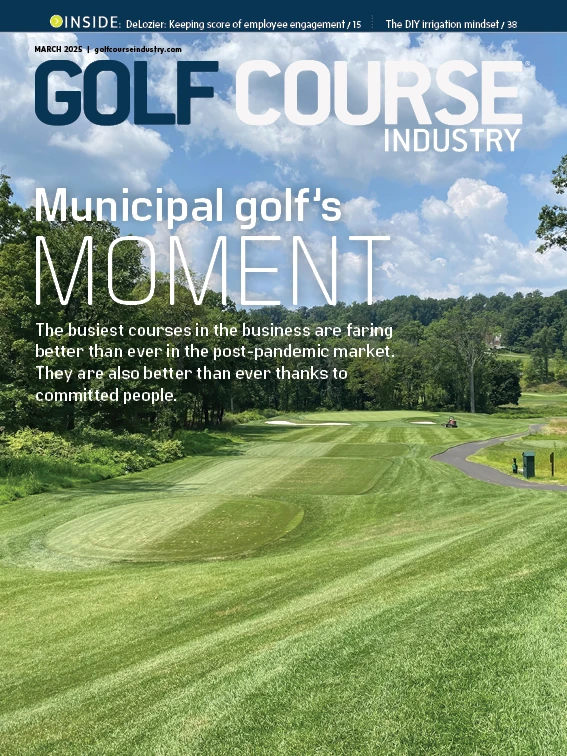
Explore the March 2025 Issue
Check out more from this issue and find your next story to read.





