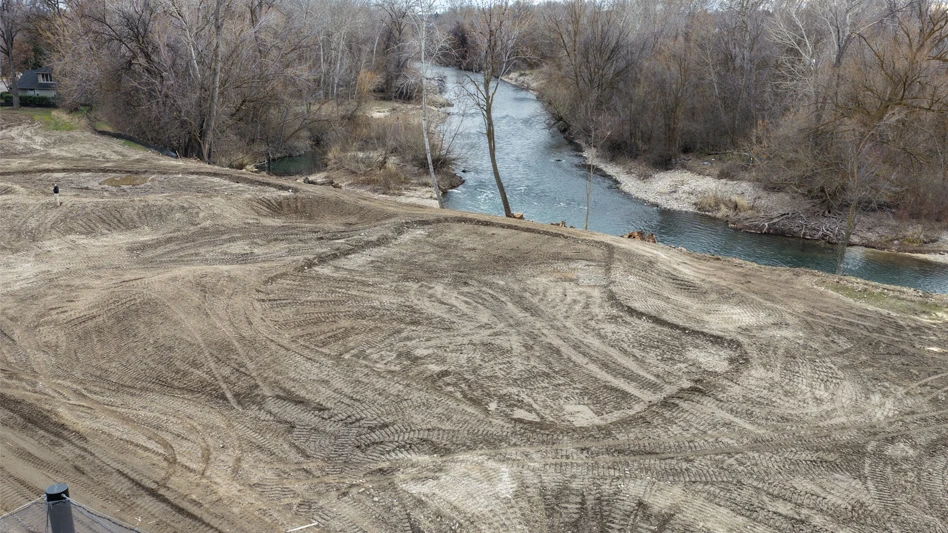
It pays to do your homework. That is one of many takeaways from a recently concluded weeklong visit our design team took to a variety of Scottish links courses.
The four of us are involved in the development of Bluebird Club, a new private club and associated real estate project in metro Denver. I’m an advisor and notetaker. The project is the vision of veteran Colorado businessman Pat Hamill. The golf architect is Dan Blankenship, who has already racked up an impressive portfolio of work worldwide, most of it in Brazil. Crucial input on golf, membership and club culture is provided by Charlie Soule, a scratch/plus amateur golfer who has played in USGA national championships and won the 2023 Colorado Western Amateur. There are lots of other skilled professionals on the team who did not accompany us on our inspection of seven courses running from East Lothian, east of Edinburgh, up the coast to Dornoch.
We have our core routing of Bluebird in place. The site is awaiting final approvals to turn dirt, with anticipated opening in 2028. Each of us had already seen lots of courses. That is evident during our on-site walks, when the conversation about specific greens, bunkers, slopes and holes invariably invokes references from the likes of Pinehurst No. 2, Los Angeles Country Club, St. Andrews and Winged Foot-West.
It’s one thing to invoke commonly known courses; it’s another thing to experience them together and to provide not just common references but a shared experience, affirmed by extensive conversation. Thus, the purpose of such itinerant research: to provide a common language and level of emotional engagement.
At Dunbar Golf Club, 30 miles east of Edinburgh, we noted the sharp contrast between the field holes (Nos. 1-3, 18) immediately adjacent to the clubhouse and the really stirring linksland holes (Nos. 4-17) on the coast side of a long wall. The breakthrough takeaway moment here came after the tight, low-lying stretch when, at the ninth hole, a 532-yard par 5, the uphill blind tee shot leads to a stunning, expansive view of the entire valley as it gives way to the North Sea. There is value, we noted, in the occasional blind shot that transcends the immediate shot at hand.
At nearby North Berwick Golf Club-West Links, we marveled at the intrigue of the 16th green, a Biarritz putting surface measuring 64 by 15 yards, with a 4-foot-deep swale arrayed diagonally at its waist. Curiously (or not), we spent a lot more time here than at North Berwick’s more famous Redan par-3 15th hole, which has been emulated repeatedly in the United States.
Cruden Bay GC, along the east coast between Aberdeen and Peterhead, impressed us deeply with the power of its dunes and its entirely natural mounding. Fraserburgh GC, the seventh-oldest links course in the world, was less imposing but equally sound for the ease in which its holes sat down naturally on frumpy dunes. It was also quite the lesson to learn, as the entire course is maintained by a staff of three — something we found out from head greenkeeper Calum Anderson, whom we encountered digging out part of the 15th fairway.
Fraserbugh, in a working-class town that has seen better days, also reminded us of how important a golf course can be to the sense of community culture. Members there proved very welcoming, both during our walk and afterward, when we relaxed for coffee. We then went up the road along the Moray Coast to Cullen Golf Club, where we meandered in awe amid towering sea stacks and observed what golf was like nearly two centuries ago.
At Royal Dornoch Golf Club in the Highlands, the consistency of the bunkering made a deep impression on us, though we have yet to decide if Bluebird Club will sport hazards as deep and revetted as those. We also spent a lot of time marveling at the boldness of the platform putting surface at the unbunkered, par-4 14th green. We loved how the surface snuggled into the last of a succession of intruding dunes and how the upslope fronting this green created nuanced ground elements to confront during approach (and recovery).
As a design team, we coined the phrase “two fingers” there to describe how the earthen folds create a double hazard of sorts. We knew full well, however, that the effect would best be described with one finger.
We ended our research trip at Skibo Castle’s Carnegie Golf Links. It’s a modern version of a classic game and filled with thoughtful bumps, hollows, mounds and deflection points.
There’s no reason the work of educational research can’t also be fun. Along the way, it provides a community of discourse and shared reference points that facilitate subsequent design.

Explore the May 2025 Issue
Check out more from this issue and find your next story to read.
Latest from Golf Course Industry
- Reel Turf Techs: TJ Vollmar
- Bernhard and Company names G.C. Duke as North American Distributor of the Year
- Course at Sewanee picks KemperSports for management
- WiTricity expands wireless charging technology
- Shining star
- SiteOne Landscape Supply acquires Reinders
- Talking Turf Weeds 17: Waking up your course after winter with Yusif Jaouni and Matt Herrmann
- From the publisher’s pen: Respect the side hustle