The robots worked Sunday.
It was a quiet Sunday afternoon at Otter Creek Golf Course and we were about to mow a newly seeded rough area for the first time. Our owner, Bob Haddad, glanced at me and asked, “Who’s working today?” I told him not to worry — the team had it covered. He laughed. “It’s great they’re willing to walk mow renovation rough on a Sunday afternoon.” “Yes,” I said with a knowing smile. “Especially considering they’re not human.” It took a moment … then, like a lightbulb in a dusty basement, the warm glow flickered as it registered. “You got the robots set up?”
“Yes, they are ready to go. No complaints.”
That moment — watching our new robotic mowers glide silently across freshly seeded ground — captured what this entire renovation has been about: reimagining how we work, not just what we build.
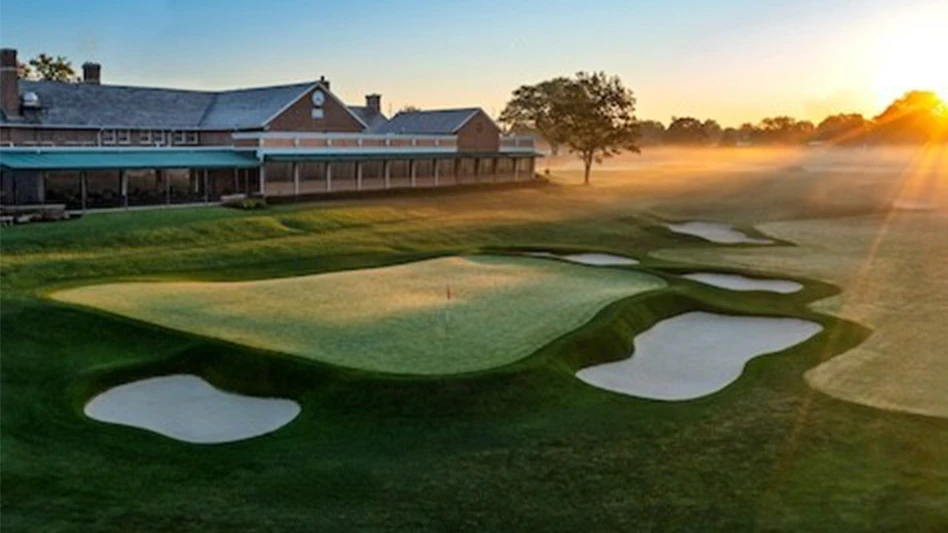
When our owner decided to invest a significant amount of capital into reviving one of Indiana’s most historic public golf courses, the challenge was clear. We had one chance to get it right. Otter Creek had a proud legacy, but time, weather and infrastructure had taken their toll. This was our opportunity to restore it to glory while preparing it for the next 50 years.
The question wasn’t how fast we could rebuild — it was how smartly we could.

A legacy reimagined
Otter Creek has always been a cornerstone of public golf in Indiana — a Robert Trent Jones design that hosted championships and cultivated generations of golfers. But like many great courses, it had aged. Infrastructure lagged. Drainage struggled. Playability had become inconsistent.
When the course ownership changed, we weren’t just tasked with restoring turf and bunkers. We were tasked with rebuilding identity — honoring the tradition of great golf while bringing in the features and the products that define the modern era.
In the early planning meetings, course superintendent Mitchell Eickhoff and I kept circling back to one question: What if we could renovate at the speed of technology?
Not speed in the literal sense, but rather speed in precision, agility and connectivity. What if we used technology not as a crutch, but as a force multiplier? What if every piece of tech, from robotics to AI software, allowed our people to do what they do best: think, lead and grow turf?
Renovation at the speed of light
The phrase “speed of light” became more than a title — it became a mindset.
We live in an industry that prizes hard work, grit and early mornings. That will never change. But I’ve learned that working smarter — with better tools and clearer data — is not about replacing people; it’s about empowering them.
For us, innovation wasn’t about chasing gadgets. It was about creating a more sustainable, efficient human operation. Our renovation used cutting-edge technology, yes — but the purpose was deeply traditional: take care of the land, protect our people and honor the craft.
Our “speeds” — data, service, robotics and trust — became the four lenses through which we made every major decision.
Renovation at the speed of data
Every great renovation starts with soil. But today, soil comes with data.
At Otter Creek, we’ve built what could be called a living map of the property. Beneath the surface, sensors constantly feed us real-time moisture, temperature, salinity and oxygen levels. On top, the moisture meters give us point-in-time readings that verify what our eyes already suspect. A weather station ties it all together, pushing continuous climate and evapotranspiration data into our central hub.
That hub is an AI-driven platform that consolidates all those data streams. It tracks clipping yields, maps applications and learns from patterns to predict stress before we see it. It doesn’t replace our agronomic instincts; it validates them.
I often compare this to professional sports analytics. A great athlete still plays by feel — but the data behind the scenes refine those instincts. Turf management isn’t so different. Our eyes and experience are still the first line of defense. Technology simply gives us a second set of eyes that never blinks.
And when all that information comes together — moisture levels, temperature curves, oxygen flow, growth rates, disease conditions — we don’t have to guess. We know when, where and how to act. That’s what “speed of light” means in practice: decision-making that’s proactive, not reactive.
Renovation at the speed of service
If data is the brain of our renovation, irrigation is one of the circulatory systems.
We’ve upgraded the irrigation platform — a central control system that lets us manage every drop of water with precision. From my phone or tablet, we can design programs for a day, a week or a season. We can make instant micro-adjustments to specific zones or heads.
For a grow-in, where seed-based renovation demands constant vigilance, that flexibility is priceless. We chose to seed rather than sod most of Otter Creek — a slower path, but one that produces stronger, more site-adapted turf in the long run. The new irrigation tech gives us the control and feedback to make that possible.
This isn’t just environmental sustainability; it’s operational sustainability. We’re saving water, time and stress — and spending more of our day doing what truly matters: coaching our team, focusing on detail work and improving turf health.
And the future? GPS-guided sprayers, variable-rate technology and AI-assisted mapping. It’s not about taking people out of the process. It’s about giving them the most accurate tools to do the job right the first time.
Renovation at the speed of robotics
I’ll admit it — when I first saw a robot mower crawling across the fairway, I wasn’t sure whether to laugh or take a picture. But now we can’t imagine the renovation without them.
During a grow-in, you have two major challenges: weight and repetition. Heavy equipment compacts delicate soil profiles and manual mowing burns labor hours when every hand is needed elsewhere. Our solution was to bring in robotic mowers — small, lightweight units that can cut around the clock.
They’re not perfect. They occasionally get stuck, lose connectivity or wander into the wrong pattern. But the trade-off is worth it. These machines minimize compaction, keep rough and tee areas consistent, and let our staff focus on cultural practices, irrigation adjustments and detail work.
That’s what technology should do — handle the repetitive tasks so people can handle the meaningful ones.
I still think of mowing as an art form, but not every brushstroke needs to come from a human hand. Sometimes innovation is just knowing where craftsmanship ends and automation begins.

Renovation at the speed of trust
If there’s one thing I’ve learned through this project, it’s that innovation only moves as fast for us as the relationships behind it.
Every piece of technology, every process improvement and every operational breakthrough at Otter Creek came down to a single principle: trust. We didn’t just choose tools — we chose people. We partnered with individuals and teams who shared our vision for precision, communication and a commitment to progress grounded in integrity and innovation.
Technology can connect data, automate systems and predict outcomes, but it’s trust that connects people. It’s the original technology — the first true network — built not with code, but with connection and consistency.
“In technology as in turf, trust is the architecture that holds everything together,” says Valentine Godin of Maya Global, one of our technology partners. “The best code doesn’t replace people; it learns, adapts, and helps turn daily complexity into clarity and purpose. Anyone can build efficient code, the real challenge is creating technology that individuals and teams trust enough to let it shape how they work, decide and grow together. That is when lasting impact emerges.”
When we made decisions about the platforms, tools and innovations used throughout this renovation, it wasn’t the logos that swayed us; it was both the technology and relationships. We sought partners (our other technology partners include Bernhard and Company at the forefront, along with Soil Scout and Kress) who were as passionate about learning and collaboration as they were about performance. Whether across town or across the ocean, every partnership was rooted in dialogue — asking questions, challenging ideas and finding shared purpose.
Trust builds speed because it removes friction. It allows teams to focus on problem-solving rather than protectionism, on shared outcomes rather than individual interests. That’s what this renovation became — a collaboration built on mutual respect, where each contributor believed not only in their own product or service, but in the collective mission of reviving a historic community golf course for the next generation.
In the end, every successful decision we made — technological or otherwise — was powered by that simple truth. The “speed of trust” might be the slowest speed on paper, but it’s the one that makes everything else possible.
No app or algorithm can replicate that.
The old school meets the future
When I entered this industry, we measured success by how hard we worked. Long hours. Short nights. Endless grind.
But during this renovation, I’ve learned that true progress isn’t about grinding faster — it’s about thinking differently. We wanted to prove that a small, forward-thinking team could deliver championship-level results without burning out or breaking budgets.
We focused on sustainability in every sense: environmental, financial and human. We didn’t want a renovation that left people exhausted and systems obsolete. We wanted one that left both stronger.
So, yes, this project is about sensors, robots and data dashboards. But it’s also about curiosity, trust and respect — for the land, for the craft and for each other.
Technology isn’t about racing ahead. It’s about seeing more clearly. It’s about merging the craftsmanship of yesterday with the precision of tomorrow — and realizing that the bridge between the two is people.
That’s the real technology driving the Otter Creek renaissance. And it’s moving at the speed of light.

Explore the December 2025 Issue
Check out more from this issue and find your next story to read.