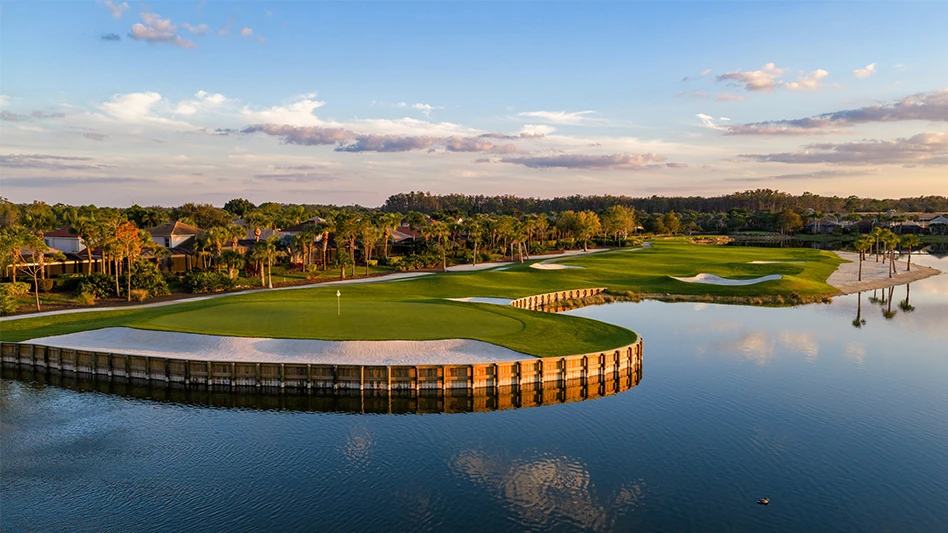
Swanhills Golf Course and its 140-acre footprint faces challenges from Belvidere, Illinois, weather, ranging from heavy rain to high humidity as the crew strives to maintain the health of its greens.
The public course’s mission is to make golf accessible to everyone, allowing those with high handicaps to improve on their skills, says superintendent Sue Spahr.
Spahr has worked at the course for 30 years and views the of Penn- cross bentgrass greens as her “babies.” She prioritizes their health and maintaining them.
“I’ve actually seeded all of the greens,” she says. “I came during the construction of the course, so I’ve often called it my firstborn.”
To take care of her “firstborn,” Spahr is not too concerned about the speed of the greens but instead creates weekly plans for the season on how to approach them culturally, chemically and agronomically.
It can be challenging to stick to her plans because of environmental factors like weather. “Being very adaptable is one of our things that we have to provide,” she says.
On two days in March and May, Belvidere experienced .73 inches of rainfall with an average humidity of 87.1 percent, creating localized dry spots on the course.
Spahr credits the wetting agent the course uses, even though the rainfall caused a slight delay in applying it. Typically, she practices split applications for the wetting agent and other plant protectants in early spring because the agent lasts several months. The course also hand waters and spikes to get rid of dry spots.
The heat and humidity can cause late July and early August to be a tough time, but Spahr says she notices that around Aug. 15 the weather becomes manageable, so she and her team are able to relax a bit.
For collecting data, she keeps track of the rainfall and season-long temperatures but does not use a Stimpmeter because of her familiarity with the greens.
“The Stimpmeter itself ... that number isn’t really important to me,” she says. “I play on the greens also, so I know when they’re slowing up a little bit, we need to do a little more.”
She also pays attention to the grass clippings and growth regulators. The course prepares greens for play by rolling them once a week and mowing them six days a week.
While watching her team work on the greens, Spahr thinks about what areas they can improve on, but remains confident in her team’s abilities.
“I would definitely say I’m not a perfectionist, and I don’t even believe … there’s definitely not a perfect [green] on the golf course,” she says. “You just want to try to do the best you can, so if you can kind of relay to your crew, ‘You did a good job. If we can get that to keep from doing that, that would be really good.’”
Spahr judges the success of the course’s greens based on golfer satisfaction.
“That’s my job to keep them healthy, smooth and nice, and then I hear the golfers are happy with the performance of them,” she says. “That’s what I think it’s all about. That’s how I judge my success.”
- Adriana Gasiewski



Explore the September 2025 Issue
Check out more from this issue and find your next story to read.
Latest from Golf Course Industry
- The Aquatrols Company launches redesigned website
- 2026 Excellence in Mentorship Awards: Justin Sims
- Foley Company hires Brandon Hoag as sales and support manager
- Advanced Turf Solutions acquires Long Island, NYC distributor
- Twin Dolphin Club earns Audubon International certification
- Carolinas GCSA supports Col. John Morley Centennial Campaign
- GCSAA announces 2025 Dr. James Watson Fellows
- Tartan Talks 115: Chris Wilczynski