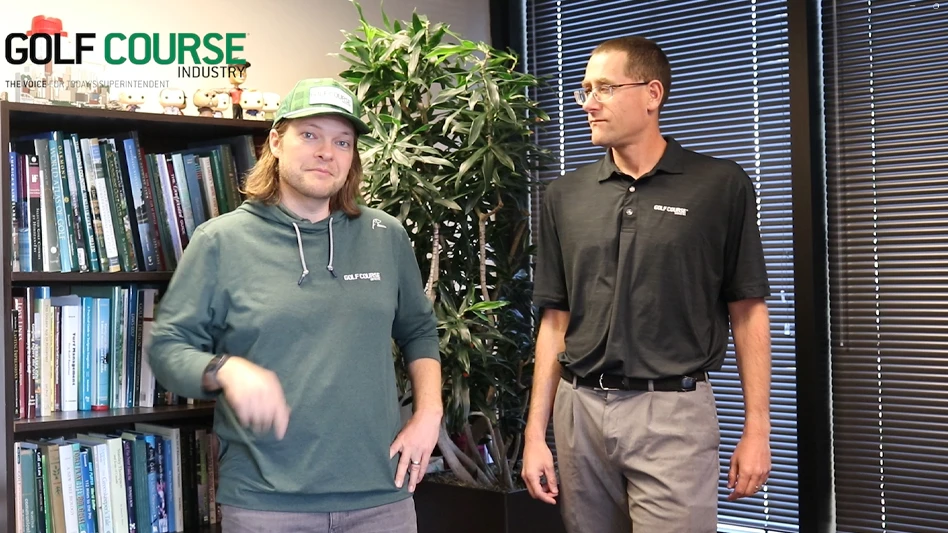
Before he helped name a single golf course maintenance product, Pat McSparin washed dishes, sold shoes, played some football, enrolled in and dropped out of journalism school, enlisted and served in the U.S. Air Force, peddled beads on Shakedown Street outside Grateful Dead shows, and lost more than a little hearing working in a Cheez-It factory.
Sensory loss be darned, he would absolutely head back to the Cheez-It factory. Eating a hot Cheez-It “right out of the oven,” he says, “will change your life.”
After earning an English degree thanks in part to the GI Bill, McSparin transitioned to a more creative career in communications. He worked at a handful of firms — including one that handled Bayer, which landed him in crop and environmental science — before winding up at PBI-Gordon. He’s worked there for the last dozen years, first as a copywriter and then as creative director. You’re familiar with Aethon? Tekken? Vexis? Arkon? All two syllables — which helps new names stick in your brain — and all the work of McSparin and his team.
And where do those names come from? What inspires McSparin and his team — and the creative teams at a variety of industry companies? We’ll get to specifics soon enough. For now, let’s just say that inspiration can strike anywhere, and often without warning.
“I stress with my designers and art directors, always be looking around, always be imagining and thinking about stuff,” McSparin says. “I don’t want you to turn off your job when you go home. I get it. I do it a lot, too, where I’m just not thinking about work, but if I’m driving around the neighborhood, there’s grass everywhere. If I see somebody has a lot of dandelions, that should trigger something.

“The ideas can come at any time. Everybody in our business has had an idea in the shower.”
A mysterious art surrounds nomenclature. You can go all the way back to the Book of Genesis for proof: So out of the ground the Lord God formed every animal of the field and every bird of the air, and brought them to the man to see what he would call them; and whatever the man called every living creature, that was its name. What power, to name every living creature.
McSparin is part of a group whose professional existence depends on wielding that power with creativity and some caution.
“I depend on imagination way more than I think some [other companies] might,” McSparin says. “PBI-Gordon has never used AI. We don’t use algorithms to come up with any names or ads or anything. I’m sure it’s coming, but for now, we’re doing just fine.”
Bill Brown is among the creatives who have perhaps not embraced artificial intelligence but have at least used it to kickstart and streamline their work.
Brown has also long used tech where it makes sense. He appeared on the cover of this magazine in October 2009, back when he still worked on the maintenance side of the business, sharing what mobile apps filled his phone and how he used them. Brown is now the director of marketing and brand development for AQUA-AID Solutions and his preferred tools are a little different.
“We’re going to have more products coming out, and I’ve just started that process,” he says. Turning to ChatGPT. “I put in, ‘Give me some names for a new patented surfactant that does x, y, z,’ and I’ll give it some bullet points. Some of the names were already taken, some of them wouldn’t make any sense and some of them I highlighted.”

ChatGPT “sparks some creativity and gets the juices going a little bit,” he says. “I’ve got six pages worth of names to pick from for three products. Whether we combine some of those names, whether some of those names lead us in a different direction, we’ll see.”
This process is far different from what the company once did. During its early days in the late 1980s, both the company and its first product were called AQUA-AID — the Solutions rebrand followed only in 2018 — which confused more than a few folks. Acronyms were popular for a long time, too: The soil-penetrating surfactant OARS is short for Organic Acid Redistribution System.
“With our new products, if it’s in the dictionary, it’s not available,” Brown says. “And, for us, if you want to include hydro or hydra, it’s probably not available.”
Brown is keeping his favorites for those new products under wraps, but he did share one suggested name that will never appear on any AQUA-AID Solutions packaging: EverMoist.
“I would never use the term EverMoist,” he says with a laugh. “First, people don’t like the word moist.” Beyond that, Evermoist — with just one capital letter — is already the name of a band in the movie Pitch Perfect 3.
Another reject? InfinityWet. “Wouldn’t want that,” Brown says. “For many reasons.”
Casey Zeller relies on far more than just AI, too, though it has come in handy.
“Before AI was so prevalent, I would just come up with names and mesh them together,” says Zeller, who was promoted in October to director of marketing for turf, ornamental and agriculture at SePRO Corporation. Not long before that promotion, AI helped inspire the name of the company’s newest herbicide. “With StriCore, I used AI to brainstorm: ‘Help me think of some words that align with this theme. Oh, that’s a good idea.’ It never gives me the name, but it does help the process.”
Zeller wanted something that sounded strong, that evoked the military.
“I started listing every military word I could think of,” he says. “Bomb. Strike. What could I do with strike? I might have 100 or 150 different words and then I just start narrowing them down. Once I find a name I like, I do a quick search online — Strike herbicide. But even if I do a search and it’s taken, I don’t give up on that word, because sometimes you can still use that word if it’s not in your category.”
Registered trademarks are a little tricky in that respect. (For more on the trademark process, see You have a name. Great. What’s next? on page 24) Even if a word is used in one market, it might still be available in another. Take Tekken. Translated literally from Japanese, it means iron fist. It’s also the name of a popular video game franchise introduced in 1994. McSparin had never played the games, much less heard of them, when he listened to the 1982 Motörhead album “Iron Fist.” Google Translate steered him from that to Tekken, which became the name of a PBI-Gordon herbicide introduced in 2018. The word was available because video games and herbicides are very different products.
StriCore is neither a video game franchise nor the translated title of an old metal album, but Zeller still had work to do even after settling on an available word. He asked everybody he knew to read it aloud. He wrote it in all caps and mixed caps. He talked regularly with the trademark attorney SePRO has on retainer. And he talked regularly with his kids, who are 10 and 6.
“I’ll always ask them what they think, if they think it’s cool, show them the logo,” says Zeller, whose wife, Jill, faces similar naming challenges as the U.S. portfolio marketing leader for corn herbicides at Corteva Agriscience. “They see things I don’t. The family is always a good test. ‘That’s dumb. Why would you do that?’”
The naming process can involve plenty of science, too. Consider Envu, which branched off from Bayer Corporation in 2022 as a new company — and needed a new name, a new logo, a new color scheme … a whole new identity.
“That was a big process,” says Bekah Mahan, Envu’s head of brand strategy and campaigns. “We had to find something that could represent a brand-new company that had 50 years of legacy and that had reputable products. No one would know the name of the company, but they would know the products. So we had to find something that would be unique and different and stand out a little bit.”
According to company literature, Envu is short for Environmental visionary, and it certainly stands out. It’s two syllables and doesn’t visually lend itself to any other pronunciations — both good. It also “wasn’t even part of the top 25” names on the original list of more than 500 contenders.
“It takes going that wide, that big, and then narrowing down to land something that’s meaningful,” Mahan says. “We take a little bit more scientific approach at time[s] to the process, rather than just going to dinner and having a couple of bottles of wine and seeing what happens.
“The corporate exercise was very large. We usually don’t go that big with every product name, because we’d never finish.”
Because Envu has global reach, Mahan and her team sometimes go global with potential language. Mahan studied Spanish in school and lived in Germany for three years while working for Bayer. Those languages are in her toolbox, as are loads of Latin root words.
“We’ll typically take a really good look at the product and its intended geography,” she says. “Where are the major markets that we think we’re going to be taking this product? And then we look at the linguistics in those countries. Sometimes it’s fun to find words that may not be common in English but are very common in other languages — like terra for earth — and see how you can turn and twist those and make those unique. And still get them registered.”
Standard Golf has a far less global scope than Envu, but the Iowa-headquartered company also deals with foreign languages: In addition to English, the company ships product catalogs in French, German, Italian and, of course, Spanish. Product descriptions are translated. Product names, normally, are not. “For the most part,” says Matt Pauli, who was the company’s director of marketing for seven years before his 2022 promotion to vice president, “those stay in English.”
Because Standard Golf sells products that go on the course rather than in the ground, the names Pauli dreams up tend to be more direct and descriptive. Range Ball Banner. Practice Green Flag. Premier Bag Stand. Pauli will normally run names by graphic designer and marketing specialist Sydney Lopez, who provides a different perspective thanks to age, gender and life experience. And he likes to talk about potential names with the sales team. “They’re the ones on the front line,” Pauli says. “They need to be able to sell them.”
Occasionally, though, there are some fun names — like the Chief Bunker Rake. At first glance, that first word might seem intended to reflect superiority. It actually recognizes a longtime employee.
Robert “Chief” Waseskuk worked for Standard Golf for 35 years, climbing to national sales manager. He was also a Meskwaki Indian, part of the Sac and Fox Tribe of the Mississippi. His nickname was a title, not an honorific. Pauli wanted to pay homage to Waseskuk near the end of his career by naming a product after him.
“So we called and asked him, ‘What do you think?’” Pauli says “Not only was he floored, but he got the tribe to bless that we were going to do that.”
Waseskuk died in October 2021 — three years after his eponymous rake first ran through bunker sand.
Watch the right (or wrong) TV programs and you’ll be slammed with pharmaceuticals ads. Aranesp. Luxiq. Qvar. Wegovy. Xeljanz. None of them sound like anything because every real word is long gone. Every one seems to have a letter or two worth at least four points in Scrabble.
This is the world where creatives work. This is why inspiration strikes when you least expect it.
Over the years, McSparin has jotted down ideas from everywhere. Years after he sold his last beads to follow the Dead on tour, he turned to the band’s catalog to name a new herbicide. He started with “Althea” (“There are things you can replace / And others you cannot”), which led him to Greek mythology, the king Aethon (pictured below) — and a conversation with his Greek wife, Sara Hantzis, “to see how horrible that person was.” Aethon passed her test.
So did Vexis, which hails from a more recent mythological tradition: Star Wars. On turf, Vexis is an herbicide granular. A long time ago, in a galaxy far, far away, it was a large, armored serpent with thick scales — “a perfect description for either whatever you’re trying to remove from the turf, or the tool you’re using to extract it,” McSparin says with a laugh. He’s not much of a Star Wars fan and doesn’t remember how it popped into his mind. “It seems like the kind of thing where I would say, ‘I am really vexed on this one, guys,’” he says. “‘Oooooh — Vexis!’”

As for the newer herbicide Arkon, credit goes to herbicide product manager Lyndsie Balstad, who was reading deeply in the fantasy genre when that product needed a name.
“Great ideas can come from anybody, and our product managers have come up with some really good ideas,” McSparin says. “We have one product out now and one in development that the names came from the product managers who are behind building the brand. That’s perfect. If they have the idea, we’ll use it.”
Unlike Adam before his Edenic fall, we only get so many bites at the apple. Most of us just help name a kid or two, maybe a family pet. We have to choose wisely.
“When Jill and I named our kids, we wanted something unique but not weird,” Zeller says. “I apply that same theory to naming a product. I want something that will capture your attention — but not something that sounds like it’s a medicine.”
Anybody need any more Xeljanz?
Explore the August 2025 Issue
Check out more from this issue and find your next story to read.
Latest from Golf Course Industry
- From the publisher’s pen: Respect the side hustle
- Super-Scratch events to expand nationally
- Beyond the Page 78: Labor solutions, AI talk and mayhem
- Construction progresses at The River Club
- VIDEO: A century of innovation
- Sentosa Golf Club preps next generation of turf pros
- Western turf leaders honored by GCSAA for advocacy efforts
- The Canary flies out of the mines