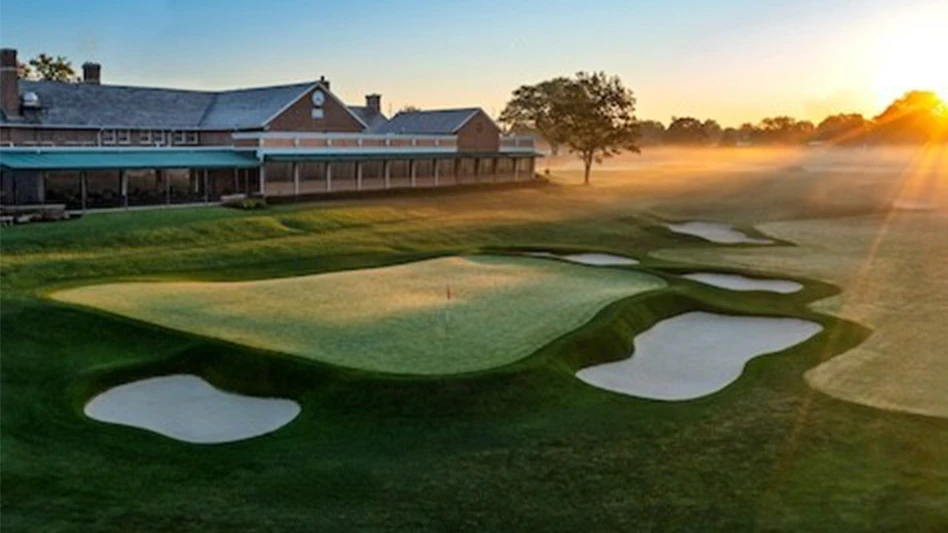
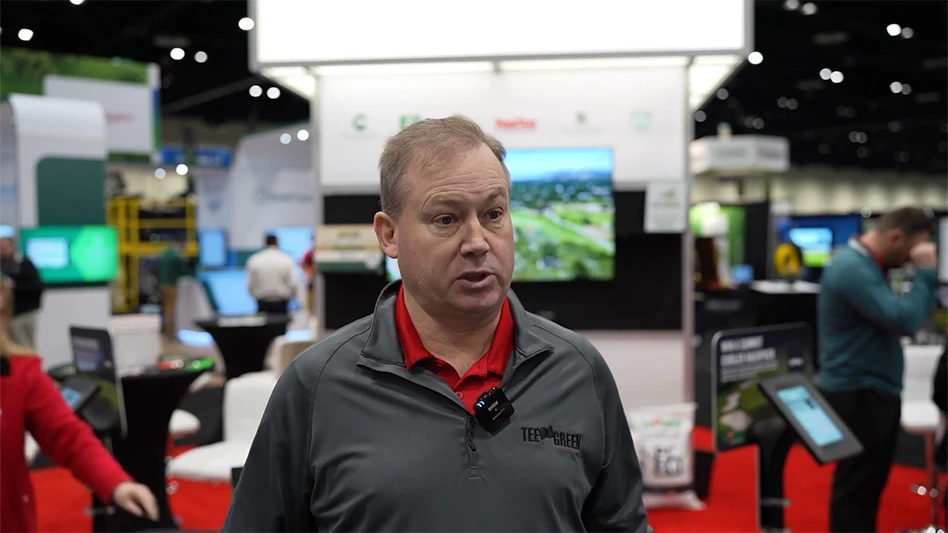
A striking image of the first tee stripped down to the dirt, a few feet from the historic Tudor clubhouse, is a symbolic visual for the beginning of the restoration of the Upper Course at Baltusrol Golf Club. The restoration of the Lower Course, reopened in 2021, was a success, and here Greg Boring, director of grounds, and the maintenance team — many of them new — were gathering themselves for 18 more holes of grit and glory.
Through two restorations, an outsider might have thought Boring was living at Baltusrol, just off Shunpike Road in Springfield Township in New Jersey. In fact, some maintenance team members and staff enjoy accommodations on and near the property. There are also guest rooms in the clubhouse, where photos, descriptions and trophy displays cover the walls. The club boasts a wonderful interactive living history display with a touch screen to select videos that interest them.
On certain spots of the Upper Course, you can view the bustling New York City skyline from the relative calm of the suburbs, though it is easy to see the maintenance team has been exceptionally busy over the past few years. While the team had to manage pandemic protocols during the first restoration, that was unnecessary, thankfully, for the second.

Lessons learned and decisions solidified during work on the Lower Course made certain aspects of the restoration on the Upper Course easier. They used the same team and suppliers, with Total Turf Golf Services executing the work. The professional relationship between architect Gil Hanse, president of Hanse Golf Course Design, and Boring was also established.
Hanse was hired as the architect in 2017, and Boring was hired in 2019, so by the time they started work on the Upper Course, they had been working together for several years. They respect one another and communicate clearly, understanding the role each must contribute to the project’s success.
Throughout the restoration of the Lower Course, decisions were made about infrastructure and playability, and a framework was established for understanding the strategy of A.W. Tillinghast’s design. It was important to build on that understanding, and layer it with today’s technological advances and the sensibilities of the modern game.
“The technology of the equipment for the game is not the only area where improvements have been achieved,” Hanse says. “The continued advancements in how we maintain our courses has been the biggest cause for change in designs of this era. Our approach at Baltusrol set out to balance the advancements in technology and maintenance, with a respect for the original Tillinghast design.”

The irrigation system was replaced, and PrecisionAire was added. “We get asked most about the PrecisionAire system and how much we use it,” Boring says. “We were utilizing it almost every day this summer and it will be a tool that we will continue to use as the golf course matures.” The Watertronics pump was new for the Lower Course in 2020, and it powers the irrigation for both courses.
Boring is savvy about turf types. “One of the things we love about that is you’ve got a superintendent who’s comfortable maintaining Poa and continues to maintain Poa, but there’s also a certain patina that the greens take on,” Hanse says. “They feel older than they actually are. So, you’ve got all modern conveniences and infrastructure underneath them, but you’re still presenting them in a fashion that looks as if they were a hundred-plus years old.”
It’s good they weren’t a hundred-plus years old, though, because the summer weather was very difficult — likely the most difficult Boring has faced since 2005. “Heavy rains early in the summer and extreme heat has been the norm,” Boring says. “Humidity has also seen some record highs throughout the summer, which is not what you want for a brand-new golf course.”
Boring’s experience meant he knew to stay away from aggressive maintenance practices, so the team is enjoying fall with the courses relatively unscathed. “We knew we had to be patient,” he says. “In a normal year you can’t push new turf too early or be too aggressive. We knew that going into the first season on the Upper Course and we communicated that to the membership.”
Boring is good at listening and answering questions, and on weekend mornings you can find him around the practice facilities, which are often referred to as the “third course.” The practice area near No. 1 on the Upper Course was significantly expanded and the putting green behind the pro shop was rebuilt. The practice facilities will continue to expand, with an eye on hosting the 2029 PGA Championship on the Lower Course.
The conundrums experienced on the Upper Course post-restoration are not unusual. “Honestly, we have a few bumps and bruises out there, but we expected that,” Boring says. “Most of our thin turf is due to construction compaction areas and thinning of some of the bentgrass on our putting surfaces. The Poa on the greens tends to handle our mowing and rolling much better than bentgrass.” With proper attention, the turf is only getting stronger.
The team is also working to achieve the right balance for the fescue, or “eyelashes” around the bunkers. If it’s too thick, people can’t hit the ball out properly should it land there, and that’s frustrating. If it’s too thin, it doesn’t look right. The team is working through a learning curve while the fescue is being cultivated and hand-sheared. The look is distinctive, with aesthetics on both courses impressing members.
Course comparisonsStatements comparing the Upper and Lower courses are amicably debated.
“The Upper and Lower courses at Baltusrol are distinct in their design and strategy but equal in their conditioning and playability,” Hanse says. “More layout changes were made to the Lower than the Upper over the years, but the infrastructure beneath the surface was consistent throughout the property. That consistency has been preserved and improved with new drainage and irrigation systems on both courses as well as PrecisionAire technology beneath all greens. These improvements allow Greg and his team to provide Baltusrol’s members with near-championship conditioning on a daily basis.”

Providing that conditioning in high summer, after two restorations, meant the team was fighting fatigue. There were six interns, and the courses were extremely busy. Annually, they host 36,000 to 38,000 rounds between the two courses. There are very few maintenance days, with none scheduled between June and mid-November.
“I can’t say enough about the team,” Boring says. “We had an entire new management team on the Upper Course and they nailed it. The crew members are very mature and couldn’t have handled this first season any better. They work with such a positive attitude and bring such excitement to the job every day. I couldn’t be more proud of James Surico, Kyle Boushell and Stephen Chumacas for stepping into this situation and hitting it out of the park.”
The members have been waiting for their courses to both be playable for years — construction affects everyone. “Most members love the scale of the property now,” Boring says. “We have opened up corridors throughout the property that makes it look so much bigger, and people like to talk about the dual green complex on No. 14. The green on the right is the talk of the club. There was a lot of anticipation for how the dual greens would turn out, but the beauty is that the design is based on our old photos. We chose what Tillinghast envisioned.”
Across Baltusrol’s 600 acres, 350 of them maintained, Boring won’t make any significant changes in direction on days that are cold, cloudy and rainy when he is reviewing the courses. “I have learned not to make decisions when the light is not hitting it,” says Boring, and technology is helping with consistency.
Drones were used in July and September to spray the fescue, and it is flailed in the fall. There are nine pop-up fans on both courses, underground and invisible when they are not in use. The USGA’s GS3 Ball and DEACON app help with data collection. There are 45 miles of drainage, with 21 miles of irrigation and 4,400 sprinkler heads. Technology is also helping with the environmental aspects of course maintenance.
“From a sustainability standpoint, it might be counterintuitive, but it’s true that the more sprinkler heads you put out there, the less water you use because you can pinpoint its accuracy and you can put it in the right place,” Hanse says. “And water is going to be the most challenging aspect that the golf industry will face going forward. So, from that perspective, I think the technology, the ability to apply water in a much more meaningful and efficient way, is going to be dramatically impactful.”
Boring will tell you that his three passions are family, golf and Ohio State. With his drive and enthusiasm, Baltusrol is lucky to have him. Having learned lessons from two full restorations, he describes the energy and support from the membership throughout it all as “first class.”
When that bulldozer was on the first tee of the Upper Course, it didn’t touch the flowerbeds by the clubhouse because even when things are changing, Baltusrol respects tradition and recognizes some things are better left alone. Boring and the team deserve the glory following the grit that transforms the dirt on the first tee into a course of which everyone can be proud. At Baltusrol, they keep building on their championship history for their future, inspired by visionaries of the past.

Explore the October 2025 Issue
Check out more from this issue and find your next story to read.