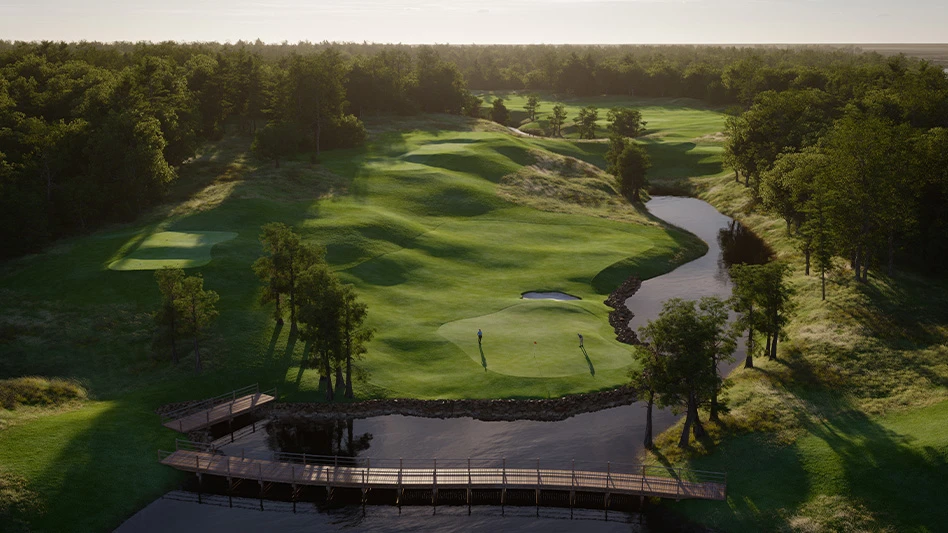
Even by Philadelphia standards, Whitemarsh Valley Country Club has a rich golfing legacy. The golf course, which opened for play in 1908, is the work of legendary architect George Thomas. Through the years, the club has hosted the 1917 U.S. Patriotic Open — which replaced the U.S. Open that year — the 1934 U.S. Women’s Amateur and the 1951 Women’s Western Open, a major championship at the time. From 1963 to 1980, Whitemarsh Valley was a tour stop.
Today, the club regularly hosts Golf Association of Philadelphia events but its member-guest event, which is traditionally held the third week in June is the “big day” on the calendar.
Superintendent Darren Farrar, who is in his third year at the club, is committed to making it a memorable experience for the participants.
“I’d say arguably your member-guest and then your member-member tournament, those are your big tournaments where you really want to focus on producing some of your best playing conditions,” he says.

Last year, Farrar, who earned a bachelor’s degree from NC State and an associate’s degree in turfgrass and business management from Guilford College, got a head start on member-guest preparations because Whitemarsh Valley hosted the Philadelphia Amateur the week before. Typically, however, the member-guest involves two weeks of preparation.
“Basically, what I try and focus on is any cultural practices,” Farrar says, “like brush cutting, verticutting, just trying to thin out the canopy of the greens a little bit so I can help myself get the green speeds I’m looking for like 12, 12½, all the way up to 14. Fourteen is really the highest I want to get green speeds. Anything over that the pace of play kind of gets a little bit out of hand.”
With an eye on pace of play, Farrar is careful to keep the rough in the 2½- to 2¾-inch range for member-guest events. Farrar says his goal is to produce fast and firm conditions for the occasion.
“Two weeks out we try to get in any sort of brushcutting, verticutting, light topdressing,” he says, “just to kind of smooth out the greens. I always back off fertilizers, applications, you always want the greens to be very lean. You really don’t want them growing very much, so we’re going to back off the fertility. We’re going to go out with plant growth regulators to make sure we’re regulating the growth of the plant.

“At that point, once I know the greens are leaned out and I have a couple brushcuts and verticuts and get the grain and texture of the plant growing the way I want it, it really makes my life a lot easier to get those fast speeds.”
Farrar notes that the lead up to a major event like a member-guest includes scheduling issues and long hours for his crew. The actual days of the event might mean an especially early workload depending on whether a double-tee or shotgun start is being utilized.
“Going into a big tournament, we kind of do split shifts,” Farrar says. “Late evening, once the golf is starting to wrap up, we come back and try to plug divots, fill divots. Sometimes we’ll try to mow fairways or tees or anything else since it’s a big tournament and you’re trying to get a lot of people on the golf course as early as possible. You can’t really get things done that we can normally get done on a regular day of golf.
“You’re trying to run split shifts and do as much as you possibly can so that the experience of your member and your guest is hopefully going to be something they’ll always remember.”

Explore the May 2025 Issue
Check out more from this issue and find your next story to read.
Latest from Golf Course Industry
- Talking Turf Weeds 17: Waking up your course after winter with Yusif Jaouni and Matt Herrmann
- From the publisher’s pen: Respect the side hustle
- Super-Scratch events to expand nationally
- Beyond the Page 78: Labor solutions, AI talk and mayhem
- Construction progresses at The River Club
- VIDEO: A century of innovation
- Sentosa Golf Club preps next generation of turf pros
- Western turf leaders honored by GCSAA for advocacy efforts